Far East Hospitality brand Vibe Hotel opens in Singapore

Far East Hospitality brand Vibe Hotel opens in Singapore

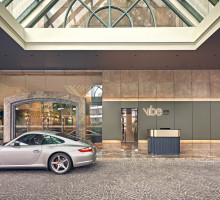
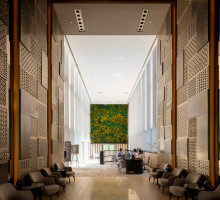
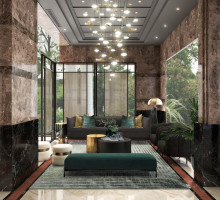
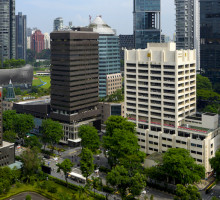
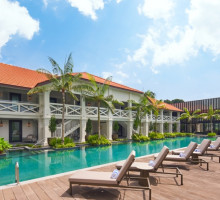
SINGAPORE (EDGEPROP) - Vibe Hotel Singapore Orchard, a hospitality brand by Far East Hospitality, was opened on Nov 3. The 256-room hotel is located at 24 Mount Elizabeth, close to the Orchard Road shopping belt.

Read also: Freehold site at Killiney Road on the market for $76 mil

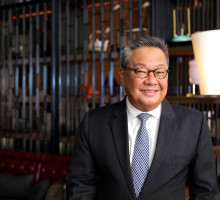
This is the first time the international hospitality group has launched a Vibe Hotel outside of Australia. “As the first Vibe property to open outside of Australia, Vibe Singapore offers the best of both worlds,” says Far East Hospitality. It adds that local guests can experience a taste of Australia served up by the hotel’s friendly staff members, while overseas visitors can enjoy the local culture.

The new hotel features five room categories — Superior, Deluxe, Premier, Family, and Suites. Room sizes start from 247 sq ft. According to a press release, “Vibe Singapore caters to travellers looking for a hotel with character that provides a welcome retreat amidst contemporary design”.

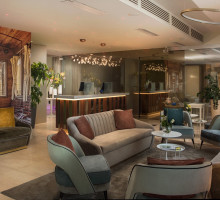
The hotel contains several purposefully designed social spaces, such as the Lobby Bar which transitions from an island bar to a lush café or evening drinking spot throughout the day. Meanwhile, food options include ROOS by lifestyle group Caerus Holding, which offers all-day dining for guests and diners.

Other hotel amenities include a swimming pool with a pool bar, a 24hr gym, and an all-day self-service snack counter.

Related Listings
Related News

Australian hospitality brand Adina to debut in Singapore on July 7

Australian hospitality brand Adina to debut in Singapore on July 7

SINGAPORE (EDGEPROP) - Adina Serviced Apartments Singapore Orchard will officially debut on July 7, and will be managed by homegrown leading hotels and serviced residences operator Far East Hospitality. This will be the Australian hospitality brand’s first debut in Asia. 

Read also: Far East Hospitality to launch Australian hospitality brands Vibe Hotels and Adina in Singapore

Formerly Regency House, the refreshed serviced apartments are located on the Orchard shopping belt and are a short walk to Somerset MRT Station (on the North-South Line) and Dhoby Ghaut MRT Station (on the North-East, North-South and Circle Lines). Several attractions are in the vicinity such as Fort Canning Park, Emerald Hill, the National Museum of Singapore and Clarke Quay.  The CBD is also a short drive away.

Under Adina, the 88-key, Australian lifestyle-inspired serviced apartments consist of a mix of contemporary furnished studio, two-bedroom or three-bedroom apartments, with sizes ranging from 387 sq ft for a studio to 1,205 sq ft for a three-bedroom apartment. In addition, there are barbeque pits, a rooftop swimming pool, a gym, and The Lounge Area at level 10 that serves refreshments.

Adina Singapore Orchard has partnered gourmet retailer Ryan’s Grocery to offer guests the option to purchase groceries online prior to check-in, and arrive at a well-stocked apartment upon arrival. Bathroom amenities provided are from Sydney-based brand Ink & Water; and other Australian-inspired touches include a fruity popsicle as a welcome snack, hamper with Australian snacks and tea, and a fedora hat to protect against the blazing tropical sun.

From coffee-sampling Mondays when guests have ample opportunities for bonding to “Make Your Own Sandwich” Breakfasts and a specially curated seasonal neighbourhood guide, Adina Singapore Orchard aims to offer an innovative hospitality experience.


Check out the latest listings near Regency House, Somerset MRT Station, Dhoby Ghaut MRT Station


Related Listings
Related News

Far East Hospitality repositions assets, focuses on ‘quality tourism’

Far East Hospitality repositions assets, focuses on ‘quality tourism’

SINGAPORE (EDGEPROP) - Last September, Far East Hospitality launched its fourth hotel on Sentosa Island, the 191-key Oasia Resort Sentosa. The opening of the resort marked the debut of Oasia Spa. Positioned as a wellness retreat, Oasia Resort Sentosa brings Far East Hospitality’s portfolio of hotels on the island to four with a total of 1,030 keys.

See also: Premium unit at Turquoise on the market for $5.18 mil

“We can’t be all things to all people,” says Arthur Kiong, CEO of Far East Hospitality. The company’s 606-key Village Hotel Sentosa is positioned as a hotel for families and tour groups. The Outpost, which has 193 keys, is the first “couples-only resort” in Sentosa. Meanwhile, The Barracks Hotel, with only 40 rooms, caters to those who appreciate heritage and exclusivity. 

Prior to the opening of Oasia Resort Sentosa, what had been missing in the company’s Sentosa portfolio was a wellness spa. “It gave us the opportunity to create a wellness retreat,” adds Kiong. 


ARTHUR KIONG - EDGEPROP SINGAPORE

Kiong: We want to pivot towards "quality tourism" (Credit: Samuel Isaac Chua/ The Edge Singapore)


Besides tourists, Oasia Spa caters to Singaporeans who want a quick wellness getaway. “We created this concept in order to bring Singaporeans back to Sentosa,” says Kiong. Oasia Resort Sentosa saw a boost from staycations during the pandemic, and “did extremely well”, he adds. 


When Singapore opened its borders in late April, Kiong had anticipated a lull in business at Oasia Resort Sentosa, with a dip in staycations prior to the return of the international travellers. What he had not expect was new business in the form of corporate retreats, long-term corporate stays of several months, and convalescing mothers. 

Kiong attributes the demand to the positioning of the property and its focus on wellness and sustainability. It is also just 11 minutes by car from the CBD, he adds. “Sentosa has achieved its objective of not being disenfranchised from Singaporeans and changed its perception that it’s only for tourists,” he says. 


Oasia Resort Sentosa lobby restaurant - EDGEPROP SINGAPORE Entrance to the restaurant at Oasia Resort Sentosa (Credit: Samuel Isaac Chua/ The Edge Singapore)


Last month, Far East Hospitality also announced that it will be bringing over two hotel brands from Australia, namely Vibe Hotels and Adina, and rebranding two of its existing properties in Singapore, namely The Elizabeth Hotel and the Regency House (serviced residence). 

Vibe Hotels and Adina are part of the hotel brands in Australia managed by Far East Hospitality in a joint venture with TFE Hotels (Toga Far East Hotels). “We want to pivot towards quality tourism,” says Kiong. This is in response to “a palpable shift” in its customer base. Pre-pandemic, Australia contributed to 7% of Far East Hospitality’s hotel guests, according to nationality. China was the biggest market, with nearly 20%. 


Post-pandemic, the markets that generate the highest average room rates are the “Western markets”, for instance, Australia, Germany, the UK and the US. Demand from Australia to Singapore has surged to almost 25% of forward flight bookings, says Kiong. Travellers from Australia are not just willing to spend more on accommodation, but also to splurge on experiences, from dining to leisure activities. “That is why we are bringing the Australian brands to Singapore,” he reasons. 


lounge of the new Adina Serviced Apartment Singapore Orchard - EDGEPROP SINGAPORE The lounge of the new Adina Serviced Apartment Singapore Orchard, with 88-apartments, that is scheduled to open in July (Credit: Far East Hospitality)


Prior to the refurbishment and repositioning of The Elizabeth Hotel at Mount Elizabeth, just off Orchard Road, the average room rate was less than $200 a night. It will be rebranded as the 256-key Vibe Hotel Singapore Orchard and is scheduled to open in 4Q2022. It will be the first Vibe Hotel outside of Australia, and is likely to see room rates of $250 to $280 a night. 

Regency House on Penang Road, just off Orchard Road, has traditionally seen rates of about $280 a night. Post-refurbishment as the new 88-key Adina serviced residences, scheduled to open in July, Kiong expects to see a 10% uplift in room rates.

He believes these new Australian brands will have “a halo effect” on the rest of the portfolio of hotels and serviced residences in Singapore. Likewise, TFE Hotels launched Far East Hospitality’s Quincy brand in Melbourne, Australia, with the opening of the 241-key Quincy Melbourne in March 2021. “It is regarded as one of the best hotels in Melbourne,” says Kiong. 


Vibe Hotel Singapore Orchard Deluxe Room - EDGEPROP SINGAPORE A deluxe room at the 256-key Vibe Hotel Singapore Orchard that is scheduled to open by the end of the year (Credit: Far East Hospitality)


Kiong intends to introduce more Far East brands to the Australian market. Meanwhile, he sees the potential of introducing the Adina and Vibe Hotel brands to other Asian markets, primarily Japan and Vietnam, followed by Malaysia. 

He sees the opportunity for Singapore to position itself as a destination by “twinning Sentosa and the city”, offering a diverse range of experiences. “Post-pandemic, you want to limit the number of countries you visit because the regulations can change on a dime and the safety policies are also uncertain,” he notes. Hence, he sees Singapore positioned as “a mono destination”. 

In the past, the average length of stay in Singapore was just over three nights. Kiong believes Singapore can be “a five-night destination”. “You can have three nights in Sentosa and two nights in the city or vice versa, in order to enjoy a diversity of experiences,” he says. 


Reception of the flagship Oasia Spa at Oasia Resort Sentosa - EDGEPROP SINGAPORE Reception of the flagship Oasia Spa at Oasia Resort Sentosa (Credit: Samuel Isaac Chua/ The Edge Singapore)


Far East Hospitality is already providing that “twinning” experience with its properties — for instance, Oasia Downtown in Tanjong Pagar with Oasia Resort Sentosa. “You can experience two nights in the city and then transfer to Sentosa for three nights,” he says. He also sees another possible twinning of the Quincy Hotel at Mount Elizabeth, just off Orchard Road, with Outpost Hotel in Sentosa, which appeals to honeymooners and young couples. Another possible twinning is The Clan Hotel at Cross Street in the CBD-Chinatown area and The Barracks Hotel in Sentosa. 


In the pipeline are new brands, for instance at the upcoming integrated development at Jalan Anak Bukit by Far East Organization. The new development will have a mix of residences, commercial office and retail space, as well as a hospitality offering. It will be linked directly to Beauty World MRT Station. The project is likely to be launched sometime in 2H2022. (Find Singapore commercial properties with our commercial directory)

At One Holland Village, a mixed-use development by Far East Organization, Sino Land and Sekisui House, Far East Hospitality will be showcasing Quincy House, its flagship serviced residences under the Quincy brand. The 255-key serviced apartments will be mainly one- and two-bedroom suites, with generous communal areas and facilities, from the living room, outdoor terrace, barbeque area, indoor gym to an open kitchen and laundry room. 


One Holland Village - EDGEPROP SINGAPORE

At One Holland Village, a mixed-use development by Far East Organization, Sino Land and Sekisui House, Far East Hospitality will be showcasing Quincy House, its flagship serviced residences under the Quincy brand (Photo: Samuel Isaac Chua/EdgeProp Singapore)


“The whole idea of the Quincy brand is about socialising — whether you’re travelling solo or as a couple, and it’s designed for those who want to meet people,” says Kiong. “Even doing laundry will be a social activity as we have designed a beautiful laundry room.”

Above Quincy House are the premium apartments, with larger one- and two-bedroom units as well as dual-key apartments. “One Holland Village is a very exciting development in terms of the composition of its retail, residential and F&B offerings,” notes Kiong. “And it’s juxtaposed against the eclectic appeal of Holland Village.” 

Even though the hospitality sector is expected to see recovery this year, it is not expected to return to pre-pandemic levels, in light of China’s zero-Covid strategy and Russia’s ongoing war with Ukraine. However, Kiong is optimistic that surprising new markets could open up, which he had not anticipated in the pandemic or even pre-pandemic era, for instance the corporate long-term stays and convalescing mothers at Oasia Resort Sentosa. 


Check out the latest listings near Regency House, One Holland Village, Beauty World MRT Station


Related Listings
Related News

Far East Hospitality to launch Australian hospitality brands Vibe Hotels and Adina in Singapore

Far East Hospitality to launch Australian hospitality brands Vibe Hotels and Adina in Singapore

SINGAPORE (EDGEPROP) - Far East Hospitality, in collaboration with Australian hotel company Toga Far East Hotels (TFE Hotels), is bringing two Australian hospitality brands — Vibe Hotels and Adina — into Singapore. TFE Hotels, the operator of the brands, is a 50:50 joint venture between Far East Hospitality and Australia’s Toga Group.

In a May 18 press release, Far East Hospitality states the move is in line with its efforts to pivot to the Australian market and increase its portfolio to 25,000 rooms worldwide by 2025. It currently owns a portfolio of 18,000 keys across 10 brands including hotels, residences and apartment hotels. “As international borders reopen, Australia is a natural key target market given that it was amongst Singapore’s top five inbound markets before the pandemic,” says Arthur Kiong, CEO of Far East Hospitality.

Kiong adds that the reopening of international borders and the resumption of flight routes between the UK and Australia offers the company an opportunity to target travellers making stopovers in Singapore. “The two new brands that we are bringing into Singapore will provide an Australian twist to what Singapore, as a destination, has to offer,” he adds.


Deluxe Room in Vibe Hotel - EDGEPROP SINGAPOREArtist impression of a Deluxe Room in Vibe Hotel Singapore Orchard (Credit: Far East Hospitality)


In the coming months, Far East Hospitality will introduce the brands through the rebranding of the company’s existing properties, The Elizabeth Hotel and the Regency House. 

The Elizabeth Hotel, located in Mount Elizabeth, will be rebranded as the 256-key Vibe Hotel Singapore Orchard that is scheduled to open in the fourth quarter of this year. The property will cater to those seeking a taste of the contemporary Australian lifestyle. It will be the first Vibe Hotel outside Australia.

Meanwhile, Regency House, located along Penang Road off Orchard Road, will be rebranded as the 88-key Adina Serviced Apartment Singapore Orchard, slated to open in July. The property will target corporate expatriates as well as leisure travellers seeking transient accommodation. 

According to Far East Hospitality, its efforts to target the Australian market started in 2021 with the launch of the Quincy brand in Melbourne last year through its partnership with TFE Hotels.


Related Listings
Related News

[UPDATE] Far East Hospitality’s Arthur Kiong: Remaking the hotel industry

[UPDATE] Far East Hospitality’s Arthur Kiong: Remaking the hotel industry

Arthur Kiong - EDGEPROP SINGAPORE

Kiong: The pandemic brings us to the cusp of the third tourism evolution (Photo: Samuel Isaac Chua/EdgeProp Singapore)


SINGAPORE (EDGEPROP) - The quick return to tighter restrictions on July 22 highlights the importance of improvisation in business, which Arthur Kiong, CEO of Far East Hospitality, seems to have a knack for. (See also: Far East Hospitality Trust secures first sustainability-linked loan worth $125 mil from OCBC)

A former radio DJ in the 1980s, Kiong recounts an incident where he had to improvise an hour-long radio show with no preparation. He had arrived at the studio of the Singapore Broadcasting Corp (now MediaCorp) one day at 7.40am to find the door to his office locked. He ran over to the security guard to get the key, as he needed to retrieve a bag of letters, from people who had written in with their song dedications, for his programme that morning. But the guard refused to give him the key, saying it was “against protocol”. With just three minutes to air time, Kiong dashed into the studio, breathless and perspiring. “I had no letters, I was unprepared and didn’t even have my records,” he relates. “I had to make up this entire hour-long programme with nothing in hand.” 

A hotelier for the past three decades, Kiong has the benefit of hindsight too. He sees the pandemic as an opportunity for Far East Hospitality to create new brand experiences, refurbish and renew older properties, expand the group’s footprint in the region, create new business streams as well as attract and retain talent. “The pandemic has brought us to the cusp of the third tourism evolution,” he says. 


The Clan Hotel - EDGEPROP SINGAPORE

The 324-key The Clan Hotel located on Cross Street opened on March 1 this year (Photo: Samuel Isaac Chua/EdgeProp Singapore)


Singapore’s first tourism evolution was in the 70s and 80s, and it was the “me-too era”. Orchard Road, with its shopping malls and five-star hotels, was Singapore’s answer to Tokyo’s Ginza district, Hong Kong’s Tsim Sha Tsui, Paris’ Champs-Élysées and New York’s Fifth Avenue, Kiong relates.  

The period from the late 1980s to 2000s marked the second tourism evolution or the “me-too-but-better”, says Kiong. “It was taking tested ideas from elsewhere and executing them better,” he adds. He points to the Singapore Flyer and the two integrated resorts as examples. 

“This third evolution is about ‘quality tourism’, and it’s where we are at now,” says Kiong. “It’s about offering unique and compelling experiences to draw visitors. It’s the ‘me-only proposition’.”


View of the CBD and Tanjong Pagar area from the rooftop of The Clan Hotel - EDGEPROP SINGAPORE

View of the CBD and Tanjong Pagar area from the rooftop of The Clan Hotel (Photo: Samuel Isaac Chua/EdgeProp Singapore)


The pandemic has forced the hotel industry to change, says Kiong. Total hotel room stock in Singapore stood at 69,367 keys as at end-2019, according to Colliers International in its 1Q2021 Hotel Insights report. Prior to the pandemic, Singapore drew 19.1 visitors in 2019, according to Singapore Tourism Board (STB). Average occupancy rate (AOR) for hotels was 86.9% with average room rate (ARR) at $221. 

Last year, the total number of visitors shrank 85.7% to 2.74 million. AOR contracted 30.2% y-o-y to 56.7%, with ARR at $152. In 1H2021, visitor arrivals slid to 118,660, a 95.5% y-o-y plunge from 1H2020. AOR decreased further to 44.94%, while ARR dipped to $147.43, according to STB data.

Singapore’s five key markets in terms of tourist arrivals are: China, India, Indonesia, Australia and Malaysia. Still, there are impediments, notes Kiong. “Even if our population is fully vaccinated, will the other countries allow their nationals to travel abroad? That’s the first impediment,” he says. “The second impediment is Singapore’s own travel restrictions, which have to be more judicious.” 


THE CLAN HOTEL QIN RESTAURANT BY TUNG LOK - EDGEPROP SINGAPORE

The Clan Hotel was voted No. 1 among 367 hotels in Singapore, according to TripAdvisor  (Photo: Samuel Isaac Chua/EdgeProp Singapore)


Most countries have to focus on domestic tourism for now. Singapore is no different. 

For Far East Hospitality, the domestic market represents just 7% to 10% of its overall business, even if the proportion of staycations has increased, says Kiong. 

However, he feels that staycations are not the solution for the post-pandemic era, especially for Singapore. “In fact, your best clients during the pandemic may  disappear post-pandemic because this is the group of people with a penchant for travel and for new experiences,” he says. “As soon as they can travel abroad, they will.” 

Far East Hospitality is banking on the resurgence of medical tourism. “Singapore is known for being clean and green,” says Kiong. “If one had to do a medical procedure, Singapore would be on the radar.” He sees opportunity in offering accommodation for such visitors during the convalescence period. 


THE CLAN HOTEL LOBBY - EDGEPROP SINGAPORE

The Clan Hotel captures the mood and history of the Chinese migrant clans (Photo: Samuel Isaac Chua/EdgeProp Singapore)


With recovery in the tourism industry still uncertain in the short term, what is clear is that the supply of hotel rooms currently outstrips demand. “We need to be able to offer something that is unique and compelling to be able to draw visitors,” says Kiong. 

This is where he sees the value in creating new brands. In Singapore, The Clan is a new brand that Far East Hospitality has launched. “We thought of ‘The Settlement’ or ‘The Crossing’, given its location at Cross Street, one of the oldest streets in Singapore,” says Kiong. “But we decided on ‘The Clan’ based on the history of the clans.” 

The clan associations in Singapore were established by Chinese migrants in the 1800s to help new immigrants to find shelter and work, and build business relationships. The clans were organised according to their hometowns or provinces, such as Fujian, Guangdong and Hainan. “Using the inspiration of the clans, we wanted to create a hotel that told the Singapore story and the whole concept of the clans, from the product to service offering,” says Kiong. 

“By doing so, we unlock the value of not just the real estate but the entire precinct,” he adds, noting the nearby boutique hotel, Amoy Hotel on Telok Ayer Street, which is part of the Far East Square mixed-use commercial development. Close by in Tanjong Pagar is another hotel, Oasia Downtown, managed by Far East Hospitality.


Amoy at Telok Ayer Street - EDGEPROP SINGAPORE

The boutique hotel, Amoy at Telok Ayer Street, has just 37 rooms and is located at Far East Square, just across the road from The Clan Hotel Hotel (Photo: Far East Hospitality)


In 2019, Far East Hospitality opened three hotels in Sentosa, namely Village Hotel Sentosa, The Outpost Hotel and The Barracks Hotel, with a combined total of 839 keys. Each hotel caters to a different market segment: Village Hotel is designed for families and tour groups; The Outpost is an adults-only hotel aimed at those who prefer exclusivity; while the third and most upscale, The Barracks, “provides a heritage experience, with personalised service”, says Kiong. The Barracks was ranked first among 17 hotels on Sentosa on TripAdvisor. 

 Slated to open in 2H2021 is the 191-key Oasia Resort Sentosa, which will cater to the wellness market, which is a new segment, says Kiong. “We have guests staying at The Barracks or The Outpost who will want to enjoy a spa treatment too,” he adds. “And Oasia Resort will cater for that.” Oasia Resort’s spa will be managed by Far East Hospitality, and marks the group’s entry into the spa business, which will provide a new revenue stream. 

Oasia Resort is also Far East Hospitality’s fourth hotel on Sentosa Island, bringing its total hotel rooms there to 1,030. This is an example of the group’s strategy of scaling up within the same locale. By creating different brand experiences catering to different market segments, the group is able to reap the benefits that come with economies of scale. 


The Barracks Hotel Suite Patio - EDGEPROP SINGAPORE

The Barracks Hotel has been voted the top hotel in Sentosa, according to TripAdvisor (Photo: Far East Hospitality)


“Centralisation allows us to manage our costs more efficiently,” says Kiong. He points to the group’s ratio of staff per hotel room is 0.2, compared to the industry average is 0.4 to 0.5. “This cost saving is passed to the hotel owner, providing them with a reasonable return,” he adds. 

Managing costs has become a priority for hotel players too. This is because while room rates stagnate, hoteliers face rising cost pressures. Automation requires investment in technology, which is expensive, especially the initial capital expenditure, explains Kiong. The pandemic has also highlighted the risks pegged to a reliance on foreign workers.

“In order to attract locals to the hospitality industry, it’s not just the salary level that has to increase, but the job scope has to be redesigned to enable the staff to become more productive,” notes Kiong. “One must also provide career paths for them to grow with the group.”


Orchard Rendezvous Hotel - EDGEPROP SINGAPORE

Orchard Rendezvous Hotel, located at the junction of Tanglin Road and Orchard Road will be refurbished, feature a new façade, and will also be rebranded (Photo: Far East Hospitality)


Far East Hospitality is a 70:30 joint venture formed in 2013 between Far East Orchard (a listed company under privately held property group, Far East Organization, controlled by the family of the late tycoon Ng Teng Fong) and The Straits Trading Co, majority owned by the Tecity Group, an organisation founded by the late banker and philanthropist Tan Chin Tuan.

Legacy properties within Far East Hospitality’s portfolio that are being refurbished and will be rebranded include The Elizabeth Hotel at Mount Elizabeth and Regency House on Penang Road, both located in the heart of Orchard Road. Likewise, Far East Plaza, which opened in 1983 on Scotts Road, just off Orchard Road, will see its serviced apartments refurbished as well. Orchard Rendezvous Hotel, located on the corner of the prime Orchard Road and Tanglin Road, will undergo an extensive makeover, as will Village Residence West Coast, which sits above West Coast Plaza on West Coast Road. 

“During this pandemic, we have quite an ambitious plan to remake our hospitality offering,” says Kiong. 


Far East Village Hotel Yokohama - EDGEPROP SINGAPORE

Far East Village Hotel Yokohama, opened on June 1, is the second hotel in Japan by Far East Hospitality (Photo: Far East Hospitality)


Right now, Far East Hospitality has more than 16,500 rooms across 100 hotels and serviced apartments. It has a presence in eight countries — Australia, Denmark, Germany, Hungary, Japan, Malaysia, New Zealand and Singapore. Kiong aims to ramp up its portfolio to 25,000 rooms by 2025. That is a 20% growth rate, notes Kiong. “While aggressive, it would put us among the top 50 hotel companies in the world,” he says. 

In 1H2021, the group opened three new hotels across Asia Pacific: the 324-key The Clan Hotel in Singapore on March 1; the 241-key Quincy Hotel Melbourne in Australia on March 12; and the 227-key Far East Village Hotel Yokohama in Japan on June 1. 

Far East Hospitality intends to continue expanding its footprint in the region, especially in Australia, Japan and Vietnam. Far East Village Hotel Yokohama marks the group’s second hotel in Japan. Its first is the 306-key Village Hotel Ariake Tokyo. The property is a joint venture between Far East Hospitality and Far East Organization. 


deluxe room of the Quincy Hotel Melbourne - EDGEPROP SINGAPORE

A deluxe room of the Quincy Hotel Melbourne that opened in March this year (Photo: Far East Hospitality)


In Australia, Far East Hospitality formed a 50:50 joint venture with Toga Group to create Toga Far East Hotels (TFE Hotels) in 2014. TFE Hotels is now one of the biggest hotel owners and operators in Australia. Brands include Adina Hotels, Vibe Hotels, Travelodge Hotels and TFE Collection. There are plans to bring some of the Australian brands to Singapore and vice versa, as in the case of Quincy Hotel Melbourne, says Kiong. 

In 2019, Far East Hospitality made its foray into Vietnam, after signing a hotel management and technical service agreement with Five Elements Development, a real estate development company with a hospitality focus in 2019. The group is managing two boutique hotels, namely Lê Công Kiều Hotel and Ngô Văn Năm Hotel in Ho Chi Minh City. They have since been rebranded Hotel Rêve and Suzu Hotel respectively. 


The Quincy Hotel Melboune - EDGEPROP SINGAPORE

The Quincy Hotel Melboune opened in March this year (Photo: Far East Hospitality)


In April this year, Far East Hospitality signed a strategic alliance agreement with Artotel Group, a boutique hospitality and lifestyle group in Indonesia, whose businesses include F&B, event management and merchandising. The move was to tap domestic tourism in Indonesia, which has a population of 270.6 million as at 2019. “We see potential in domestic tourism, given its huge middle-class population,” says Kiong. 

Artotel caters to the economy and mid-tier hotel segments, which Far East Hospitality currently doesn’t have a presence in. “We cater to a more upscale segment; hence, our businesses are complementary,” says Kiong. 

He believes this pandemic is opening up new opportunities for the group’s expansion. 


Related Listings
Related News

[UPDATED] Hotels survive on corporate bookings and government support as staycation plans go awry

[UPDATED] Hotels survive on corporate bookings and government support as staycation plans go awry

SINGAPORE (EDGEPROP) - Until recently, staycation deals were one way for Singapore’s hotels to capture local demand, even as tourist arrivals declined to zero due to a ban on short-term visitors from March 23. However, this stream of revenue has now dried up given hotels will not be able to take in new guests from April 7 to May 4 as part of the “circuit breaker” measures rolled out by the government. 

The “circuit breaker” measures were implemented from Tuesday in a bid to slow further community spread of Covid-19. Schools, preschools, non-essential businesses and shopping centres have closed, and residents are encouraged to leave their homes only for groceries and food. All dining establishments — including those in hotels — can continue to operate but only for takeaways. Other recreational facilities in hotels must also suspend services.

Prior to the latest measures, various hotels had pushed out attractive staycation promotions that were well-received by locals, such complimentary upgrades, high tea, daily buffet breakfast, massages and free parking. They now must cancel or postpone all bookings until after May 4.

Sofitel Singapore Sentosa Resort was almost full over the last weekend of March for staycations prior to the newly-announced circuit breaker measures (Credit: Accor Asia Pacific)

Sofitel Singapore Sentosa Resort was almost full over the last weekend of March for staycations prior to the newly-announced circuit breaker measures (Credit: Accor Asia Pacific)


Michael Issenberg, chairman and CEO of Accor Asia Pacific, said that Sofitel Singapore Sentosa Resort was almost full over the March 28 to 29 weekend for staycations. Kieran Twomey, COO of Millennium Hotels and Resorts, also shared that the group offered perks such as complimentary upgrades, alfresco dining promotions and complimentary parking. However, in response to “circuit breaker” regulations, the hotel group, like most of the other industry players, will be cancelling and refunding all bookings to comply with “circuit breaker” measures.

Within this month, wedding celebrations must also be put on hold. This means another important source of revenue for hotels — wedding bookings — will be impacted. It goes without saying that all other meetings and functions have been suspended too. 


Even though occupancy rates at hotels in Singapore have dropped to as low as 10–20% prior to “circuit breaker” measures and will fall further, not all operators are sitting idly by.

For one, whole blocks of hotels have been booked by the government to house returning travellers from the US and the UK since March 24 to serve out their mandatory stay-home notice (SHN). This is because a large proportion of our imported cases in the past three weeks had originated from those countries.

All other travellers will serve a mandatory 14-day SHN as announced on March 20 on their own accord, either at a residence or hotel.

[UPDATE: From April 9 (Thursday), all travellers returning to Singapore from overseas, not just those coming home from UK and US, will have to serve their 14-day SHN at designated hotels instead of their own homes.]

Read also: Working from home hacks: 11 ways to stay productive


Pan Pacific and Singapore skyline

Whole blocks of hotels, such as Pan Pacific, have been booked by government agencies to house returning travellers from the US and the UK since March 24 to serve out their mandatory stay-home notice (Credit: Samuel Isaac Chua/The Edge Singapore)


Hotels involved will not discuss details of the commercial arrangements but can only point to the fact that their large scale of operations make it more effective for returning Singaporeans to serve their SHNs in the hotels.

Issenberg of Accor Asia Pacific says, “Because we are the largest operator of hotels in Singapore, we are able to provide whole-hotel blocks for SHN guests and move our normal guests to other hotels within the network that are not being used for isolation.”

Other hotels involved include Shangri-la Rasa Sentosa Resort and Spa, selected Holiday Inn Express hotels and Pan Pacific Singapore.

These hotels are located relatively further away from the heartlands, which reduces the risk SHN guests of spreading to the community, should there be a confirmed case. On top of that, the hotels have more resources to disinfect the premises frequently.

A source, who is currently serving his SHN at a Holiday Inn Express Hotel and does not want to be named, reveals that the government-arranged stay and the meals are free. Before the arrangement was announced, he had already booked a stay at Furama Hotel to serve out his SHN as he lives with elderly with several health conditions. He later cancelled the booking upon receiving government-arranged accommodation.


Meanwhile, a number of hotels have also been engaged to house Malaysian workers who are affected by the nationwide lockdown in Malaysia announced by Prime Minister Muhyiddin Yassin on March 16.

Initially, the lockdown was supposed to last approximately two weeks from March 18 to March 31, but this has since been extended to April 14. The lockdown affects some 150,000 workers and children who live in Johor Bahru, Malaysia, and requires them to find lodging in Singapore in order to carry on working or studying here.

Hotel 81 is offering 50% discounts for stays of more than 40 nights, aimed at stranded Malaysian workers who cannot return home due to the lockdown (Credit: Samuel Isaac Chua/The Edge Singapore)

Hotel 81 is offering 50% discounts for stays of more than 40 nights, aimed at stranded Malaysian workers who cannot return home due to the lockdown (Credit: Samuel Isaac Chua/The Edge Singapore)


While employers scramble to find temporary lodgings for their staff, the Singapore government has stepped in to help to defray the accomodation costs for around 2,000 firms and 10,000 workers. However, beyond March 31, the government will put the responsibility back in the hands of employers.

Many of the Malaysian workers affected provide essential services such as public transport, postal services and supermarket operations. Social media posts from employees who have received arranged accommodation reveal that SBS Transit and SMRT have put these workers up at Village Hotel and Oasia Hotel Novena. Singpost also arranged for over 400 affected workers to be housed temporarily in three different hotels.

In response, hotel operators have quickly pivoted their businesses to market to employers needing accommodation for their stranded Malaysian workers. For instance, at Hotel 81, bookings with a minimum stay of 40 nights are charged at between $50 to $60 a night, which is more than 50% discount from the usual room rates. Aqueen at Jalan Besar has also shared that they are offering corporate discounts between 50% and 70%.

While demand for temporary short-term accommodation does not replace revenue from tourist bookings, every little bit helps. Arthur Kiong, CEO of Far East Hospitality, which operates Village Hotel chain and Oasia Hotel Novena, says, “Bookings from companies that need to house their stranded Malaysian staff have helped to reduce the loss from the decline in bookings from international travellers.”

Oasia Hotel Club Suite - Following the lockdown in Malaysia, employers have put their stranded Malaysian workers up at hotels, one of them being Oasia Hotel (Credit: Far East Hospitality)

Following the lockdown in Malaysia, employers have put their stranded Malaysian workers up at hotels, one of them being Oasia Hotel (Credit: Far East Hospitality)


Large hotel chains such as Accor Asia Pacific group are also providing corporate discounts. 

Issenberg says, “Several Accor hotels are providing housing at reduced rates for Malaysians who work in Singapore and cannot return home due to the lockdown. We are offering preferential rates for these bookings to help those in need and we are open to working with companies who may need to house their workers beyond March 31.”

Likewise, Twomey of Millennium Hotels and Resorts says that the hotel will work closely with local businesses to “support their business continuity needs”. Kiong adds Far East Hospitality will “work with [corporate companies] to mitigate the additional cost that they have to bear”. 


So far, the Singapore government has announced three stimulus packages totalling some $60 billion to mitigate the impact of the Covid-19 outbreak on jobs, companies and the economy. In the $48.4 billion Resilience Budget announced on March 26, the government announced an exemption for property tax for hotels. Also, together with travel agencies, tourist attractions, cruise terminals and operators, hotels will also get a wage offset of 75% for the first $4,600 of each employee’s salary. This will help them keep their staff, rather than retrenching them.

To help hotels manage excess manpower, the Ministry of Manpower has taken the lead to hire 200 temporary staff from hotels and other sectors hit by Covid-19. They will fill roles such as survey interviewers, customer service assistants, social service officers, relief teachers and ambulance drivers, which are high in demand during this period.

Far East Hospitality’s Kiong says the measures are “welcome news for property owners, and it will go in partnership with the job support measures that were announced as well”.

It is not only hotels in Singapore that are suffering. The global hotel industry has already been severely hammered by the outbreak. Tourist hotspots such as Thailand, Las Vegas in the US, and Spain have shut down all hotel operations. In Sweden, where the government has taken a flexible strategy to ask citizens to stay home rather than enforce a full lockdown, the hotel sector is still not spared. In March, bankruptcies in Sweden’s hotel sector reportedly more than doubled from the same period last year.

Grand Shanghai - All recreation facilities in hotels have to shut down during the circuit breaker period. Only restaurants can remain open and offer takeaways (Photo: Grand Copthorne Waterfront)

All recreation facilities in hotels have to shut down during the circuit breaker period. Only restaurants can remain open and offer takeaways (Photo: Grand Copthorne Waterfront)


It is still too early to see if Singapore’s circuit-breaker measures can slow or stop the spread of the outbreak. At time of writing, imported cases have fallen to single-digit numbers and the ban on short-term visitors continues. This means the government may stop reserving hotel rooms for returning travellers beyond the next few months.

And if Malaysia opens its borders and the Causeway as planned on April 14, the demand for short-term accommodation may fall as well. When that happens, group bookings for many smaller hotel operators who are not involved in housing SHN guests may cease as Malaysian workers revert to commuting back home via the causeway.

If this happens, the only revenue stream left for hotels during the “circuit breaker” period will be from restaurant takeaways, but that will only apply for those that operate F&B services. 


Read also:

Related Listings
Related News

The Barracks Hotel Sentosa by Far East Hospitality to open in December

The Barracks Hotel Sentosa by Far East Hospitality to open in December

With 40 exclusive rooms, The Barracks Hotel Sentosa is designed by architect and director Laurence Liew of Arc Studio Architecture + Urbanism (Credit: Samuel Isaac Chua/ The Edge Singapore)

With 40 exclusive rooms, The Barracks Hotel Sentosa is designed by architect and director Laurence Liew of Arc Studio Architecture + Urbanism (Credit: Samuel Isaac Chua/ The Edge Singapore)
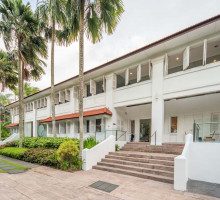
 

SINGAPORE (EDGEPROP) - On Dec 1, international hospitality owner and operator Far East Hospitality will open its third hotel on Sentosa, The Barracks Hotel Sentosa. This follows the launch of its flagship 606-key Village Hotel Sentosa that targets families, and its 193-key The Outpost Hotel Sentosa which caters exclusively to adults, particularly couples.

The refurbished The Barracks Hotel Sentosa takes up two out of the six conserved heritage buildings, which made up a British military outpost back in 1904. One other building will be used as an Events Centre, while the remaining three are to be the Mess Hall, which is partly tenanted currently. The tenants include Japanese restaurant Hidemasa By Hide Yamamoto, Royal Taj which serves up an Indian fare, 7-Eleven, and Eurasian restaurant Quentin’s. 

Just like Far East Hospitality’s two other hotels on Sentosa, The Barracks Hotel Sentosa is designed by architect and director Laurence Liew of Arc Studio Architecture + Urbanism, with the interior design of the rooms conceived by KKS International. Conceptualised in 2014, the restoration and internal alteration works for the hotel started at end-2015, while the groundworks itself began in mid-2018. 

The columns, as well as the doors, are conserved (Credit: Samuel Isaac Chua/ The Edge Singapore)
The columns, as well as the doors, are conserved (Credit: Samuel Isaac Chua/ The Edge Singapore)


The Barracks Hotel Sentosa offers “an ultra-exclusive” experience that is “tailor-made for the discerning traveller seeking timeless luxury and service with attention to detail”, notes Far East Hospitality in a press release. 

Of the 40 available rooms across two storeys, 33 are 312 sq ft premier rooms; six are 635 sq ft suites with a king-size bed each; and the last is a 312 sq ft accessible room fitted with a queen-size bed. In each premier room are a king or twin bedroom with an en suite bathroom, and an outdoor patio for those on the ground floor or a balcony for those on the second floor. The patio comes with direct access to the pool. For the suites, semi-private jacuzzi access is available.

As part of the hotel’s personalised Equerry Concierge Service, guests will have access to round-the-clock assistance, including in-room dining. Private tours, which are exclusively designed for guests, are also available. Nightly room rates start from $500.

There are only six 635 sq ft suites with king-size beds at The Barracks Hotel Sentosa (Credit: Samuel Isaac Chua/ The Edge Singapore)

There are only six 635 sq ft suites with king-size beds at The Barracks Hotel Sentosa (Credit: Samuel Isaac Chua/ The Edge Singapore)


According to interior designer Kunio Iwata of KKS International, the design was “based on [the] footprint of the [hotel’s] rich history”. “Since the hotel is housed in a designated conserved building, there are more opportunities for the design to be more experiential with the raw and rustic feel of the existing site,” he says.

To that end, the rooms feature the stand-alone bathtub from Australian brand Apaiser, which is dark-coloured and stone-like, and made to contrast with the white marble floor. The shell-shaped basin from Hansgrohe is in white porcelain, with red gold fittings. Together, these elements give the rooms a “timeless [yet] modern” look, notes Iwata. 

The standalone bathtub is from Australian brand Apaiser (Credit: Samuel Isaac Chua/ The Edge Singapore)

The standalone bathtub is from Australian brand Apaiser (Credit: Samuel Isaac Chua/ The Edge Singapore)


The shell-shaped basin in white porcelain by Hansgrohe gives a timeless yet modern look (Credit: Far East Hospitality)

The shell-shaped basin in white porcelain by Hansgrohe gives a timeless yet modern look (Credit: Far East Hospitality)


Each suite also features a vintage leather sofa from British brand Chester Field, while soft touches are added to the décor in all the rooms, which includes artworks and accessories reminiscent of vintage objects.

The minibar and the Nespresso machine on a vintage-looking cabinet (Credit: Far East Hospitality)

The minibar and the Nespresso machine on a vintage-looking cabinet (Credit: Far East Hospitality)


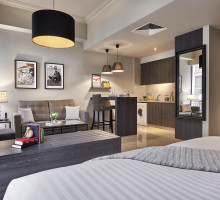
At The Barracks Hotel Sentosa, the moulded columns, traditional timber louvered windows, and moulded timber doors are all in their original conserved state. New features have been added, like the timber feature wall at the head of each bed, and rustic rounded door handles. The divider, added to separate the bedroom and the bathroom, is a timber louvered sliding door that is coated with white paint.

The bedside table in the Premier Room (Credit: Far East Hospitality)

The bedside table in the Premier Room (Credit: Far East Hospitality)


As a member of the Small Luxury Hotels of the World (SLH), The Barracks Hotel Sentosa joins SLH’s global portfolio of over 500 hotels. SLH is present in more than 80 countries worldwide. 

The study desk in the premier room (Credit: Far East Hospitality)

The study desk in the premier room (Credit: Far East Hospitality)


“The unique offerings of The Barracks Hotel Sentosa would be an exciting addition for our members,” says Mark Wong, vice president, Asia Pacific, at SLH. “Apart from its luxurious décor and exclusive activities for guests, the hotel’s efforts in preserving the heritage of the place are in line with SLH’s vision of creating a sustainable future where people explore the world with intention, experience its intensity and protect its integrity.”

Related Listings
Related News

The Clan Hotel: Where luxury and culture meet

The Clan Hotel: Where luxury and culture meet

The Clan Hotel Singapore is only minutes away from Raffles Place, yet is surrounded by heritage streets (Credit: Far East Hospitality/ Artist's Impression)

The Clan Hotel Singapore is only minutes away from Raffles Place, yet is surrounded by heritage streets (Credit: Far East Hospitality/ Artist's Impression)


SINGAPORE (EDGEPROP) - International hospitality owner and operator Far East Hospitality will add The Clan Hotel, its latest brand, to its growing portfolio. Slated to launch in 2Q2020, The Clan Hotel Singapore will be the group’s first luxury hotel in Singapore. 

Arthur Kiong, Far East Hospitality’s CEO, says the 324-key, 139,931 sq ft hotel has been in the conceptualisation stage for several years. “The good that came out is that we had a lot of time to consider what the product is that we want to create, that will be unique and special,” he says. 

 Meeting rooms are available at The Clan Hotel (Credit: Far East Hospitality/ Artist's Impression)

Meeting rooms are available at The Clan Hotel (Credit: Far East Hospitality/ Artist's Impression)

According to Kiong, there has been a “complete shift in thinking” on what constitutes a “luxury hotel”. From expecting a hotel to be “grand” and “spacious”, travellers now expect a place that is spacious and offers personalised touches. 

“In the past, luxury was about being exclusive. For the modern-day traveller, ‘luxury’ is about being inclusive, it’s about wanting to feel that you are welcome,” says Kiong. At The Clan Hotel, the services include immediate room check-in services at the airport with limousine transfer, a welcome tea ceremony with Chinese tea and traditional snacks, and turndown services with flower tea and essential oil rollers. Guests will also be able to sign up for tours, which the hotel staff will lead.

The 324-key, 139,931 sq ft The Clan Hotel sits atop Far East Square (Credit: Far East Hospitality/ Artist's Impression)

The 324-key, 139,931 sq ft The Clan Hotel sits atop Far East Square (Credit: Far East Hospitality/ Artist's Impression)

At The Clan Hotel, four room types are available. The rooms are priced from $300 a night. They are the Superior, Deluxe, Premier and Grand Premier rooms. The latter two room types are part of the MASTER Series rooms that offer highly customised services. 

The twin room at The Clan Hotel (Credit: Far East Hospitality/ Artist's Impression)

The twin room at The Clan Hotel (Credit: Far East Hospitality/ Artist's Impression)


Kiong points out that there is also a shift in expectations among travellers – from good-quality finishings to good designs. That is why the Sky Gym at The Clan is designed like a Chinese dojo, paying tribute to the heritage in the area. 

The Sky Gym at The Clan Hotel is inspired by the Chinese dojo (Credit: Far East Hospitality/ Artist's Impression)

The Sky Gym at The Clan Hotel is inspired by the Chinese dojo (Credit: Far East Hospitality/ Artist's Impression)


The Clan Hotel wants to “connect more travellers to unique experiences and deliver both a deeper cultural connection and a strong sense of place”, he adds. It helps that situated atop Far East Square, the hotel is only minutes away from Raffles Place and Collyer Quay, yet is surrounded by the heritage streets around Far East Square, Telok Ayer Street, Ann Siang Hill, and even Chinatown. That the area is steeped in history is to the hotel’s advantage, he notes. 

Kiong also questions the conventional idea of “quality tourism”. In land-scarce Singapore, the constant formula that hotel developers have been adopting is to maximise land use by building more rooms, coupled with the introduction of technology like service robots. “Small rooms, lots of robots. Is that quality tourism?” he asks.

Lounge area at The Clan Hotel (Credit: Far East Hospitality/ Artist's Impression)

Lounge area at The Clan Hotel (Credit: Far East Hospitality/ Artist's Impression)


The launch of The Clan Hotel comes on the heels of Far East Hospitality’s new launches in April – its flagship 606-key Village Hotel Sentosa that caters to families, and the 193-key The Outpost Hotel Sentosa that aims to attract couples. This December, Far East Hospitality’s third hotel in Sentosa, The Barracks Hotel Sentosa, will open its doors. With just 40 rooms, The Barracks Hotel Sentosa will cater to the “more discerning and mature traveller”, says Kiong. 

“What we hope to do is to actually create a new tier of business in Sentosa. What’s missing in Sentosa right now is obviously the mid-tier customers, because Sentosa is seen as an expensive destination,” he says. 

Kiong: We want to connect more travellers to unique experiences that deliver both a deeper cultural connection and a strong sense of place (Credit: Albert Chua/ EdgeProp Singapore)

Kiong: We want to connect more travellers to unique experiences that deliver both a deeper cultural connection and a strong sense of place (Credit: Albert Chua/ EdgeProp Singapore)

Expansion continues to be a focus, notes Kiong. He says that Far East Hospitality is looking at opening four other hotels outside of Singapore – in Japan, Vietnam and Australia.  

The 306-key Village Hotel Ariake Tokyo in Japan will be the first under the Village brand outside of Singapore. Owned by a 50-50 joint venture between Far East Hospitality and Far East Organization, the hotel is in Koto City, near the Ariake waterfront area. Situated in the Olympic Village, it will open just before the Tokyo 2020 Olympics, says Kiong. 

The Grand Premier Room is part of the MASTER Series rooms (Credit: Far East Hospitality/ Artist's Impression)

The Grand Premier Room is part of the MASTER Series rooms (Credit: Far East Hospitality/ Artist's Impression)

In Vietnam, the 56-key Hotel Reve and the 30-key Suzu Hotel, situated in District 1, will be under a management agreement with developer Five Elements Development, and are expected to open in the first half of next year. In Australia, The Quincy Melbourne will be a joint venture with TFE Hotels, located on the corner of Flinders Lane and King Street.

Related Listings
Related News

Far East Hospitality to launch The Clan Hotel Singapore

Far East Hospitality to launch The Clan Hotel Singapore

SINGAPORE (EDGEPROP) - International hospitality owner and operator Far East Hospitality will add The Clan Hotel, its latest brand, to its portfolio. The Clan Hotel’s first luxury hotel in Singapore is slated to launch in 2Q2020. 

“To meet the growing momentum of experience-driven travel, we challenged ourselves to introduce a new perspective on luxury with The Clan Hotel,” says Arthur Kiong, CEO, Far East Hospitality. He adds that “through carefully curated touchpoints, we want to connect more travellers to unique experiences that deliver both a deeper cultural connection and a strong sense of place”.

The 324-key hotel comprises four room types, namely the Superior room, the Deluxe room, the Premier and Grand Premier room, which are part of the MASTER Series rooms that offer highly customised services. The services include immediate room check-in services at the airport with limousine transfer,  a welcome tea ceremony with Chinese tea and traditional snacks, and turndown services with flower tea and essential oil rollers.

The rooms range from 226 sq ft for a Superior room; to 258 sq ft to 290 sq ft for a Deluxe room; about 334 sq ft to 244 sq ft for a Premier room; and 388 sq ft for a Grand Premier room. 

The guestrooms are located on levels 6 to 29, while the gym and pool are located on level 30.

Located along Cross Street, The Clan Hotel Singapore is a one- to six-minute walk from Telok Ayer MRT Station on the Downtown Line, China Square Central, Chinatown, Lau Pa Sat, and Raffles Place MRT Station.

Read also:

Related Listings
Related News

Tanjong Pagar pilots Business Improvement District programme

Tanjong Pagar pilots Business Improvement District programme

SINGAPORE (EDGEPROP) - Eight property and business owners at Tanjong Pagar are collaborating to form Discover Tanjong Pagar. The precinct was the first out of nine precincts to take-off the Business Improvement District (BID) programme announced by the Urban Redevelopment Authority (URA) in September last year.  

The eight stakeholders in this pilot are Carlton City Group’s Carlton City Hotel Singapore; OUE’s Downtown Gallery; GuocoLand Singapore’s Guoco Tower;  Far East Organization’s Icon Village; Tian Teck Group’s International Plaza; Far East Hospitality’s Oasia Hotel Downtown Singapore; the owner of Orchid Hotel; and Sofitel Singapore City Centre.  

The group has been working closely with government agencies to build a community and connect people and businesses together. “With the rejuvenation of the precinct, it is timely for the multiple stakeholders to join hands to further the transformation of Tanjong Pagar through synergised efforts,” says Cheng Hsing Yao, chairman of Discover Tanjong Pagar and group managing director of GuocoLand Singapore. 

Tanjong Pagar - To launch Discover Tanjong Pagar, the stakeholders partnered the People’s Association and Sports SG to organise activities such as a lantern walk and an artisan market at Tanjong Pagar. (Photo: Shutterstock)

To launch Discover Tanjong Pagar, the stakeholders partnered the People’s Association and Sports SG to organise activities such as a lantern walk and an artisan market at Tanjong Pagar. (Photo: Shutterstock)

Tanjong Pagar is the first area in Singapore to be gazetted under the government’s conservation plan in 1989. In recent years, it has also seen new additions on the residential front, including Altez, Skysuites@Anson and Wallich Residence. Incidentally, Wallich Residence is part of the Tanjong Pagar Centre integrated development developed by GuocoLand Singapore which includes Sofitel Singapore City Centre and Guoco Tower. Other mixed-use developments include Icon and Icon Village, Downtown Gallery and Oasia Downtown. New hotels in the area include Carlton City Hotel and Orchid Hotel.  

Prior to the announcement of BID, Cheng says GuocoLand has already been thinking about how to work together with its neighbours in Tanjong Pagar to transform the area. On its part, GuocoLand has been organising activities at its flagship integrated mixed-use project, Tanjong Pagar Centre. When it unveiled its 150,000 sq ft Urban Park as part of the development in October 2017, the developer started programming community fitness, lifestyle, music and family-friendly activities. 

One of the initial efforts by the eight stakeholders was to give back to the community during the Christmas season, before the pilot BID was formed. According to Cheng, this initiative benefitted 800 beneficiaries and the stakeholders are planning to continue giving back to the community through its programmes.

“At the end of the day, our circle of influence is within our own development,” he says. As such, he believes Discover Tanjong Pagar is beneficial to everyone in the district whether they are stakeholders or not. He explains that Tanjong Pagar is not the first place that comes to mind for both tourists and locals where “must-visit destinations” are concerned. 

To launch Discover Tanjong Pagar, the stakeholders partnered the People’s Association and Sports SG to organise activities such as a lantern walk and an artisan market at Tanjong Pagar. “At this launch event, a lot of people were coming from the surrounding areas because we had this event. Quite a few people said they’ve never been here before,” he says.

Upcoming activities include an urban exploration race where runners can explore and navigate their way through Tanjong Pagar, as well as collect points to win the top prize of a 3D/2N weekend stay at Oasia Hotel Downtown.

According to Cheng, the stakeholders have also started discussions with government agencies such as Singapore Tourism Board and National Heritage Board. “We are discussing with them how to promote or leverage their knowledge on heritage and history since Tanjong Pagar is one of the oldest districts in Singapore,” he reveals. 

Currently, participation in the BID is voluntary with each stakeholder contributing a portion of the budget. According to Cheng, this amount is matched one-for-one by the URA for a period of four years. “Within these four years, they are helping us to get more resources to use. It’s not a big budget so we have to spend wisely,” he adds. 

While there are only eight stakeholders at the moment, they are currently in talks to rope in more property and business owners in time to come. These include shophouse owners at Tras Street and even further at Duxton Hill and Keong Saik Road. 

“For [the stakeholders], it is a lot of effort and time because we have our day jobs and we are doing this and trying to make it more efficient and effective,” Cheng says. 

For price trends, recent transactions, other project info, check out these projects' research page: Guoco TowerIcon VillageInternational PlazaOasia HotelOrchid HotelAltez, Skysuites@Anson and Wallich Residence

Read also:

Related Listings
Related News