
Seoul, Tokyo to lead global prime residential growth this year: Savills


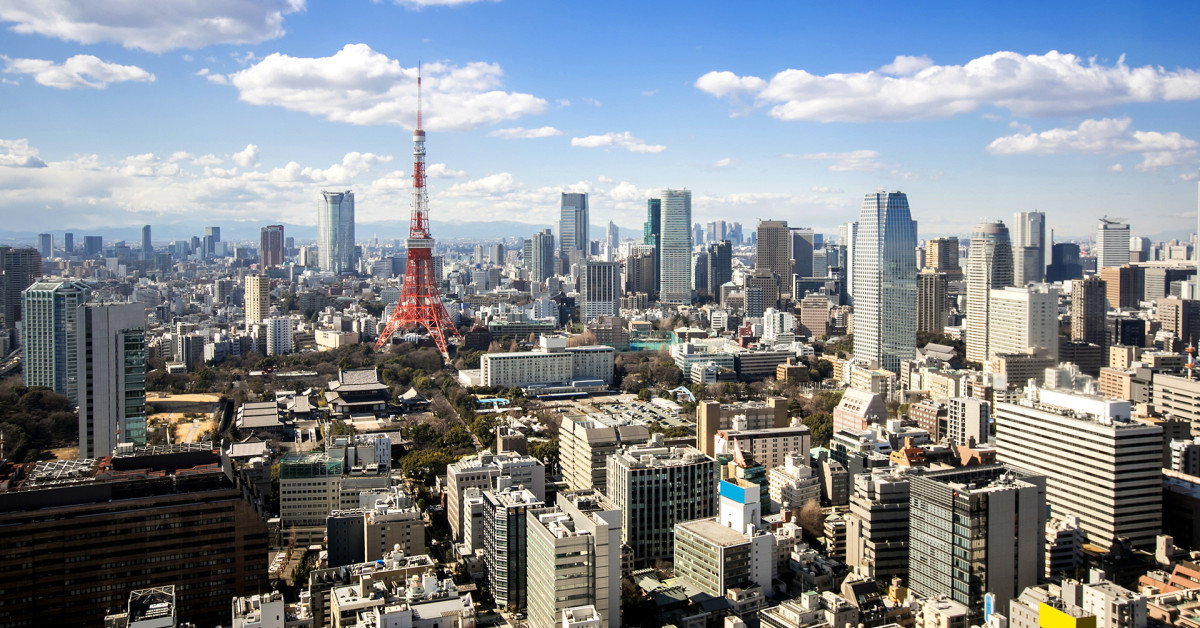
In Tokyo, competition for land, particularly from office developers, is restricting residential development. (Photo: Savills)
Seoul and Tokyo are likely to lead increases in global prices of prime residential properties in 2026, while Singapore could see a modest recovery, according to real estate services firm Savills.
In Seoul, South Korea, prime apartment prices could rise between 6% and 7.9% this year, slightly easing from their 14.3% increase in 2025. Scarce land availability, slow development pipelines and concentrated demand within core districts continue to place upward pressure on pricing, based on Savills’ latest Prime Residential World Cities report.
Meanwhile, capital values in Tokyo, Japan, are expected to grow between 4% to 5.9% this year. This will be slower than last year’s 30% surge, which had been driven by acute supply scarcity and enduring appeal to both domestic and international investors.
Competition for land — particularly from office developers — is restricting residential development in Tokyo, even as widening gaps between new apartment prices and construction costs raise longer-term sustainability considerations.
In Singapore, prime apartment prices are likely to grow between 2% and 3.9% this year, reversing from its decrease of 0.10% in 2025, in Savills’ view.
“Singapore’s luxury residential market is slowly regaining momentum as more locals and permanent residents realise that value offerings are in the air after the price correction in 2025,” said Alan Cheong, executive director of research and consultancy at Savills Singapore.
These forecasts come as structural supply shortages, improving buyer confidence and selective demand are seen to support price stability and gradual growth in key Asia Pacific and European markets, according to the report.
That said, the narrative across the Asia Pacific region is mixed. Tokyo, Seoul, Sydney, Mumbai and Kuala Lumpur remain regional powerhouses supported by international capital and strong end‑user demand. Mumbai’s luxury segment continues to benefit from demand for larger homes and hybrid‑work dynamics, while Seoul’s core districts maintain concentrated demand despite fewer transactions.
Conversely, major cities in mainland China faced pressure in the resale market in 2025. Thus, while prime new‑build stock remains resilient, the broader outlook is subdued.
China’s headwinds continue, with weak demand and demographic challenges weighing on prices of prime residential properties. Savills sees decreases of 2% to 3.9% in 2026 across the Chinese cities in the index — including Beijing, Shanghai, Hangzhou, Shenzhen and Guangzhou.
Hong Kong’s luxury home prices are showing signs of stabilisation, with stronger demand from new mainland Chinese buyers who are acquiring residences in the city’s prime enclaves. Its capital values may increase by 2% to 3.9% this year, Savills noted.
Prime residential capital values: 2026 forecast and 2025 growth:
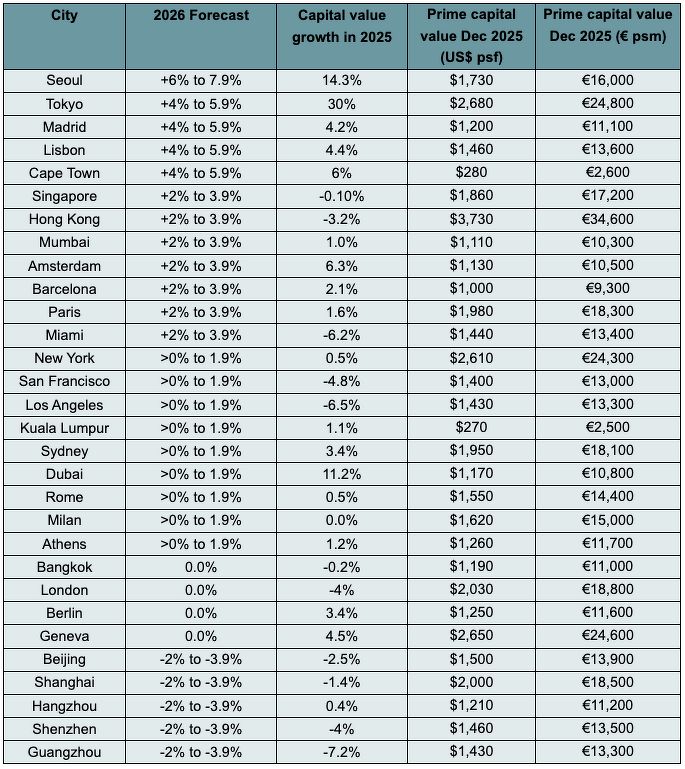
Source: Savills Research; Savills World Cities Prime Residential Index
Moderate outlook in other regions
In contrast, the outlook across much of Europe and the US is more subdued, with the firm expecting average price growth between just over 0% and 1.9% in 2026.
Easing mortgage rates may support activity in the US. European cities including Rome, Athens and Paris are positioned for gradual recovery amid improving buyer confidence and limited supply, though markets such as Milan could be dampened by elevated prices and cautious sentiment.
In the United Arab Emirates, Dubai’s capital values grew 3.6% in the second half of 2025 and 11.2% for the full year. Savills reckons the city is set to see more moderate growth of 1.9% in 2026. This comes as constrained prime supply has sustained prices, but there is a significant pipeline of mainstream stock which could contribute to a two-tier market.
As for London’s outer prime areas, the firm forecasts capital values to stay flat (0%) this year, although it expects a 12% increase over the next five years. House values are likely to hold up better than flats, at least in the short term.
Outer prime London might see stronger growth than prime central London as the former’s market is more influenced by cost and the availability of mortgage debt.
However, continued pressure on prices in central London will also mean a lack of trickle-down growth that is typically expected during the early part of a recovery.
Prime central London’s property values could see a modest drop of 2% this year, Savills says. It reckons values will increase by 8.1% over the next five years, with changes to the tax and regulatory environment causing prices to improve gradually, rather than experiencing a significant bounce. Values across London’s most rarefied postcodes fell 4.8% in 2025, leaving prices 24.5% below their 2014 peak.
In 2025, global prime residential property markets were resilient despite a backdrop of economic volatility, geopolitical tensions and shifting policy environments. Across the 30 cities in Savills’ index, capital values rose by 1.8% on average last year. In the second half of 2025, capital values outperformed rents for the first time since 2021, signalling a modest shift in sentiment on firmer expectations of interest rate cuts.
For more news and analysis, read our weekly e-paper. Prefer a print copy? Get it delivered to your home or office every Monday.
Follow Us
Property updates, 24/7.


Subscribe to Newsletter
Market insights, delivered weekly.
Top Articles
Search