
Singapore ranked third top destination for world’s wealthy: Savills
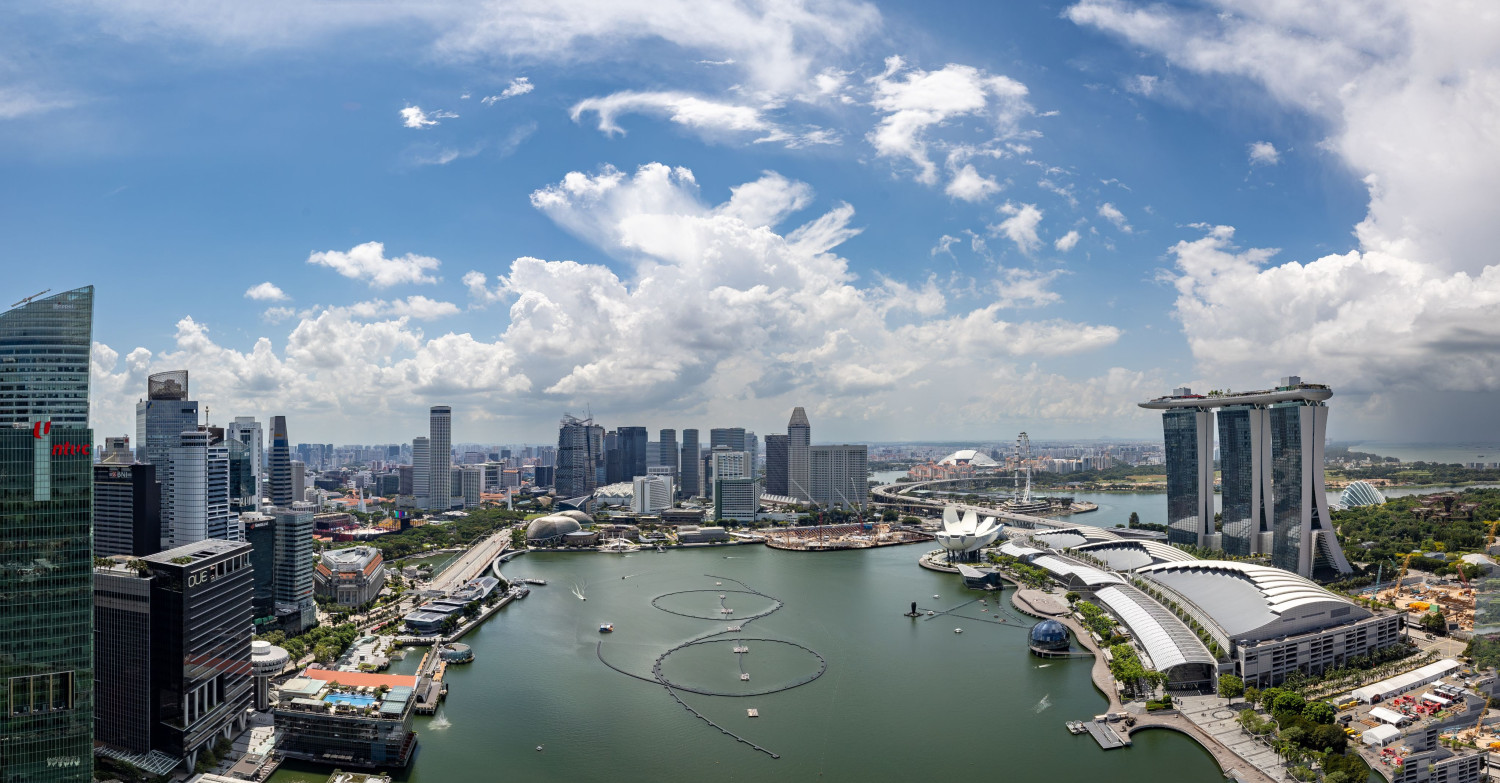
Singapore ranked third on the Savills HNW Individuals Hotspot Index, after Dubai and New York City (Picture: Samuel Isaac Chua/The Edge Singapore)
Singapore remains a key wealth hub, despite the rapid shift in the global landscape for high-net-worth individuals (HNWIs), according to Savills’ Spotlight on Wealth Trends report, published in November. The city-state ranked third in the firm’s inaugural HNW Individuals Hospot Index, which analyses top destinations for the world’s wealthy based on five key pillars: business environment, family environment, legacy, lifestyle and privacy and security.
Nearly 100 wealth hotspots were analysed, with Dubai emerging at the top of the list, followed by New York City. Hong Kong and Abu Dhabi rounded out the top five destinations. “Each of these cities offers the full suite of strong business and family environments, legal structures that make redistributing straightforward, strong lifestyle provisions, and high levels of security and privacy,” the report states.
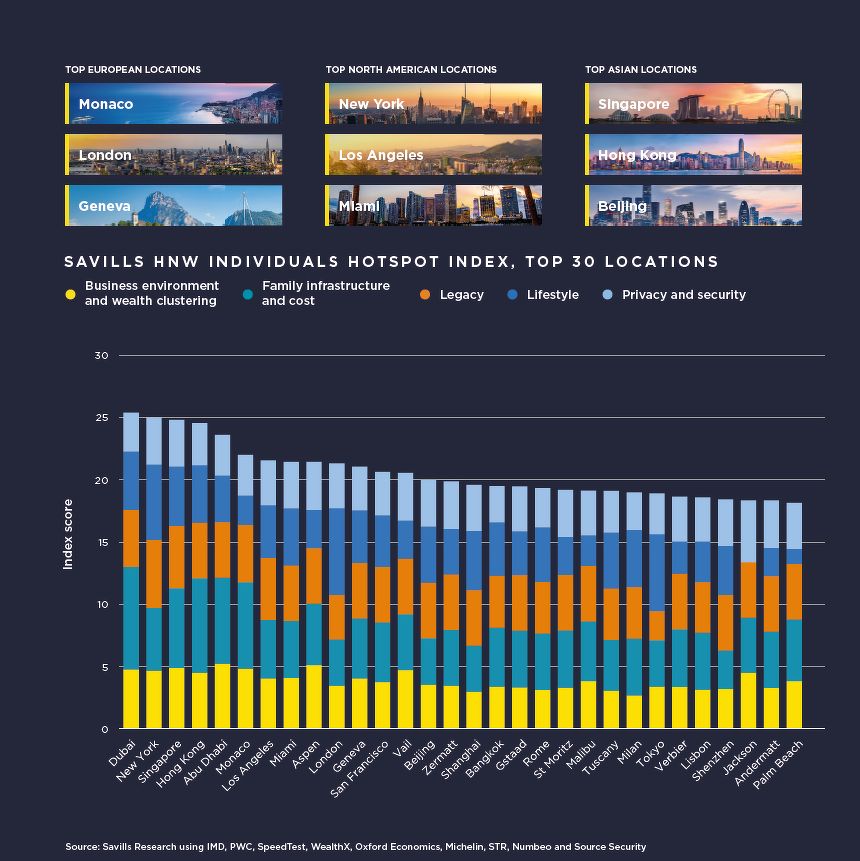
Other Asia Pacific (Apac) cities that made the top 30 ranking include Shanghai (16th), Bangkok (17th) and Tokyo (24th). The report adds that wealth creation in Apac is the fastest-growing among all regions and has resulted in a surge of wealthy individuals in cities such as Seoul, Kuala Lumpur, and Sydney, which all sit just outside the top 30.
Elsewhere, traditional wealth hubs in Europe, such as Monaco, London and Geneva, remained popular among HNWIs, ranking in sixth, tenth and eleventh position, respectively. The US, which is currently home to more than 38% of the world’s millionaires, also features heavily in the top 30 across cities including Los Angeles (7th), Miami (8th), Aspen (9th) and San Francisco (12th).
All-rounder appeal
Singapore’s strong ranking in the index reflects its broad appeal to HNWIs seeking both stability and long-term value, notes Yap Hui Yee, executive director of investment sales and capital markets at Savills Singapore. “Its position as a global wealth hub is further reinforced by the strength of its real estate fundamentals,” she adds.
Singapore scored well across all five metrics analysed under the index. For the business environment pillar, Savills assessed factors including competitive and innovative economies, corporate tax rates, airport connectivity and strong digital infrastructure. Here, Singapore emerged as one of the top destinations alongside Abu Dhabi and Hong Kong, with HNWIs drawn to its pro-business environment, robust economic fundamentals and strong GDP per capita.
Singapore also scored highly under the family environment pillar, which takes into consideration incentives offered to HNWIs by governments, such as tax breaks and golden visa schemes, as well as the availability of top-tier international schools.
Within this category, Dubai also stood out, thanks to the UAE’s golden visa program, which offers a 10-year residency in a low-tax, expat-friendly environment in return for an investment of AED2 million ($709,577). In addition, Dubai is home to the largest number of international schools among any destination in Savills’ index, at 168, significantly more than the 70 to 80 schools in the next-highest cities, such as Hong Kong, Mumbai, and Abu Dhabi.
Under the legacy pillar, destinations were assessed for factors pertinent to long-term wealth strategies and succession planning. In its report, Savills notes HNWIs are increasingly drawn to cities that offer the ability to establish family offices, trusts and other estate planning vehicles.
Exposure to inheritance tax is also a major consideration, with places that have higher thresholds for inheritance tax, such as the US and the Middle East, being preferred over cities with broader-reaching inheritance tax systems, like the UK. Singapore also ranked among the top locations for legacy, given its absence of inheritance, capital gains and wealth taxes.
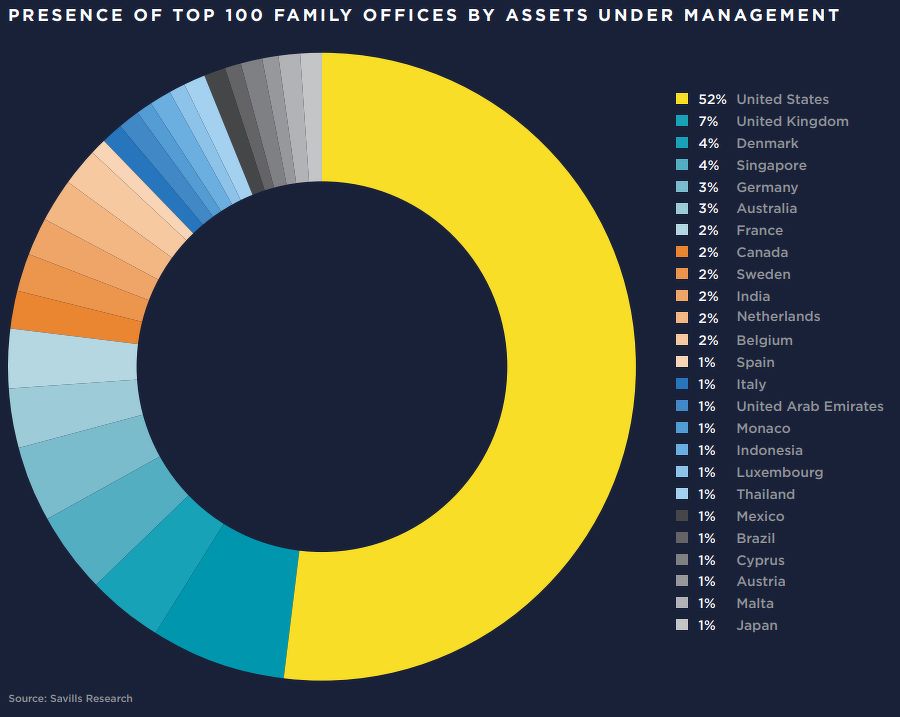
In any case, the increased focus on legacy planning among HNWIs has led to a surge in the number of family offices. Citing research from Deloitte, Savills notes that the number of global family offices has increased from approximately 6,130 in 2019 to over 8,000 today, with the figure expected to rise further to around 10,700 by 2035. At present, over half of the top 100 family offices by assets under management are based in the US, at 52%. The UK accounts for 7%, followed by Denmark and Singapore, each at 4%.
Under the lifestyle pillar, Singapore emerged as the seventh most popular destination. London, which ranked first, was lauded for its depth of offerings across shopping, dining, hospitality, members’ clubs and quality of life. Tokyo, which boasts the highest number of restaurants in the Michelin Guide, ranked second for lifestyle rankings, followed by retail and fashion capitals New York City and Paris.
Meanwhile, privacy and security remain crucial considerations for the wealthy, particularly as the threat of cybercrime continues to rise. According to Savills’ report, rising concerns over surveillance and data breaches have led to a surge in demand for digital privacy services. At the same time, physical security measures continue to evolve, with HNWIs turning to proactive measures such as private security teams and prioritising properties with high security features. Within this landscape, the US and UK stand out, with both countries having the highest number of private security providers.
Emerging hotspots
While established cities remain important hubs for the rich, the global wealth geography is shifting rapidly, driven by a convergence of business environments, family and lifestyle trends, and legacy strategies, says Savills. “We are witnessing a clear pivot away from traditional financial centres towards dynamic, tech-enabled cities and lifestyle locations,” the report states.
Up-and-coming hotspots include Shenzhen and Bengaluru, which each posted triple-digit growth in millionaire populations over the past decade. In addition, traditional second-home and resort destinations are also expanding their offerings and turning into year-round destinations. In Savills’ HWN Hotspots Index, countryside and ski locations such as Tuscany, Aspen and Zermatt all made the top 30, pointing to a growing preference for leisure and wellness.
Savills predicts that in the next decade, the redistribution of wealth to the Millennial and Gen Z generations will prompt a shift in preferred destinations to those aligned with their personal values, which may include a strong focus on digital infrastructure, quality of life and sustainability.
“The new map of wealth is more fluid, decentralised and globally distributed than ever before,” says Kelcie Sellers, associate director of Savills World Research. “In this new era, the next hotspot may be less about legacy and more about agility, vision and the ability to attract the globally mobile.”
Follow Us
Property updates, 24/7.


Subscribe to Newsletter
Market insights, delivered weekly.
Top Articles
Search