
Singapore's two-speed office market: Why premium space keeps winning

For occupiers, the decision to locate in Premium and Grade A offices, such as CapitaSpring (pictured), extends beyond physical attributes (Photo: Samuel Isaac Chua/EdgeProp Singapore)
The flight-to-quality trend in the office sector shows no signs of abating, underpinned by a confluence of factors. Even as premium rents rise, occupancies in these buildings have tightened considerably, with vacant space swiftly backfilled once it hits the market.
For occupiers, the decision to locate in Premium and Grade A offices (premium offices) extends beyond physical attributes — such as grand vehicular drop-off points, state-of-the-art lift lobbies and large open floorplates — to encompass broader strategic imperatives, including talent attraction, sustainability commitments and corporate image.
However, the outlook is less rosy for the rest of the office market, with selected buildings facing a range of challenges, from maintaining occupancy to keeping pace with rental growth. While asset enhancement initiatives could be a significant repositioning lever, they require significant capital expenditure, entail potential downtime and may not always guarantee meaningful returns. Separately, alternative approaches such as proactive lease management, tenant engagement and flexible space offerings can be effective in driving meaningful improvements and enhancing competitiveness in the current market.
The question of whether older buildings are underperforming is more nuanced. Two simple benchmarks can help determine whether a building is truly lagging the market.
Are rents falling behind the expected pace of growth?
Using URA’s office rent classifications as a reference, Category 1 buildings are considered premium, while Category 2 represents the remaining office stock in the Central Area.
As shown in Chart 1, Category 1 buildings consistently command a rent premium over Category 2 buildings. Over the last five years, Category 1 rents have grown at a compound annual growth rate of 8.3%, compared to 4.1% for Category 2.
More critically, the rental gap between Category 1 and Category 2 buildings has been rapidly widening. In 4Q2025, this gap expanded to $4.95 psf per month, the widest since 4Q2020. This trend is unsurprising, as the confluence of tight prime office supply, the broad return-to-office movement and occupiers’ preference for more efficient floorplates has continued to fuel demand for premium buildings, driving rents higher in the process.
By this measure, a Category 2 building that has consistently achieved rental growth exceeding the 4.1% market average, or commands rents at or above the Category 2 median, can be considered an outperformer relative to its peers.
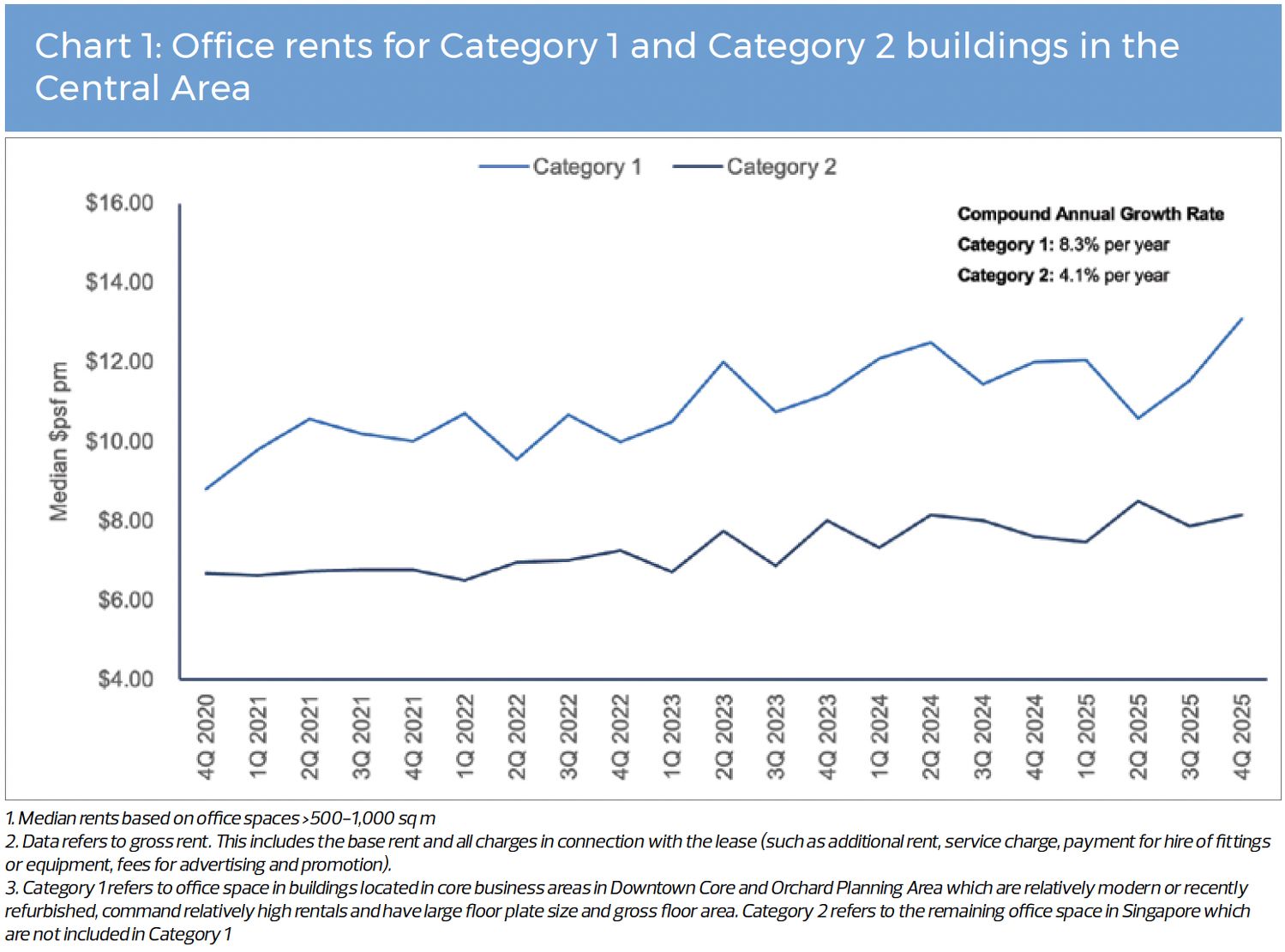
Chart: URA, Newmark Research
Is the building vacancy above market benchmark?
Within the Central Area, average vacancies have hovered between 9% and 14% over the past five years. While no official vacancy breakdown exists for Category 1 and Category 2 buildings, data collected by Newmark since 2024 suggests vacancy for premium office buildings remains well below 10%, while other categories may exceed 20%, underscoring the widening divergence across office categories.
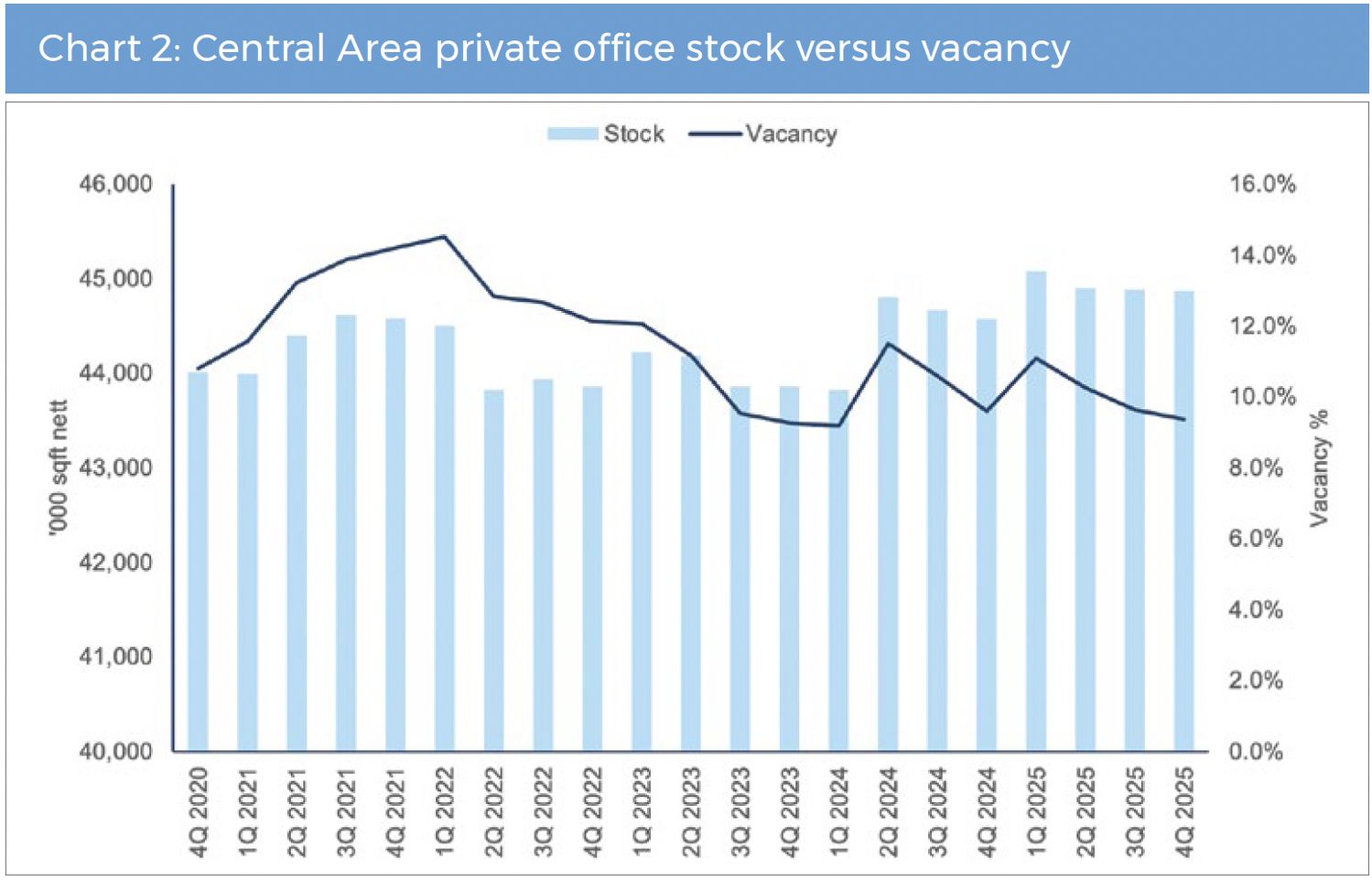
Chart: URA, Newmark Research
Understanding these market dynamics is crucial to identifying practical and cost-effective solutions that some landlords have adopted with much success. At times, a more nuanced approach is all it takes to see improvement.
Elevating the sense of place through cosmetic improvement and customer service
Cosmetic improvements to a building’s facade and lobby, paired with exceptional customer service, can go a long way in elevating the sense of place. Simple touches such as warmer lighting, ambient scenting and hospitality-trained concierge staff can create a welcoming environment that resonates with tenants and visitors alike.
While such measures may not suffice to court larger occupiers bound by stringent sustainability mandates, they can meaningfully enhance a building’s appeal among smaller tenants who prioritise environment and experience over green credentials.
Strengthening community engagement to foster tenant cohesion
With many organisations actively drawing employees back to the office, tenant engagement programmes have emerged as a key lever, offering employees a reason to show up beyond their desks. Such programmes are not new, but their scope has expanded considerably.
CapitaLand, for instance, organised over 970 activities across its Singapore workspace properties in 2023, spanning festive celebrations, sports events and wellness workshops. In October 2025, it further formalised this commitment through a three-year partnership with the Health Promotion Board to deliver health and wellness programmes benefitting some 45,000 participants annually.
Lendlease has similarly embedded placemaking at Paya Lebar Quarter, participating in URA’s Business Improvement District pilot programme to activate public spaces and shape the precinct’s identity.
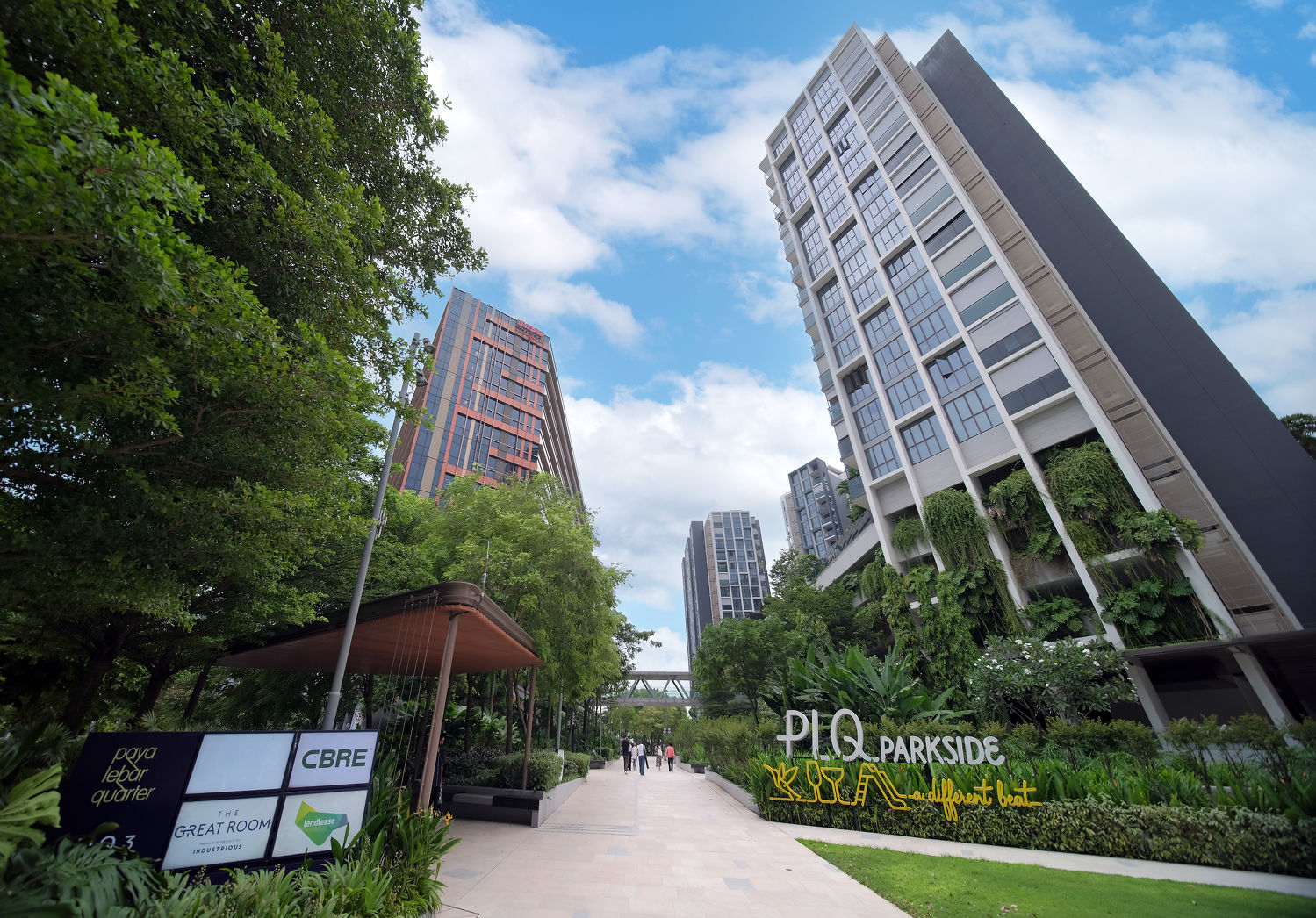
Lendlease has embedded placemaking at Paya Lebar Quarter (pictured), participating in URA’s Business Improvement District pilot programme to activate public spaces and shape precinct identity (Photo: Albert Chua/The Edge Singapore)
Offering flexible lease structures, or initiating early renewal discussions
Consider proactively reviewing upcoming lease expiries 12 to 18 months in advance. Early engagement allows landlords to understand tenants’ intentions and provides lead time to accommodate changing space requirements or counter tenants’ relocation plans.
Offering shorter terms with renewal options, rent-free fit-out periods or stepped rent arrangements, can meaningfully lower the barrier to renewal for cost-conscious tenants, making lease flexibility a key lever in retaining occupiers.
Fitted-out office options
Fitted-out office options have gained traction among tenants as they remove the need for significant upfront capital commitment, offering plug-and-play spaces that allow occupiers to move in with minimal lead time — a compelling proposition for smaller tenants, start-ups and firms undergoing restructuring.
By working with landlords to incorporate fit-out costs into the rental structure, tenants can eliminate the need for upfront capital expenditure, making the overall leasing decision more financially manageable.
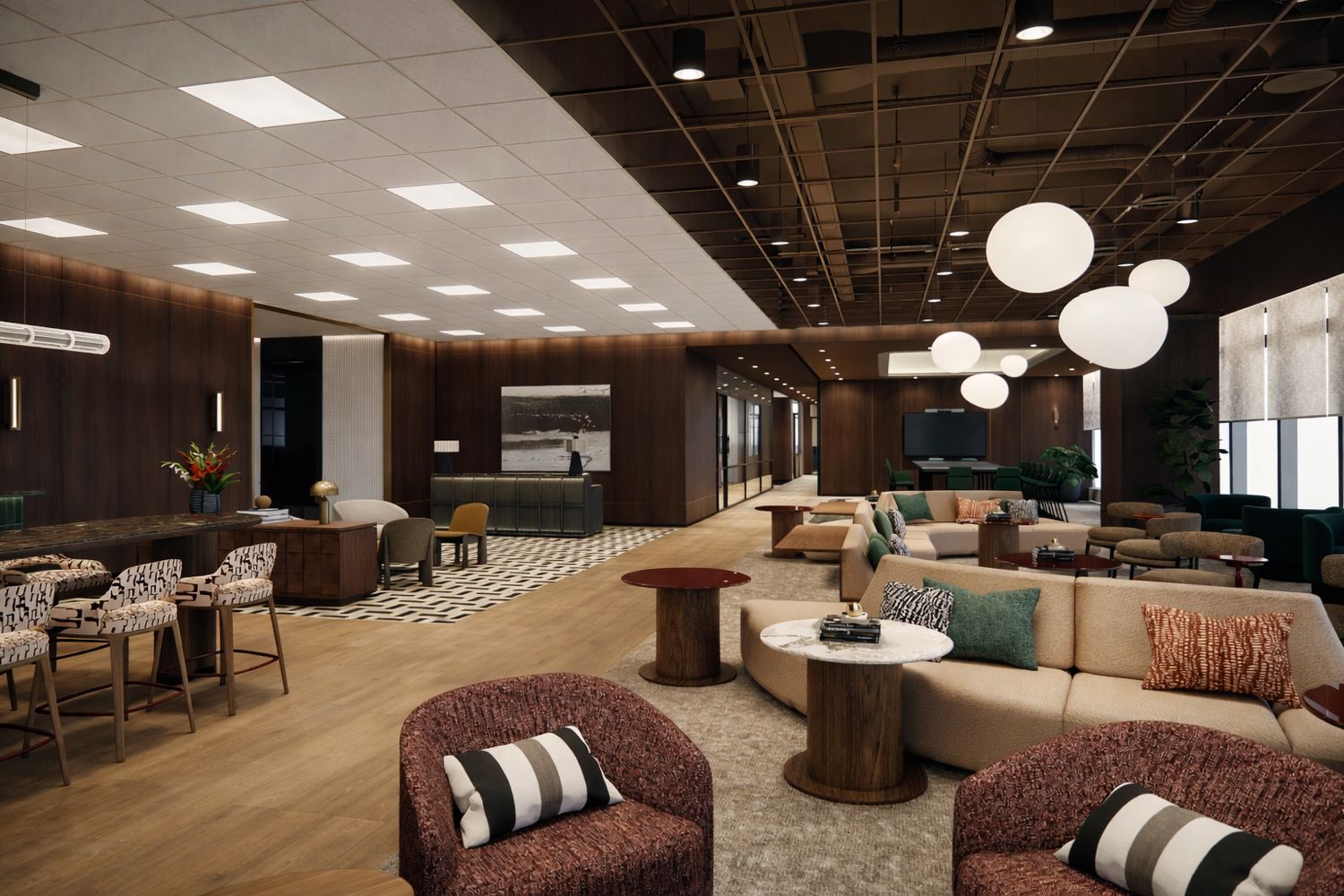
Fitted-out office spaces, such as The Great Room at Keppel South Central (pictured), have gained traction as they eliminate the need for significant upfront capital expenditure (Photo: Siren Design Studio)
In conclusion
As the gap between premium and non-premium office buildings widens, landlords who act early and think creatively will be better placed to weather the divergence. The solutions outlined above are by no means exhaustive, but they underscore a broader truth: staying occupied in a two-speed market demands more than competitive rents. It requires a genuine commitment to elevating the occupier experience through active tenant engagement and a deeper understanding of their day-to-day challenges.

June Chua is senior managing director, head of Singapore leasing, at Newmark

Wong Shanting is director, head of research, at Newmark
For more news and analysis, read our weekly e-paper. Prefer a print copy? Get it delivered to your home every Monday.
Follow Us
Property updates, 24/7.


Subscribe to Newsletter
Market insights, delivered weekly.



Top Articles
Search