
Tight supply lifts Singapore office rents even as global headwinds weigh on sentiment

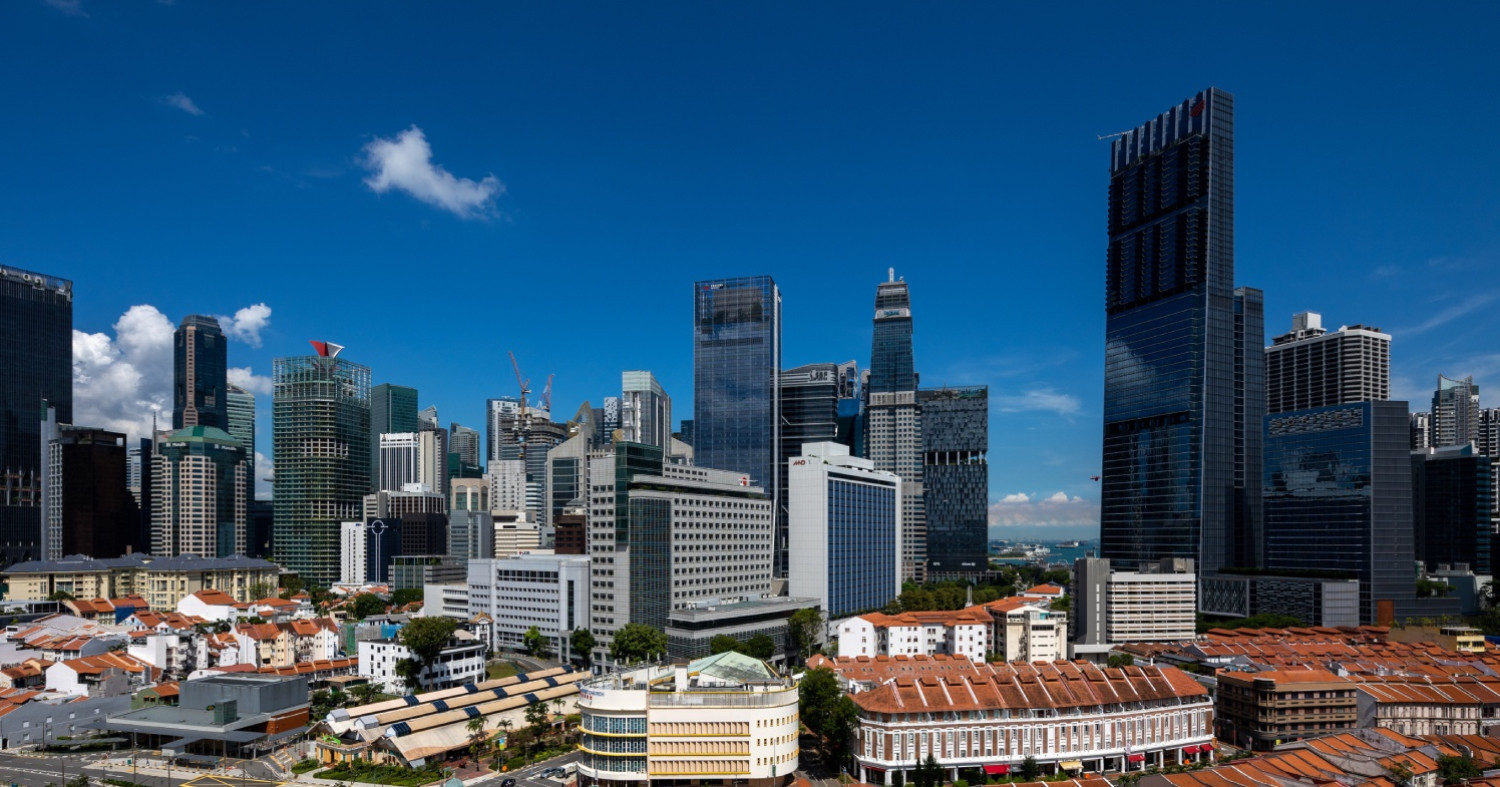
Singapore CBD skyline. Geopolitical tensions have made some office landlords and occupiers more cautious, though this did not meaningfully slow leasing activity. (Photo: Samuel Isaac Chua / EdgeProp Singapore)
Singapore's prime office market sustained its upward trajectory in the first quarter of 2026, with rents rising even as geopolitical tensions tempered leasing sentiment, according to quarterly research reports released by property consultants.
Vacancy rates continued to tighten as well, driven by a persistent mismatch between robust occupier demand and a thin pipeline of new supply.
Higher rents on firm demand, thin pipeline
Across insights from CBRE, Colliers, JLL and Knight Frank, rents in the core CBD area generally ranged from $11.57 to $12.40 psf per month in 1Q2026, with all four consultancies recording quarterly gains, albeit at varying rates — partly reflecting the differences in the segments and precincts that each firm tracks.
Analysts broadly attributed the higher rents to firm occupier demand, a continued flight to quality towards newer and better-specified buildings, and a near-term supply pipeline that remains thin.
Geopolitical tensions, particularly in the Middle East, have made some landlords and occupiers more cautious, though this did not meaningfully slow leasing activity.
CBRE Research noted that core CBD Grade A rents went up by 0.8% q-o-q to $12.40 psf per month in 1Q2026, marking the fifth consecutive quarter of growth and building on a 2.9% increase through 2025.
Core CBD gross effective rents:
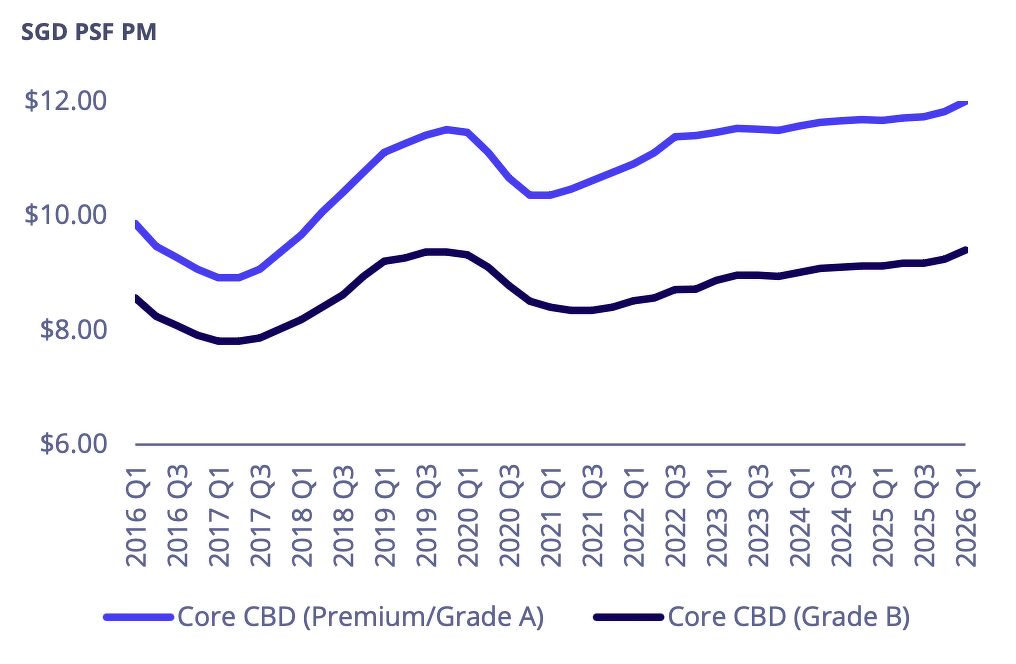
Source: Colliers. Note: Average gross effective rents are benchmarked to a full-floor space in mid-zone level; conservative figure towards lower-end of rental range for a property. Effective rent refers to the average rate payable over the lease term after accounting for incentives.
Colliers similarly recorded a 1.5% quarterly gain in rents of premium and Grade A assets in the core CBD area to $12 psf per month, and said this is the strongest q-o-q rise since Q2 2022.
JLL put the average gross effective rent for Grade A offices in the CBD at $12.04 psf per month, up 0.5% from the previous quarter and its highest level since 1Q2009.
Knight Frank — which publishes a precinct-by-precinct breakdown covering areas including the CBD, city fringe and the suburbs — noted that rents of prime-grade office space in the Raffles Place and Marina Bay precinct averaged $11.57 psf per month, up 0.7% q-o-q.
Average office rentals, by key precincts, in 1Q2026:
Vacancies fall to new lows
Vacancy rates declined in the first quarter of this year, driven by strong demand for quality space and limited new supply coming onto the market.
In the core CBD area, vacancies of Grade A offices shrank to a record low of 3.3%, down from 4.5% in 4Q2025, according to CBRE. Islandwide office vacancy also fell to 5.1%, with tightening seen across the board, including the fringe CBD and decentralised locations.
Colliers noted a slightly sharper decline, with core CBD vacancy dropping to 2.4% from 4% in the prior quarter, supported by net absorption of about 330,000 sq ft.
Office rents and vacancies in CBD, city fringe and suburbs:
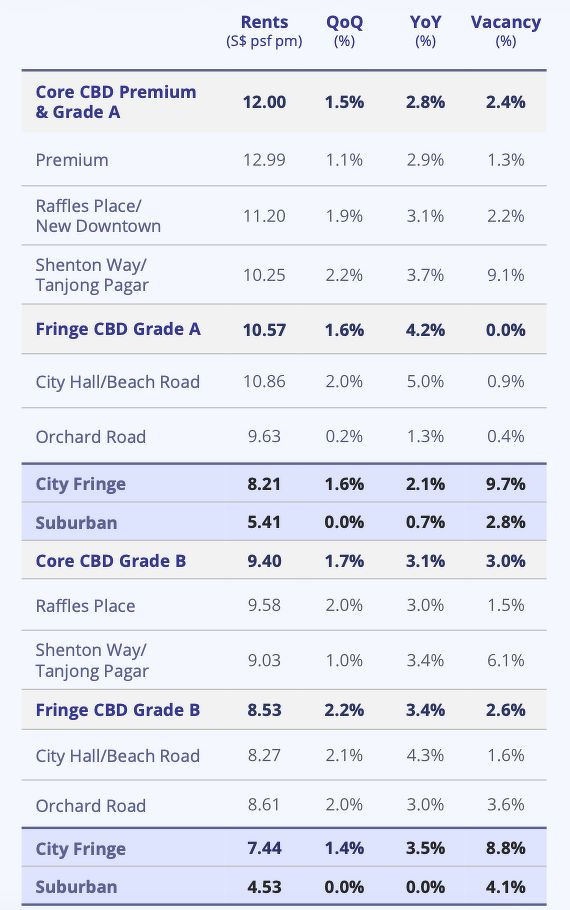
Source: Colliers
JLL found vacancy tightening at the top tier, falling for the fourth consecutive quarter for CBD investment-grade offices.
This was led by the Marina Bay submarket, where vacancy decreased to 6% in 1Q2026 from 7.2% in the previous quarter. It marked the submarket’s lowest level since IOI Central Boulevard Towers entered the market in mid-2024 with 1.26 million sq ft of space, JLL said.
Knight Frank placed overall CBD occupancy at 94.7%, with a slight q-o-q dip of 0.2 percentage points but a y-o-y increase of 1.2 percentage points.
Specifically in the Raffles Place and Marina Bay precinct, occupancy levels rose to 97% in the first quarter of this year, increasing by 1.3 percentage points q-o-q and by two percentage points y-o-y.
“The consistently tight occupancy rates demonstrate the attraction that the CBD continues to have for office occupiers, where most prefer to maintain their existing premises,” said Tridiana Ong, head of occupier strategy and solutions at Knight Frank Singapore.
Continued flight to quality drives absorption
The flight-to-quality trend remained a key driver of demand. Occupiers continued to gravitate towards newer, well-located Grade A buildings offering premium specifications, a wide range of amenities, sustainability and wellness credentials, efficient floorplates, and good connectivity.
Examples of such buildings seeing significant intakes in 1Q2026 included IOI Central Boulevard Towers, Marina One and MBFC Tower 1, according to CBRE.
Demand was supported by a diverse mix of sectors. “For example, we have seen active leasing from commercial banking, wealth management, and insurance,” said CBRE head of office services and head of leasing for Singapore, David McKellar.
He has also observed AI businesses, predominantly international firms, graduating from flexible co-working arrangements and committing to dedicated, self-managed office spaces.
Colliers likewise highlighted AI firms, fintech, insurers and flexible workspace providers as sources of occupier demand, with operators moving into prime developments to serve enterprise needs.
Also, cost and efficiency priorities will reinforce consolidation into newer, higher-quality buildings.
“Landlords of older or less competitive assets will need to invest in asset enhancement, repositioning or, where viable, redevelopment, to stay relevant as tenants increasingly scrutinise building efficiency, sustainability credentials and fit-out standards,” Colliers wrote in its report.
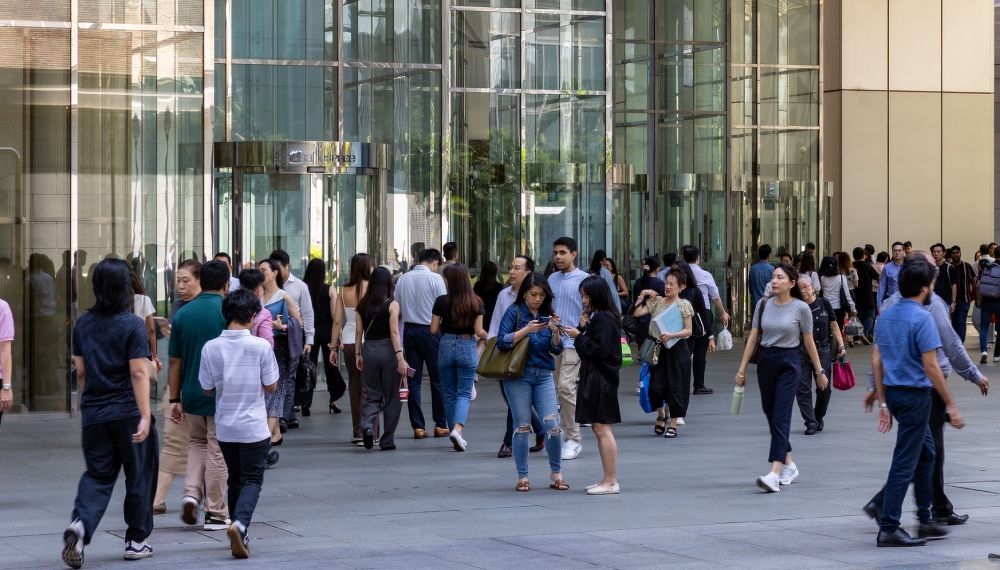
Office workers in Raffles Place. Landlords of high-quality buildings are operating in a “distinctly landlord-favourable environment”, said CBRE. (Photo: Samuel Isaac Chua / EdgeProp Singapore)
In Knight Frank’s view, companies were still turning to newer Grade A buildings in the CBD as they prioritised prestige, accessibility, talent attraction and retention, and cost considerations.
That said, well-connected decentralised nodes such as Buona Vista and the Alexandra corridor continued to be viable alternatives for occupiers seeking more affordable space without compromising on general islandwide connectivity.
“However, within the same location, buildings with higher specifications and better amenities will perform better with higher occupancies and be in a stronger position to retain A-list tenants than their neighbours,” Knight Frank wrote.
Therefore, office landlords in fringe locations that could come under stress are likely to focus on maintaining and ensuring stable occupancy by providing flexible lease terms, selective fitted-out offerings and targeted marketing to cost-sensitive occupiers, Knight Frank added.
Geopolitical tensions cloud outlook
The Middle East conflict has introduced a degree of caution among both landlords and occupiers.
In select sectors, macro uncertainty may extend occupiers’ decision cycles and shift negotiations towards flexible terms, fitted space and targeted incentives, in Colliers’ view.
JLL’s head of research and consultancy for Southeast Asia, Chua Yang Liang, said that the recovery in Singapore’s office market was again disrupted by renewed tariff uncertainty and heightened geopolitical tensions.
“Office rents continued to trend upwards in 1Q2026 but were unable to sustain the growth momentum of 2H2025 as q-o-q gains fell back to the sub-1% region,” Chua added.
While leasing activity continued in the latest quarter, landlords remained in “largely conservative positions” to maintain healthy occupancy levels, according to Knight Frank’s report.
For most occupiers, the impact of hostilities in the Middle East have yet to affect their real estate strategy. At the same time, the conflict has reinforced Singapore’s safe-haven status, Knight Frank noted.
It reckoned that some multinational companies in the affected zones might consider flight-to-safety relocations, with Singapore as a stable base for Asia Pacific operations.
Most companies are likely to delay major expansion plans until there is clearer visibility on the global outlook, the impact on energy markets, costs and interest rates.
In the nearer term, this suggests that leasing demand for offices will continue to be driven more by optimisation strategies such as upgrades, consolidations or renewals, instead of by large-scale headcount growth, Knight Frank wrote.
Limited supply sustains landlord advantage
Looking ahead, the supply picture is expected to keep the market in landlords' favour.
As CBD availability tightens, rental growth should persist but become more selective, concentrated in premium and well-located Grade A assets, according to Colliers.
Besides, the scarcity of large floor plates is likely to accelerate pre-commitments as tenants secure the required space ahead of completion. This is also supporting occupancy in newly completed projects; for example, Keppel South Central has seen increasing take-up, Colliers noted.
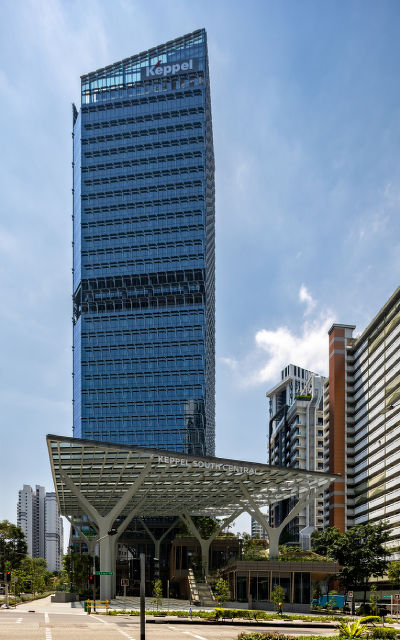
The scarcity of large floor plates is supporting occupancy in newly completed projects like Keppel South Central, according to Colliers. (Photo: Samuel Isaac Chua / EdgeProp Singapore)
CBRE’s McKellar said: “With limited new Grade A supply entering the core CBD over the near term, landlords of high-quality buildings are operating in a distinctly landlord-favourable environment.”
Pre-commitment activity is already emerging for developments slated for completion as far out as 2029, reflecting the urgency among tenants to secure quality space, he remarked.
This imbalance between demand and supply could keep rents well-supported throughout 2026.
Singapore has navigated such cycles before. For example, amid high inflation in 2022, some occupiers opted to renew leases and remain in place, instead of committing to new space, said Tricia Song, head of research for Singapore and Southeast Asia at CBRE.
A similar pattern might emerge if global uncertainty persists and the low turnover contributes to the limited vacancy, thus strengthening landlords’ negotiating position, she added.
JLL pointed out that completions of investment-grade offices for 2026 and 2027 look set to be at their lowest in three years, with Shaw Tower and Newport Tower as the only major completions scheduled during that period. Other upcoming developments are mainly boutique or strata-titled.
This may contribute to a continued space shortage and sustain CBD office rent growth in the range of 4% to 5% for 2026, said Andrew Tangye, head of office leasing and advisory at JLL Singapore.
He added that some spaces were being re-let even before the existing occupants vacated, with landlords increasingly favouring reputable tenants who can commit to early occupancy.
Selected upcoming office supply islandwide:
Source: URA, Knight Frank Research
Overall, Knight Frank expects the Singapore office market to remain stable in 2026, with rents potentially growing by 3% to 5% for the whole year.
The key risk to the outlook remains external. Any sustained surge in energy prices might impact the operational costs of buildings, and these may be passed on to tenants. “Hence, occupiers in energy-efficient buildings are likely to be better insulated from these unexpected shocks,” Knight Frank said.
For more news and analysis, read our weekly e-paper. Prefer a print copy? Get it delivered to your home every Monday.
Follow Us
Property updates, 24/7.


Subscribe to Newsletter
Market insights, delivered weekly.
Top Articles
Search