
No room on campus? Co-living steps up for students in Singapore

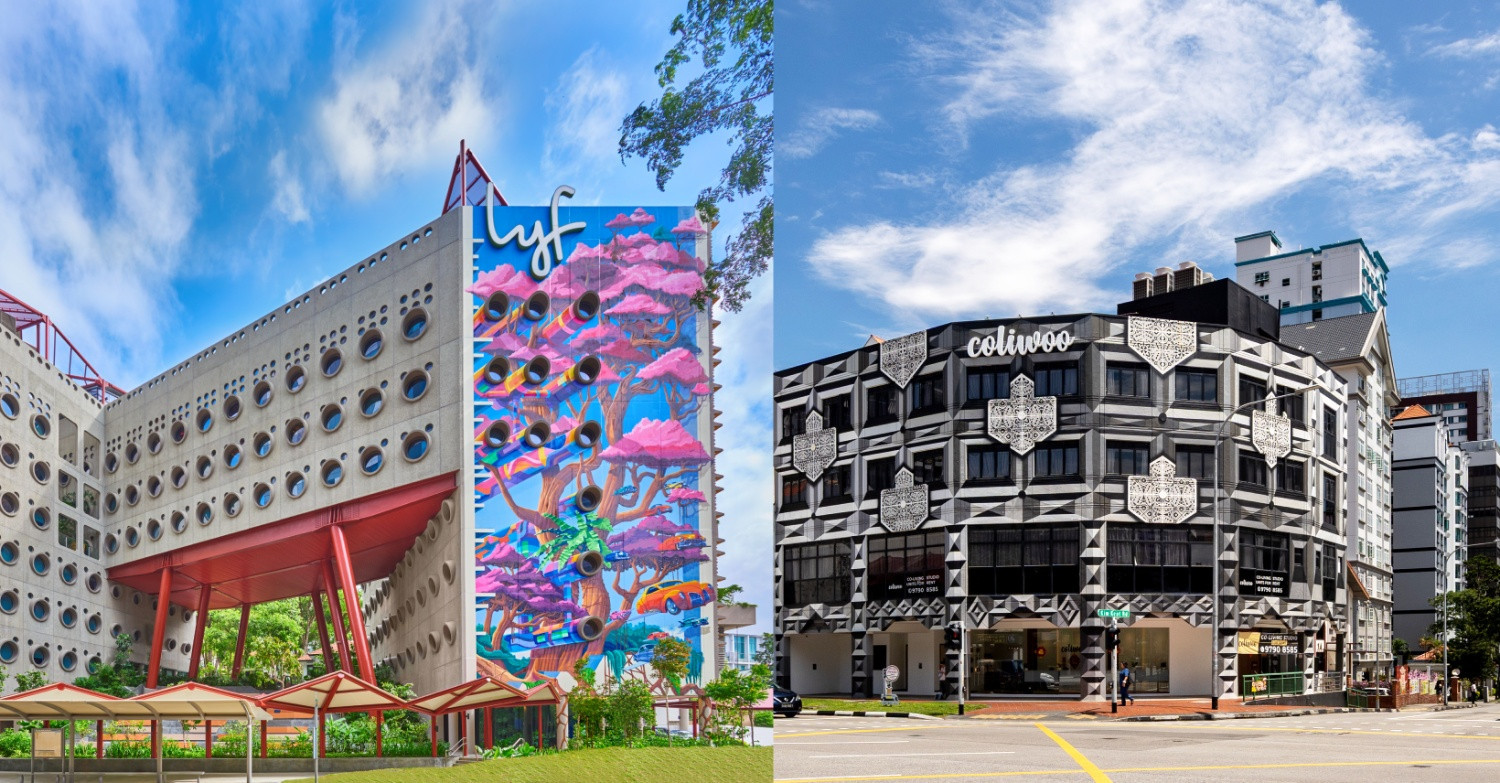
Lyf one-north Singapore (left) and Coliwoo Balestier 320. Rising student demand is fuelling growth in co-living as tenants seek alternatives to campus housing and private rentals.





Singapore has spent years positioning itself as a major education hub in Asia, and the pitch has worked. With foreign student numbers climbing, the tens of thousands who are expected to arrive in the city over the next few years will need somewhere to live.
On-campus halls of residence, often heavily oversubscribed and not guaranteed after the first year or two at many universities, were not built to absorb demand at that scale. Meanwhile, the private rental market runs largely on annual leases, which can be a poor fit for students on semester timelines or short exchange stints.
Stepping neatly into this gap are co-living operators, which offer fully furnished rooms, all-in pricing, flexible lease terms, and a built-in community of peers including fellow students, young professionals and expats.
The segment has proven to be an attractive one, operators tell EdgeProp Singapore. Academic intake cycles generate predictable demand while students’ desire for community, flexibility, convenience and professional management aligns closely with the co-living format.

A community event at Campus. Themed meetups, skills-sharing workshops and well-being and lifestyle events are meant to help TAP members feel at home and part of a community. (Photo: The Assembly Place)
A fast-growing segment
Singapore's international student population has been rising steadily. Estimates indicate there were 79,300 foreign students in early 2023, increasing by 25% from 63,600 a year earlier.
Supported by intensified post-pandemic recruitment, the higher education market in the Republic is projected to grow at an annual rate of 6.7% from 2025 to 2031, which implies the international student population could exceed 100,000 in the next few years.
The student nationality mix at Singapore’s co-living properties remains predominantly foreign at 70%-90%, with strong representation from regional markets including China, Malaysia and India, real estate consultancy JLL noted in a research report in September 2025.
In recent interviews with EdgeProp Singapore, major co-living operators say that students, most of them hailing from abroad, now make up as much as 58% of their residents. The segment has become a key growth driver for many firms.
At Cove, the tenant mix today sits at about 55% working professionals and 45% students, with a 15% y-o-y growth in the latter segment. This also follows a “noticeable uptick” in student arrivals from January 2025 onwards, says Mugdha Agrawal, its head of sales.
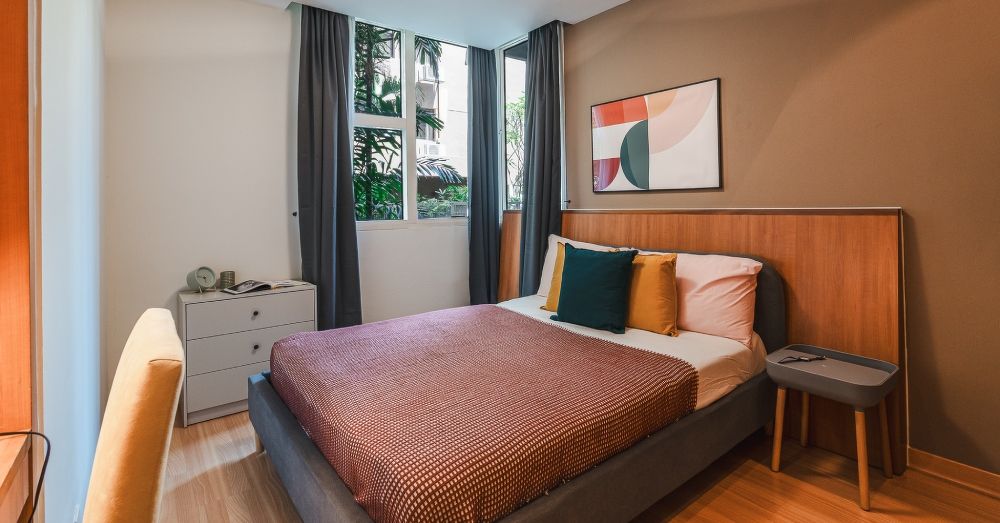
Cove’s student residents are predominantly affiliated with the Singapore Management University, Essec, EHL, SP Jain and National University of Singapore. (Photo: Cove)
Coliwoo reports a similar share, with students forming roughly 50% of its resident base. As at end-March, its portfolio exceeded 3,500 rooms, including about a thousand rooms which are under renovation.
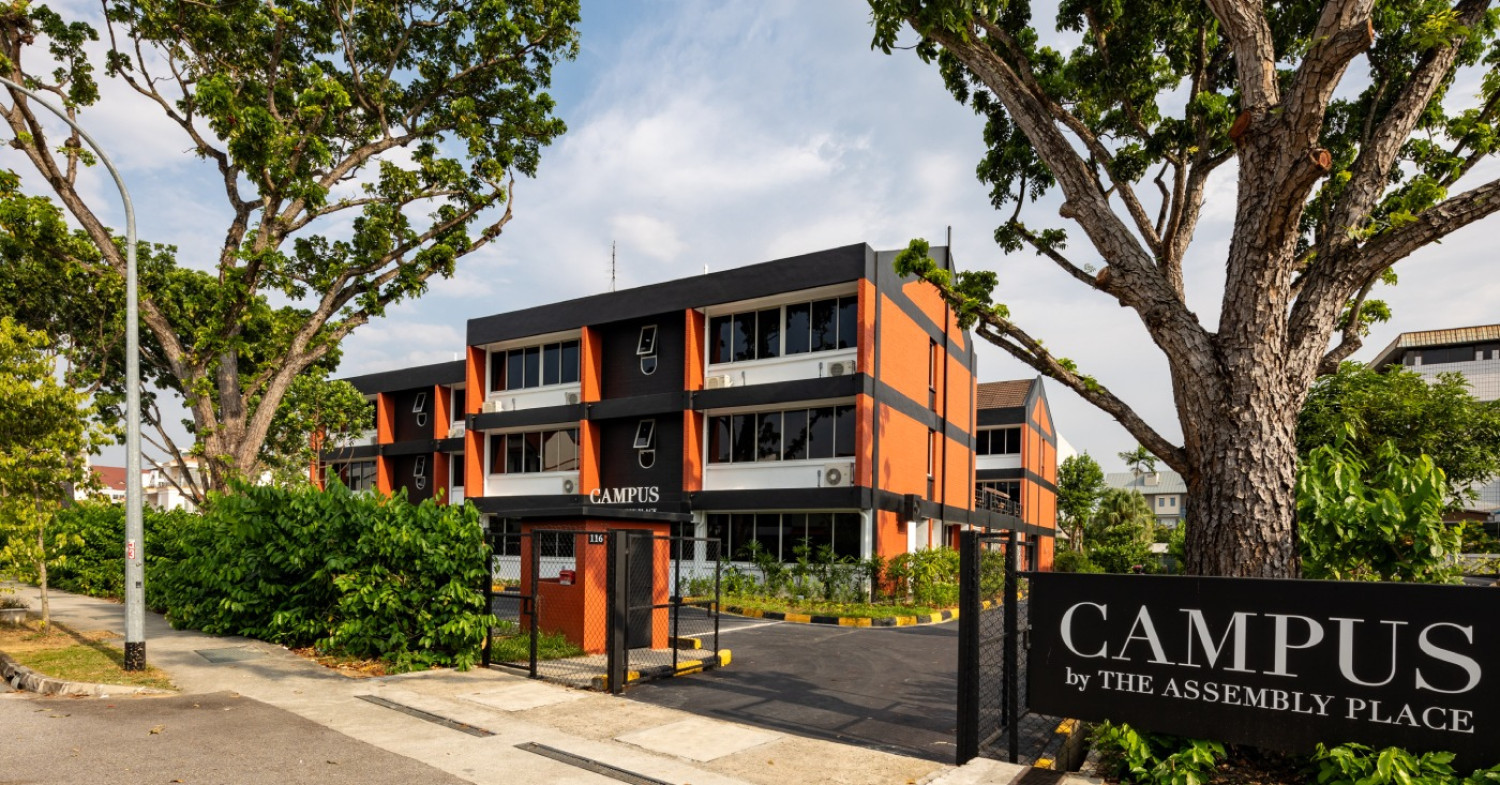
The Assembly Place’s (TAP) flagship student property, Campus, accounts for 426 keys or 11% to 12% of its total inventory of more than 3,400 keys. This student housing complex at Telok Kurau has seen over 90% occupancy since it opened its doors in late 2023.
In addition, students live at TAP’s other properties, though the company did not provide specific occupancy figures for those.
Bespoke Habitat notes that students previously made up about 49% of its residents in 2023. By 2025, that share had climbed to 58%. The firm manages more than 600 units — totalling thousands of rooms — across condos, apartments and landed properties islandwide.
At lyf, Ascott's social living brand with close to 1,300 units at five Singapore properties, overall occupancy has averaged above 80% across diversified guest profiles, with the education segment contributing about 10%-12% of total room nights.
When demand outpaced supply
A turning point for the sector came post-Covid as borders reopened, which unleashed a wave of pent-up student demand just as Singapore was also cementing its standing as a global education hub.
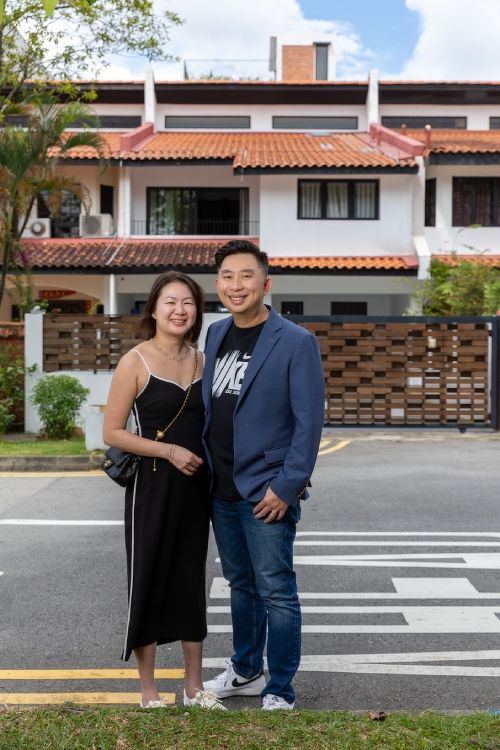
Jelene Sim and Ernee Ong, co-founders of Bespoke Habitat. They note that parents of student residents prioritise safety, a structured environment and accountability. (Photo: Samuel Isaac Chua/EdgeProp Singapore)
Bespoke’s co-founder and CEO, Ernee Ong, started noticing a spike in interest from 2022 onwards, especially when universities resumed full on-campus activities.
At the same time, a shortage of campus housing — particularly at the National University of Singapore (NUS) and Nanyang Technological University (NTU) — led to a spillover into the private rental market.
"Students represent a stable and recurring demand pool, and there's a clear need for safe, managed and community-driven housing solutions," Ong adds.
TAP likewise began actively planning its Campus property around 2022, after noticing undergraduates struggling to find affordable housing on a limited budget.
“We came to realise that Singapore did not have quality purpose-built student accommodation (PBSA),” says Eugene Lim, executive director and CEO of TAP.
Lim sees students as a natural fit for co-living, as they require flexibility, convenience and a ready-made community. “It’s a structurally growing segment for Singapore, and one we’ve leaned into deliberately,” he says.
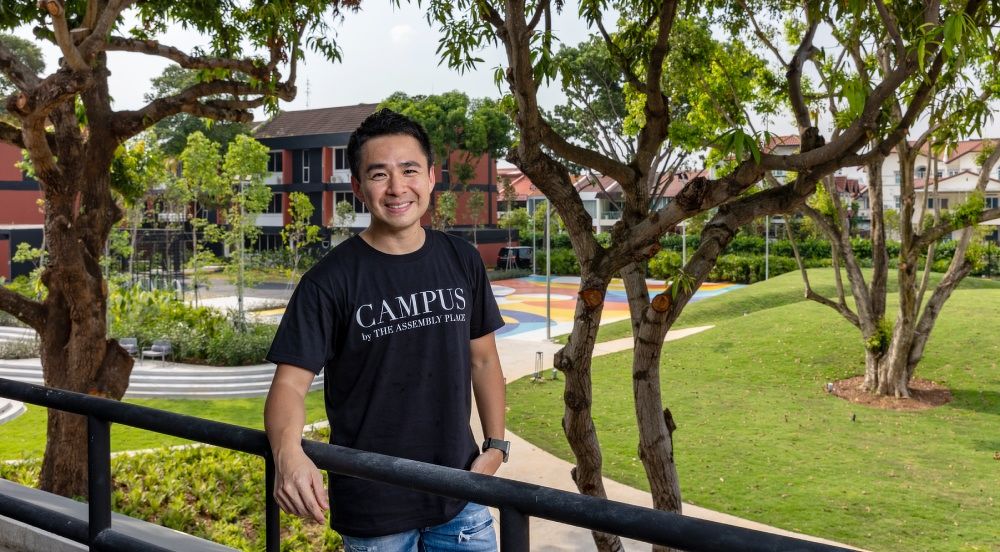
Eugene Lim, The Assembly Place: "We conceived Campus after noticing how undergraduates struggled to find affordable accommodation options on a limited budget." (Photo: Samuel Isaac Chua/EdgeProp Singapore)
TAP has also come up with its Stay concept to provide supervised homestays for upper-primary and lower-secondary school students. This came after numerous parents of the tertiary-level residents at Campus requested accommodation for their younger children as well.
On top of the post-pandemic rebound in demand, local universities have significantly expanded their exchange programmes with institutions in the US, Australia and Europe in recent years.
That is driving a sustained increase in incoming students — but without a corresponding increase in on-campus beds, according to Cindy Halim, head of corporate development at Cove, which has over 2,000 rooms in Singapore, mainly in the central and eastern areas.
The supply gap presents a compelling opportunity to cater to a growing, underserved segment with consistent demand and clear accommodation needs, she adds.
As for Coliwoo, there has been a meaningful uptick in student enquiries and bookings over the past few years. Its executive chairman and CEO, Kelvin Lim, says this signals not just Singapore’s emergence as a leading study destination, but also the acceptance of co-living concepts among foreign students and their parents for medium- to long-term stays.
From a business standpoint, the segment offers reliable demand due to the relatively predictable academic intake cycles, he adds.
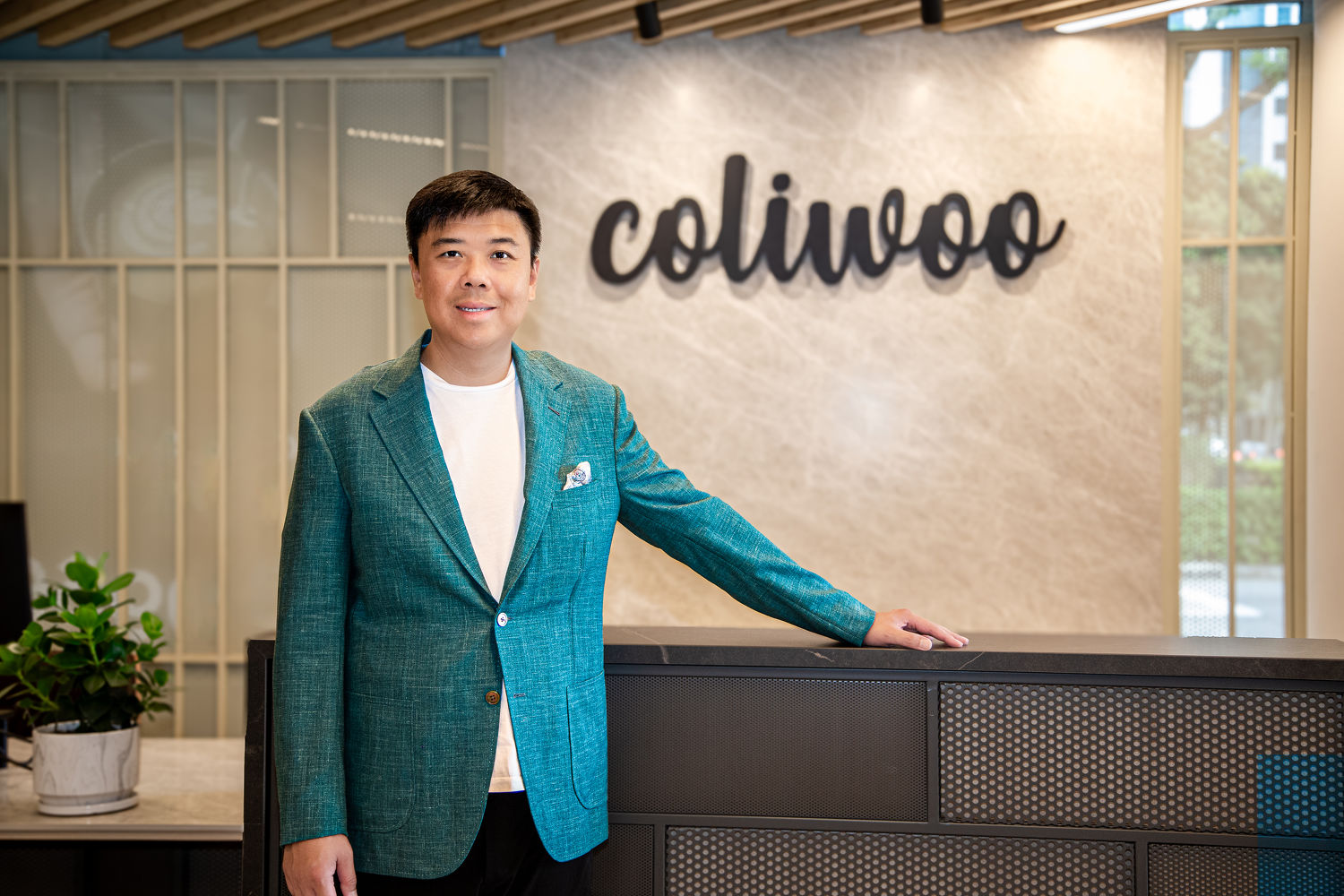
Kelvin Lim, Coliwoo: "Postgraduates often prioritise independence and focus, which is why our fully self-contained studio units resonate strongly with them." (Photo: Coliwoo)
Move-in ready with flexible leases
The appeal of co-living usually comes down to a few practical considerations for students and their parents.
The all-in proposition — fully furnished units, utilities, Wi-Fi, housekeeping and maintenance — lightens the logistical burden of setting up a new home in a foreign country with little more than a suitcase, which can be daunting.
Setup is minimal, addressing common pain points associated with traditional rentals, highlights TAP’s Lim.
Security and professional management matter too, especially to families making decisions from thousands of kilometres away.
“Singapore’s reputation as one of the world’s safest cities already provides a strong foundation, which we reinforce by detailing our property security protocols,” says Halim.
To give further peace of mind, Cove is transparent about potential flatmates, including their ages and genders, to help students feel confident in their new home before even moving in.
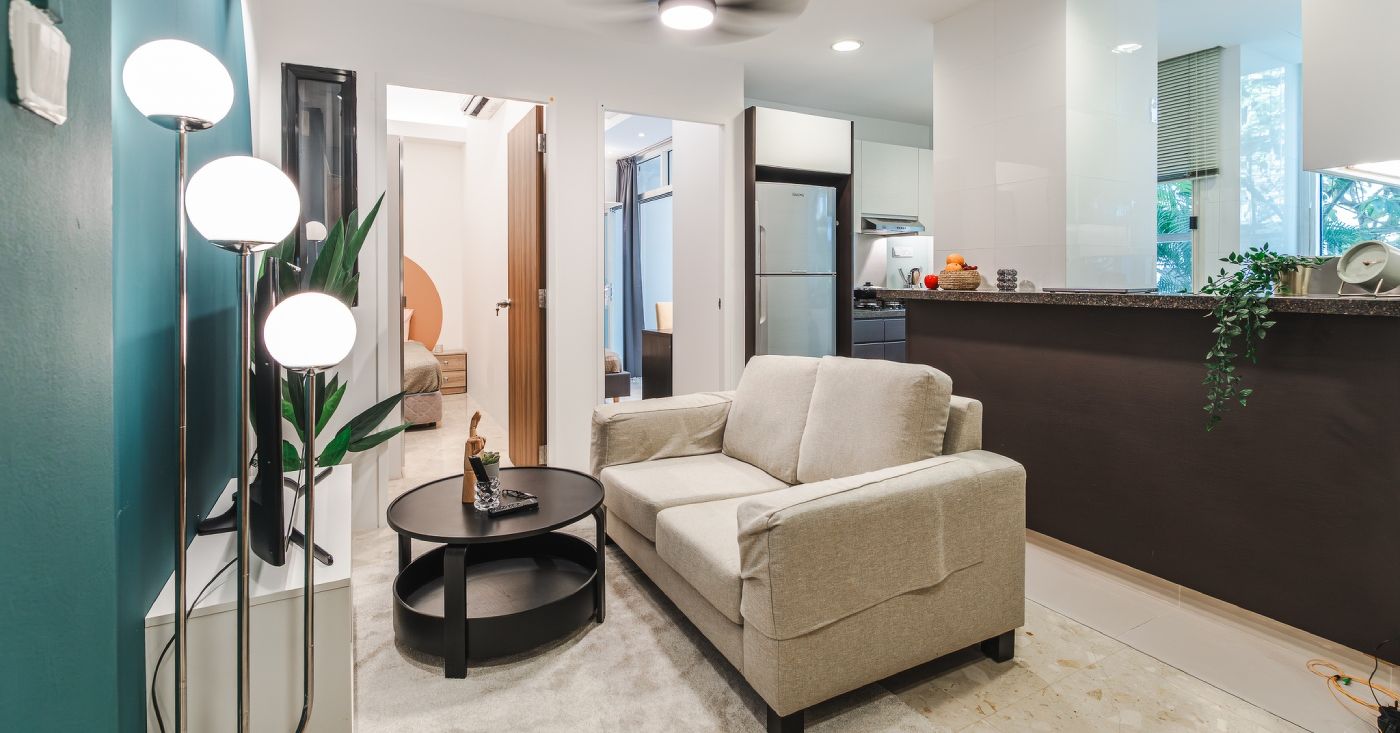
A District 9 condo unit managed by Cove. Across its portfolio, the operator runs five to six events per month spanning sports, social, cultural and interest-based experiences. (Photo: Cove)
And for students whose stays are tied to academic calendars or exchange programme durations, a deciding factor is the flexibility to structure a lease around those commitments, to avoid paying for months they do not need.
Although Singapore's private rental market technically allows leases as short as three months, many individual landlords are reluctant to go below one to two years.
At lyf, lease arrangements are meant to enable guests to better manage changes in study schedules. New bookings come with a seven-day cancellation window and early termination requests are assessed on a case-by-case basis.
"In practice, many student residents prefer month-to-month extensions, to align their stays more closely with semester timetables," says Wong Kar Ling, Ascott’s chief strategy officer and managing director for Southeast Asia.
A ready-made community
Wong reckons co-living has gained appeal among students because it strikes a balance between independence and belonging.
It offers "more autonomy than on-campus housing while removing some of the friction that can come with renting a room from an individual landlord", she says.

Wong Kar Ling, Ascott: "Community is a core part of the lyf experience. An 'Ambassador of Buzz' at each property curates programmes and introduces guests to the neighbourhood." (Photo: The Ascott)
Moreover, the social infrastructure — through shared common areas, community events and neighbours who are often in similar situations — eases what can otherwise be a disorienting first few months abroad.
“When they arrive in a new city, often without prior connections, they require more than just a place for rest. They need community, flexibility, and a safe, well-managed environment,” notes Coliwoo’s Lim.
Jelene Sim, co-founder of Bespoke, echoes this from the parents’ perspective, pointing out that the key draws are safety, a structured environment and the accountability that comes with professional management.
She acknowledges there will inevitably be some trade-offs. For example, those renting a room may feel there is less privacy than taking up an entire apartment, and there are house rules to follow.
“But in most cases, these are balanced out by the sense of community and the support system that co-living provides,” Sim says.

A farewell dinner for Bespoke Habitat’s international student tenants before they head back home, having completed their studies in Singapore. (Photo: Bespoke Habitat)
Compared to on-campus residences, co-living units or beds are generally easier to secure as tenants are not subject to the same supply constraints or strict allocation criteria — with access to city locations and often more modern facilities to boot.
Ascott’s lyf brand approaches the segment from a slightly different angle, positioning it not as a conventional co-living product but as an "experience-led social living concept within a professionally managed hospitality environment", according to Wong.
lyf has attracted both undergraduates and postgraduates "who are comfortable investing in a more premium" option that supports their lifestyle, she adds. What resonates with these guests is the combination of well-designed private rooms, highly adaptable social spaces, a strong sense of community and the convenience from housekeeping services.
Hailing from across the globe
As the overwhelming majority of students who opt for co-living are primarily tertiary-level, they are typically aged between 18 and 30. Most are undergraduates, enrolled in both autonomous universities and private education institutions.
Foreigners far outnumber Singaporeans and permanent residents. Top markets include China, India, Southeast Asia and, increasingly, Europe.
At Coliwoo, the student base skews towards Southeast Asian long-stay residents who are full-time undergraduates, postgraduates and researchers.
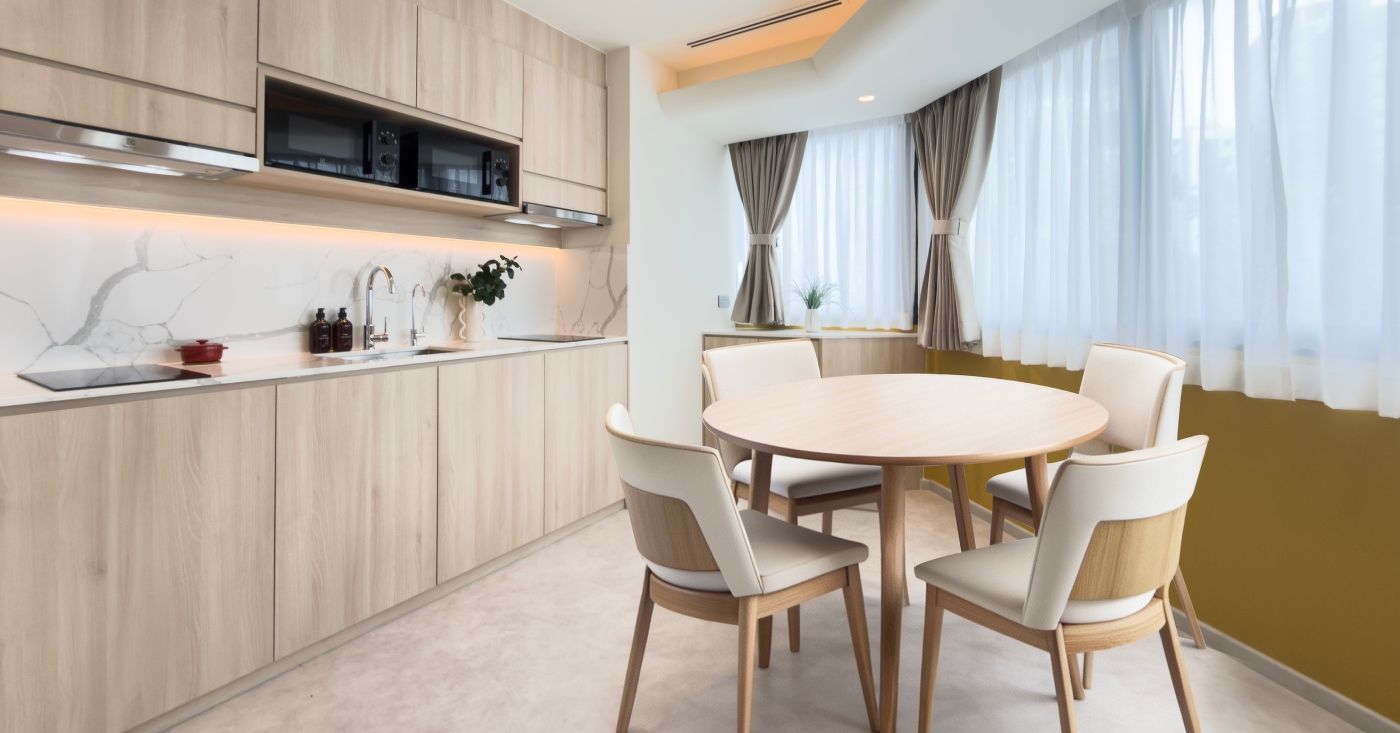
The dining area at Coliwoo Midtown. Students often gather to eat and cook their own meals, driven by cost-saving habits and cultural preferences. (Image: Coliwoo)
TAP houses students from over 20 countries, with China, India and Vietnam being the three largest source countries. Occupants at Campus, a fully dedicated student hostel accommodation, mainly comprise Student’s Pass holders.
Students at lyf properties hail from China, the UK, France, Italy, India, Indonesia and the Philippines, among others.
At Cove, about 70% of student residents are on short-term exchange programmes. This places particular importance on flexible tenure offerings, as exchange students have fixed and often non-negotiable start and end dates that rarely conform to standard six- or 12-month leases.
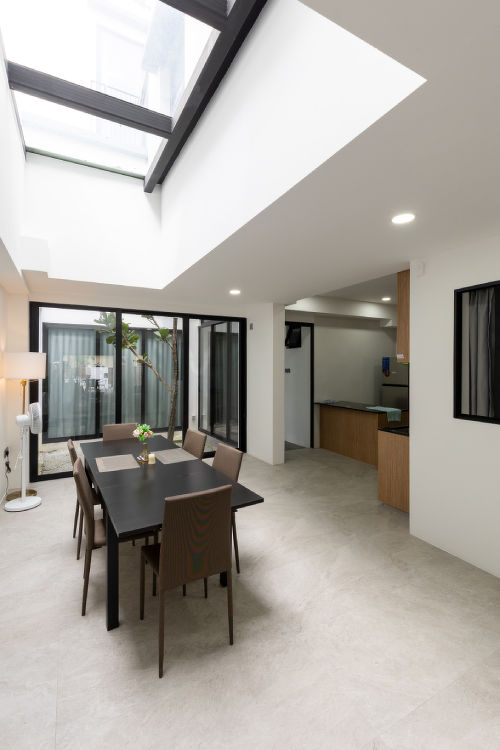
The dining and kitchen area at a house managed by Bespoke Habitat. The company has adapted its operations extensively to support first-time overseas students. (Photo: Samuel Isaac Chua/EdgeProp Singapore)
High turnover, first-time renters and anxious parents
Behind the scenes, serving students well comes with a unique set of operational demands and complexities.
A significant proportion are first-time overseas students — young people navigating a foreign country, a new academic environment and independent living all at once.
To support such guests, Bespoke has adapted its operations extensively. For instance, it offers pre-arrival onboarding, document guidance, airport coordination and transport, meet-and-greet services, a digital check-in process, as well as 24-hour support channels for maintenance and general queries.
"Many are first-time renters, so they require a higher level of support," says Sim. "But, with our standard operating procedures and systems in place, these challenges are more manageable and fairly predictable."
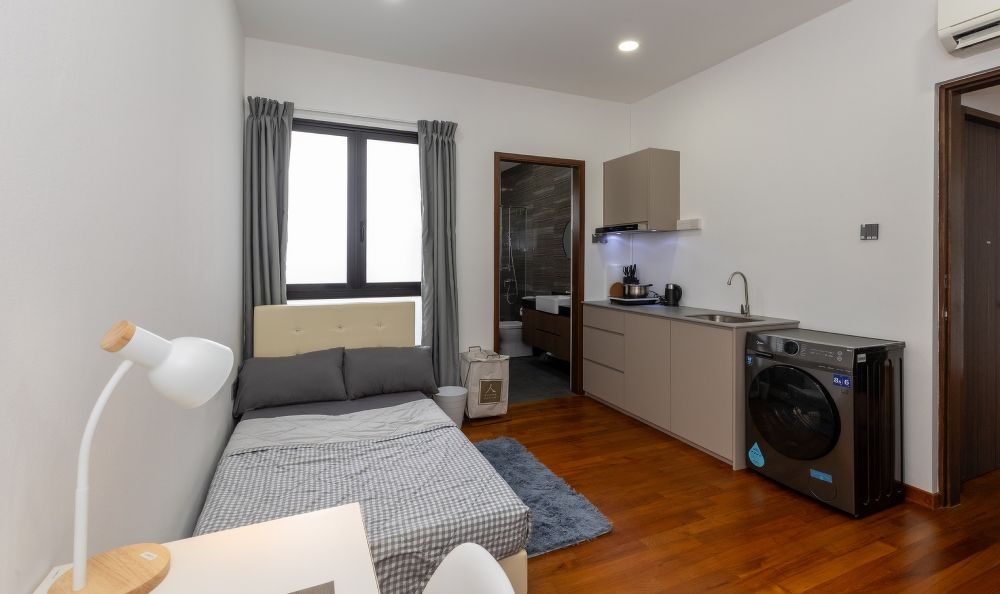
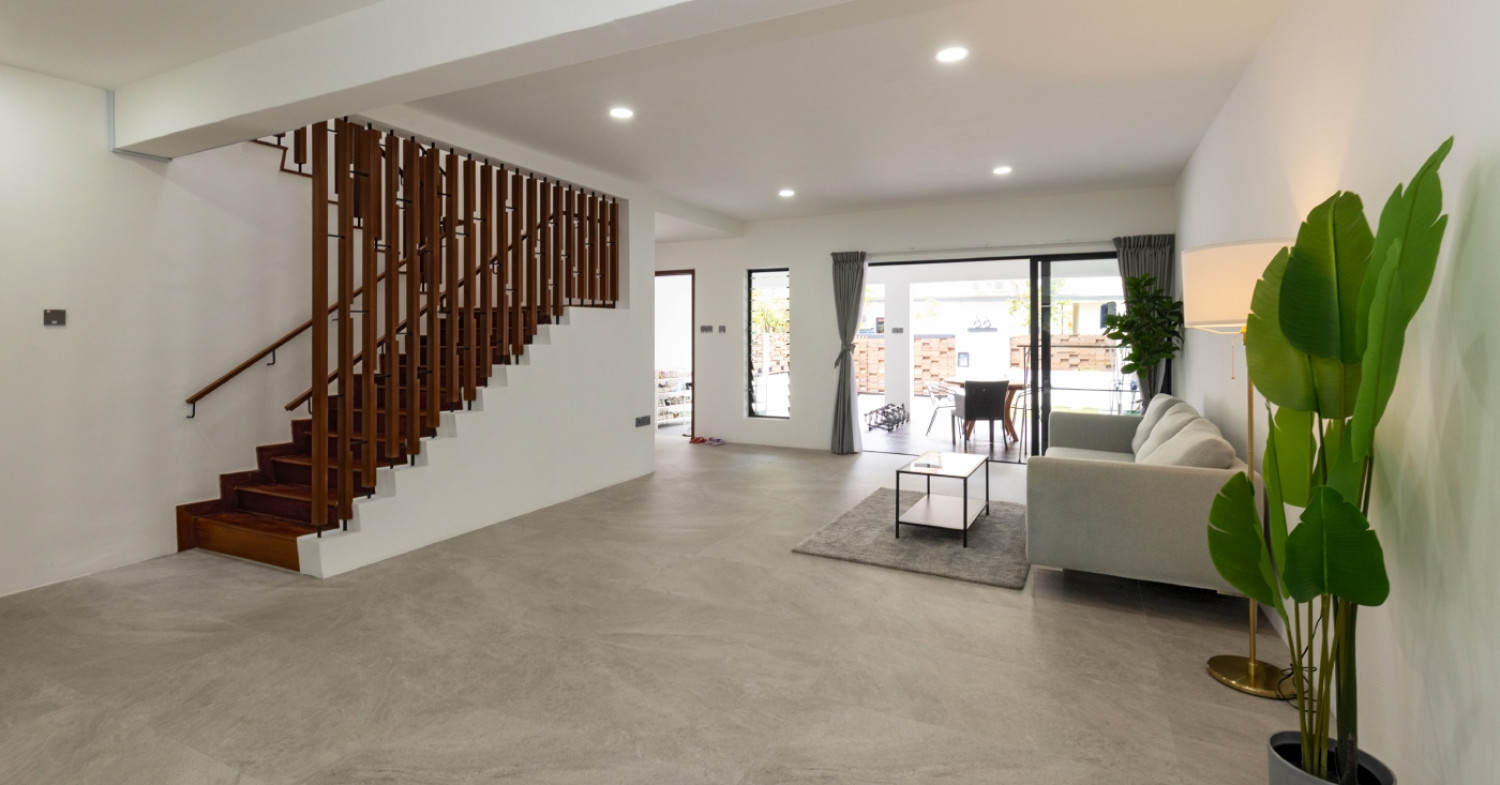
A room in a landed home managed by Bespoke Habitat. The property is situated near Pioneer MRT station and Nanyang Technological University. (Photo: Samuel Isaac Chua/EdgeProp Singapore)
Seasonal demand fluctuations, shared living dynamics and managing expectations from both students and parents are other pressure points. Lim of TAP notes that these are addressed through operational planning and clear communication.
One of the more nuanced aspects lies in navigating familial expectations. Parents back home, sometimes on the other side of the world, need a level of reassurance that goes “well beyond” what a typical landlord would provide, says Coliwoo’s Lim.
Coliwoo does this through transparent communication, clear documentation of management protocols and house rules, and a responsive support team that parents know they can reach when needed.
Noise and communal space etiquette occasionally give rise to friction among residents, especially in mixed-use properties where students live alongside corporate residents and travellers.
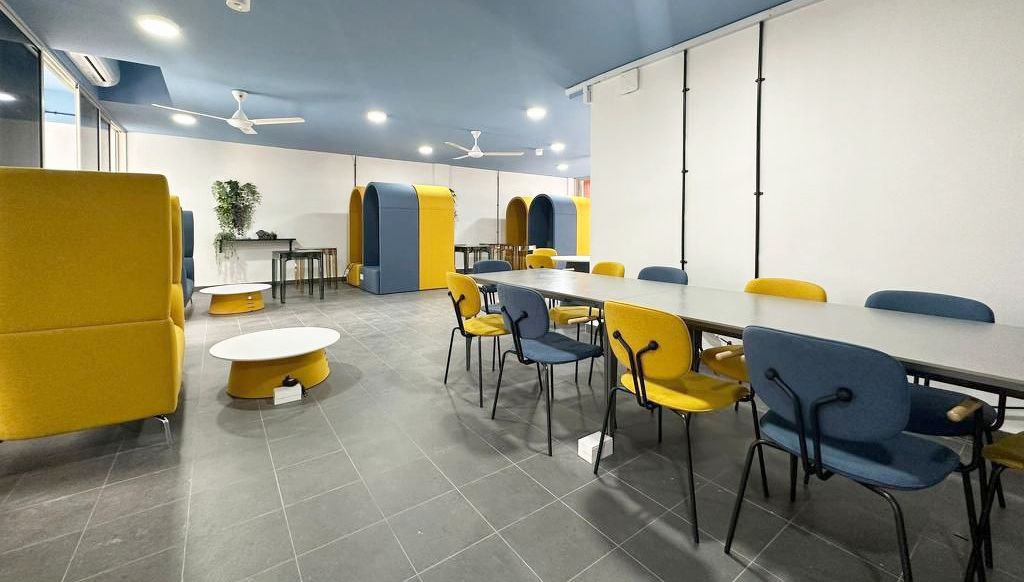
The study lounge at Campus. TAP aims to provide everything a young adult might need: social interaction, health and fitness, convenience and a conducive study environment. (Photo: The Assembly Place)
Other challenges operators face in building out the segment include a higher turnover driven by academic cycles, and cultural differences in living habits. Requests for student-only housing or gender-specific floors can also make room allocation and inventory planning more complicated.
The short-term nature of exchange programmes inherently leads to greater churn as compared to long-stay professionals, placing heavier demands on leasing, housekeeping and inventory management.
“This requires a well-oiled process to ensure units are turned around efficiently and re-occupied without significant vacancy gaps,” says Cove’s Agrawal.
Raising the bar in a maturing segment
The influx of international students shows little sign of slowing. With it, industry players expect both demand and competition among operators to intensify.
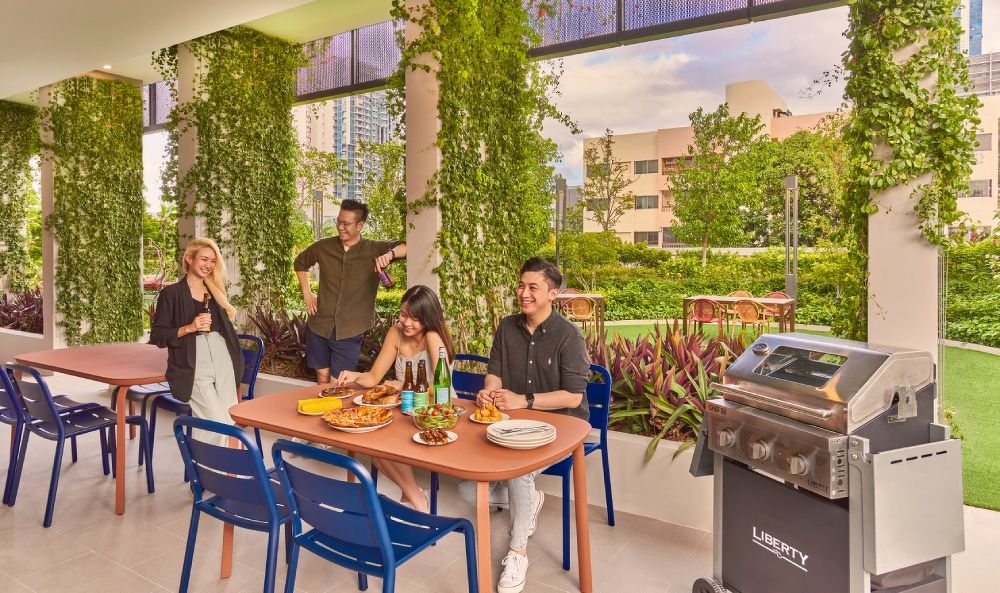
Residents can rent a barbecue pit to host a cook-out with friends (pictured) or whip up a meal at the Bond social kitchen at lyf Farrer Park Singapore. (Photo: The Ascott)
They see Singapore’s reputation as a regional education hub continuing to strengthen, while geopolitical headwinds make traditional study destinations like the US, UK, Canada and Australia less straightforward a choice.
In Coliwoo’s view, the student segment within co-living will mature from what has largely been an opportunistic play for many operators into a deliberate, institutionally recognised asset class.
Investors and developers are increasingly attuned to the recurring demand that these residents represent, and thus more purpose-built or purpose-adapted, student-oriented co-living stock could enter the market, says Lim of Coliwoo.
“More operators taking the segment seriously means better product quality, higher service standards and a wider range of options for those choosing Singapore as their study destination,” he adds.

Situated near schools, Coliwoo Balestier 320 has rooms averaging 15-20 sq m (161-108 sq ft) in size and priced at $2,800 per month. (Photo: Samuel Isaac Chua/EdgeProp Singapore)
Coliwoo will therefore focus on deepening its university partnerships, expanding the portfolio in proximity to key campuses and refining its community programming for students.
Bespoke’s Ong predicts demand will become more segmented and driven by quality, which likewise means operators will have to raise their standards in terms of service, safety and overall experience.
Singapore is starting to see the emergence of PBSA offerings — a format still nascent here but well-established in markets like the UK, Australia and the US.
As these PBSA developments come to market, they will raise the bar across the board. For co-living operators, “the growing institutional interest in student housing validates the segment’s scale and commercial viability, and will push all players to sharpen their product and service offerings”, Cove’s Halim notes.
She thinks the next evolution will be defined by how deeply operators can personalise and co-create the living experience with students. Cove has observed students being increasingly vocal about what they want, from the design of their spaces to the programming in their communities.
"Operators who listen and adapt will build the strongest loyalty and the most compelling product,” Halim shares. "The accommodation itself will become less of a differentiator; the experience wrapped around it will be what sets the best operators apart."
----------
Designed with students in mind
Many co-living firms are making considered design, inventory and operational decisions with this category of residents in mind — from the location of properties and layout of units, to on-site amenities and programming such as culinary workshops, social mixers and fitness activities to foster a sense of belonging.
Several operators have strategically positioned properties near schools and transport nodes.
And at the product level, move-in readiness is a priority: fully furnished rooms with reliable Wi-Fi and dedicated workstations are becoming the standard. In some cases, in-room washer-dryers are provided to address privacy concerns around shared laundry facilities.
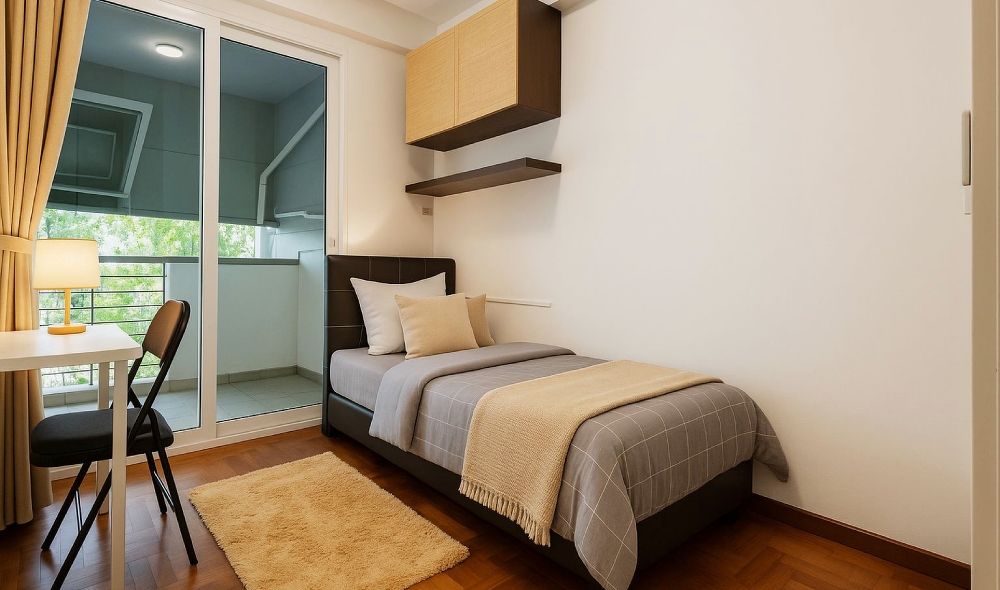
Common rooms are a top pick among budget-conscious students, notes Bespoke Habitat. Last year, students made up 58% of its tenants. (Photo: Bespoke Habitat)
Bespoke Habitat structures a significant portion of its inventory, located in condos and landed homes, around common rooms — the most popular choice among budget-conscious students — while also offering some master bedrooms for those seeking more privacy and space.
Prices vary across operators and room types, generally ranging from a monthly rate of $850 per bed with shared bathrooms at the more affordable end, to around $3,500 for private studios with an en suite bathroom and in-room kitchenette.
Cove calibrates its room tiers to student budgets and lifestyle preferences, and applies longevity discounts for those who commit to longer stays. It offers Basic, Classic and Luxe categories within a typical range of $1,200 to $1,800 per month.
TAP’s Campus uses a modular space system where each self-contained loft pod includes a bed, wardrobe, desk, shelves and luggage space — meant to give students a degree of privacy while keeping them connected to the wider community.
The Campus property also features an outdoor CrossFit gym, running track, basketball court, meeting rooms, study areas, kitchen and dining spaces with vending machines stocked with ready-to-eat meals, as well as a shuttle service to an MRT station.
Coliwoo Midtown's "Wellness in the City" concept offers cold plunge and sauna facilities, the largest gym in the company's portfolio, and a mezzanine co-working space.
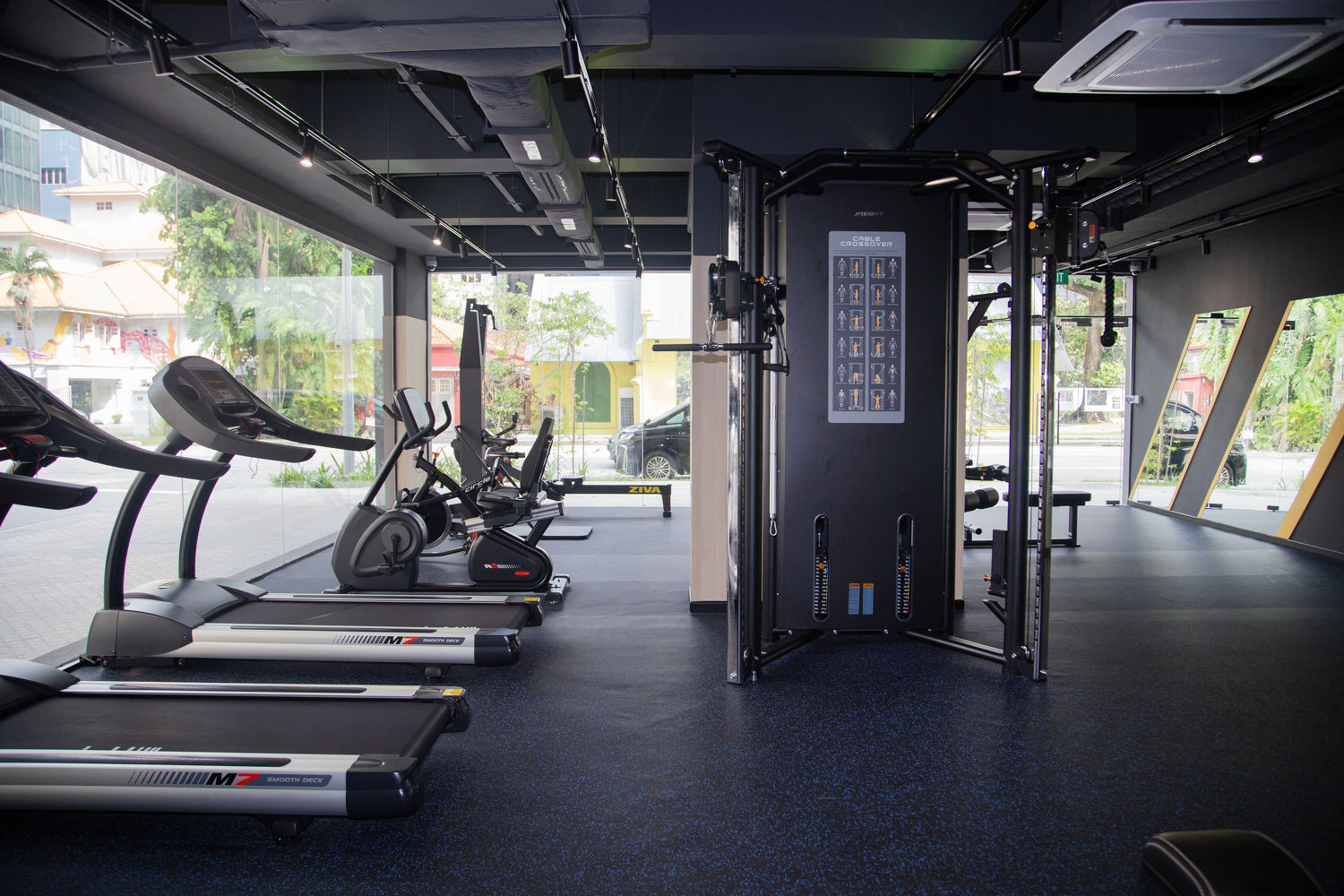
As gym memberships in Singapore can be expensive, having a gym on-site is a strong value proposition for students, says Coliwoo's Kelvin Lim. (Image: Coliwoo)
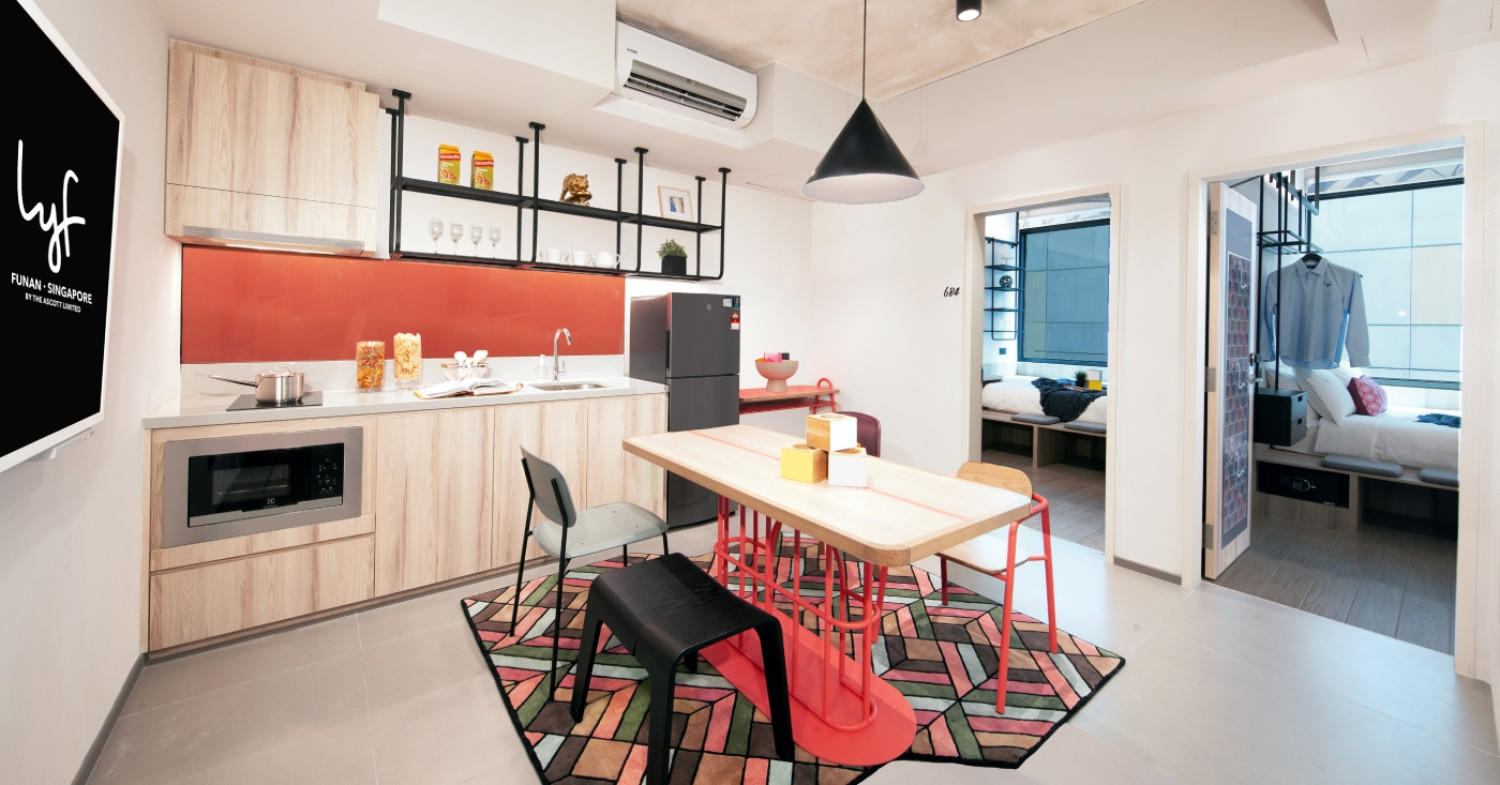
Lyf provides purpose-designed co-working zones, social kitchens and fitness facilities that allow students to move between focused work, exercise and social interaction without leaving the building.
Operators also run curated events — ranging from yoga classes, craft sessions and cultural celebrations to upskilling workshops and innovation talks — to ease the transition into a new country, encourage interaction and build connections.
Engagement tends to be strongest when activities are guest-initiated, going by Ascott’s observations. At lyf one-north, students from Insead and Essec have organised rooftop gatherings that have brought together student residents, other guests and the on-site lyf team.
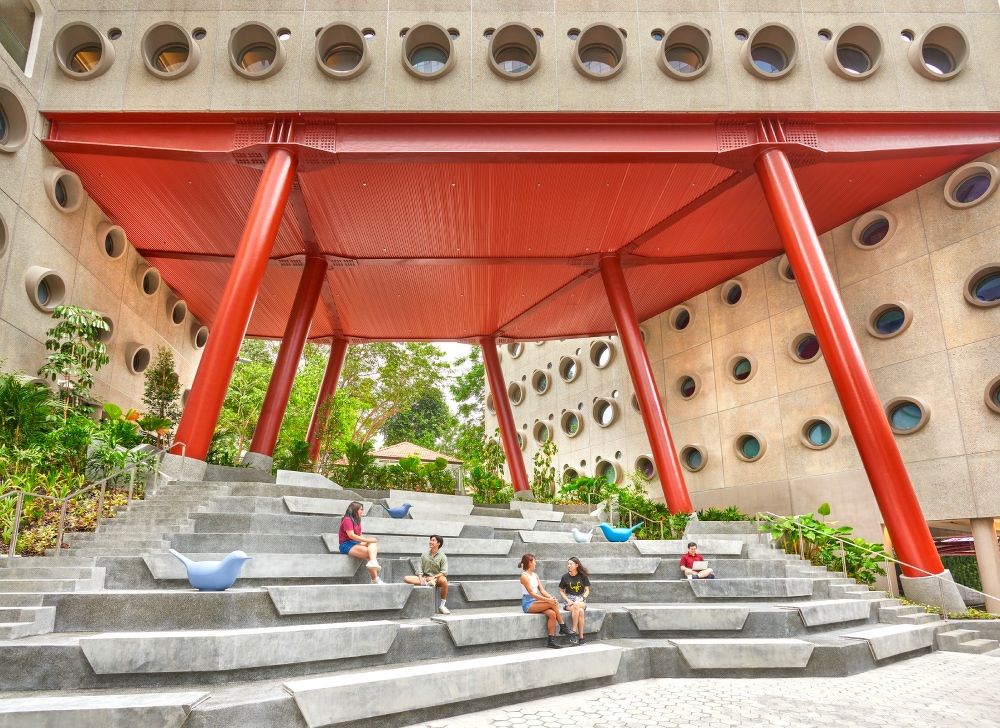
The amphitheatre at lyf one-north Singapore. Engagement tends to be strongest when the activities are guest-initiated, Ascott notes. (Photo: The Ascott)
Convening residents of different ages and backgrounds is often an intentional part of the programming mix.
At Commune on Henderson, Singapore’s first intergenerational co-living development, students mingle with seniors through activities such as low-impact sports, chess, mahjong and cooking. During career-sharing sessions, senior residents talk about their industry experiences which may be relevant to students pursuing the same course of study, TAP notes.
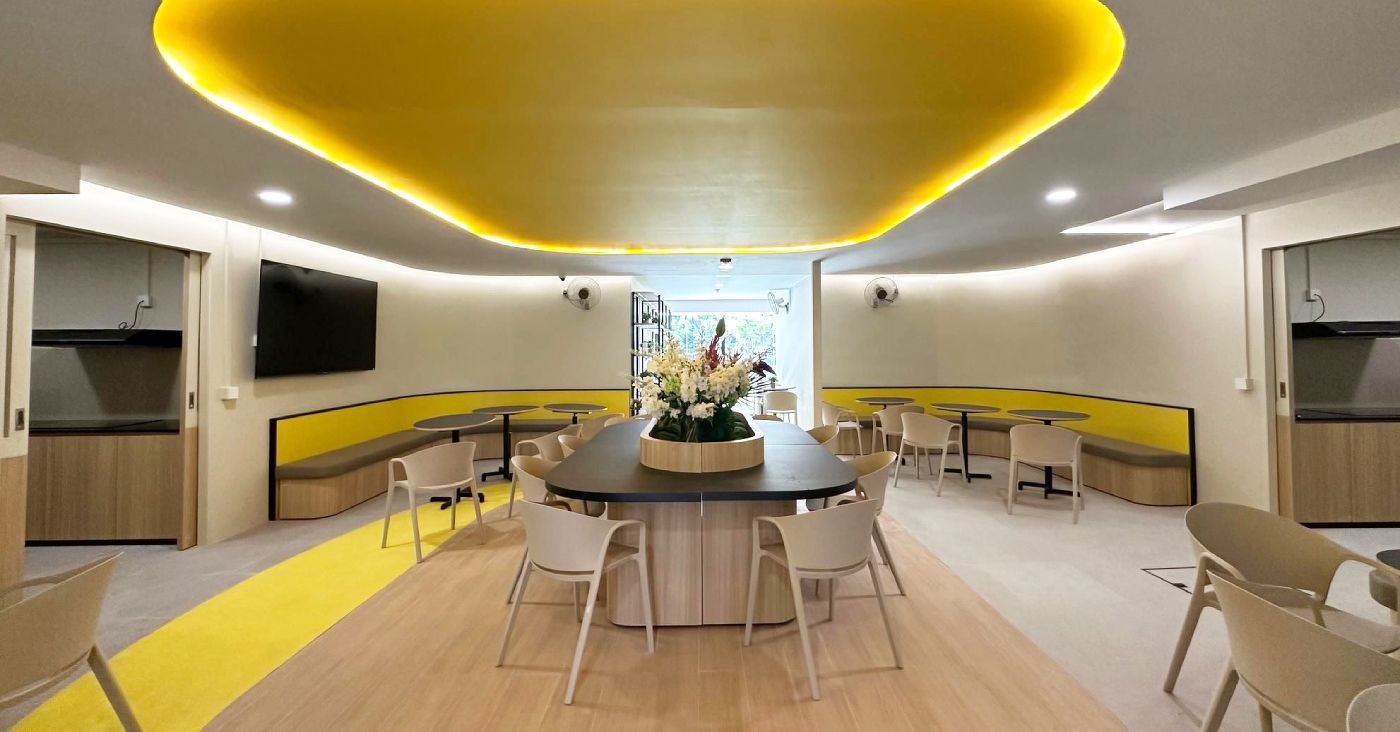
The programming vision at Commune on Henderson is "explicitly intergenerational", bringing together seniors and students, says TAP. (Image: The Assembly Place)
Cove's networking sessions are among their most well-received events, as it gives students the opportunity to connect with professionals living in the same property and gain exposure to career perspectives and industry contacts.
----------
Collaborating with universities
Tie-ups with educational institutions have become an important part of how co-living players attract student members.
These arrangements typically involve accommodation referrals, preferential pricing, and co-branded or co-listed student housing pages. The specifics and extent of formalisation varies by organisation.

To facilitate flexible accommodation for students, Ascott works with educational institutions and student-related bodies. (Photo: The Ascott)
TAP has inked MOUs with 14 institutions, including James Cook University (JCU) and the Singapore University of Technology and Design, with partner universities listing Campus on their websites as an accommodation option.
Bespoke Habitat partners with NUS, NTU, JCU, and London School of Business and Finance, positioning itself as a trusted alternative accommodation option.
Cove works closely with a number of institutions including Essec, JCU, Singapore Institute of Management, and Curtin Singapore, providing dedicated online landing pages and booking pathways, as well as preferential rates for referred students.
Ascott’s lyf maintains more informal arrangements with educational institutions and student-related bodies, offering direct booking options via promotional codes, particularly for stays that do not meet traditional monthly lease requirements.
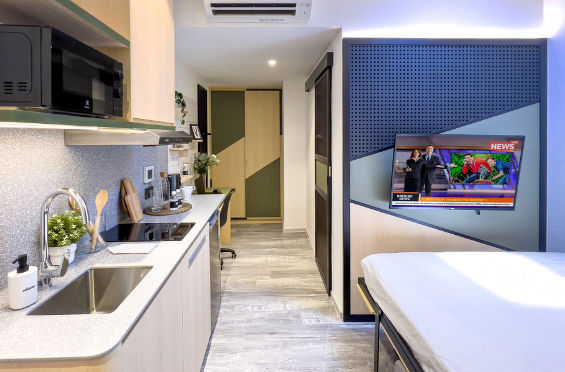
The Standard Murphy Queen studio at Coliwoo Balestier 320, featuring a kitchenette, fridge, washer-dryer, ensuite bathroom, workstation and housekeeping services. (Image: Coliwoo)
For more news and analysis, read our weekly e-paper. Prefer a print copy? Get it delivered to your home every Monday.
Follow Us
Property updates, 24/7.


Subscribe to Newsletter
Market insights, delivered weekly.



Top Articles
Search