
Singapore ranks as Apac’s most expensive flexible office market: Savills
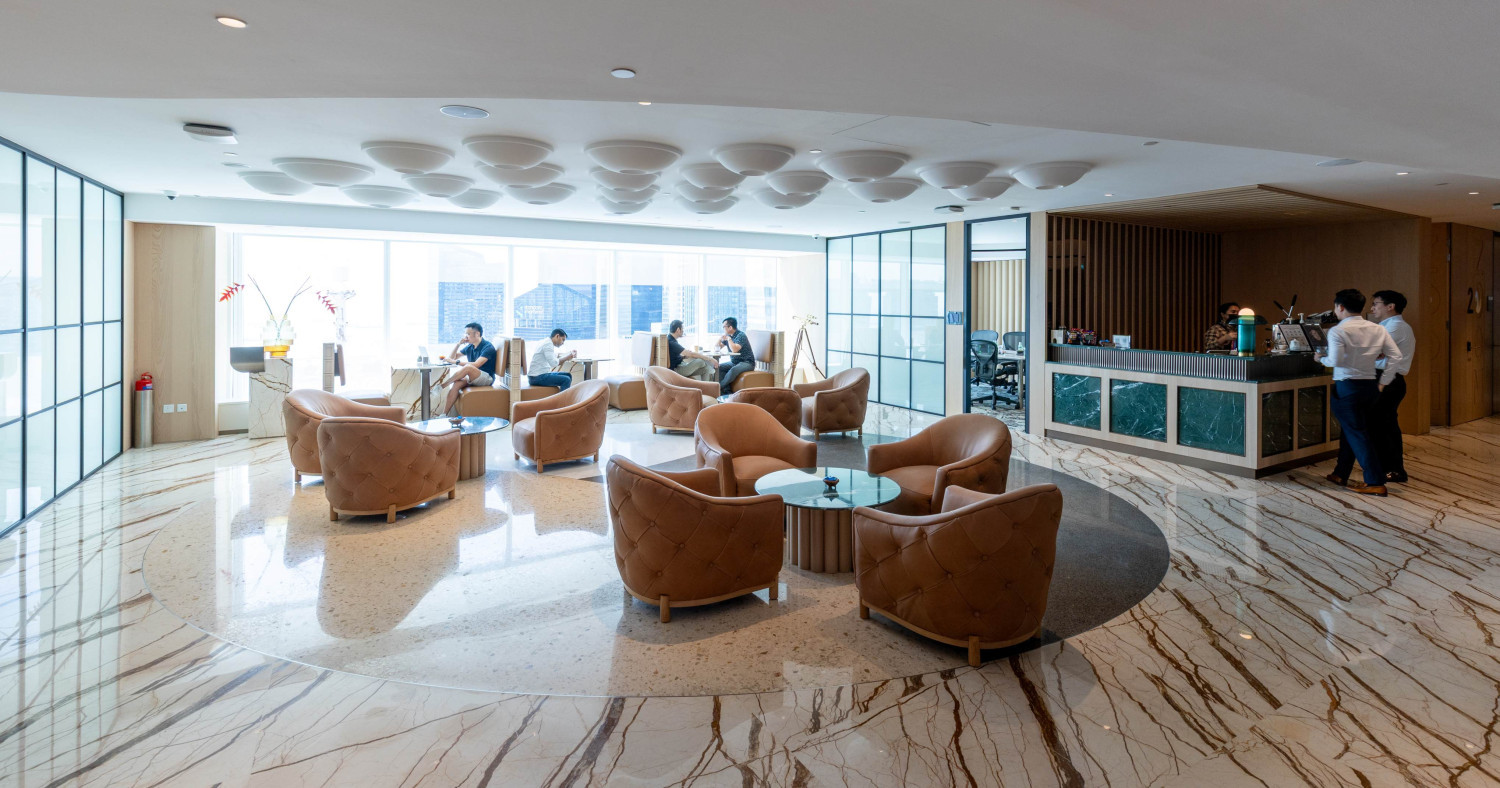
A workspace by flexible workspace provider The Executive Centre at Singapore Land Tower (Picture: Samuel Isaac Chua/EdgeProp Singapore)
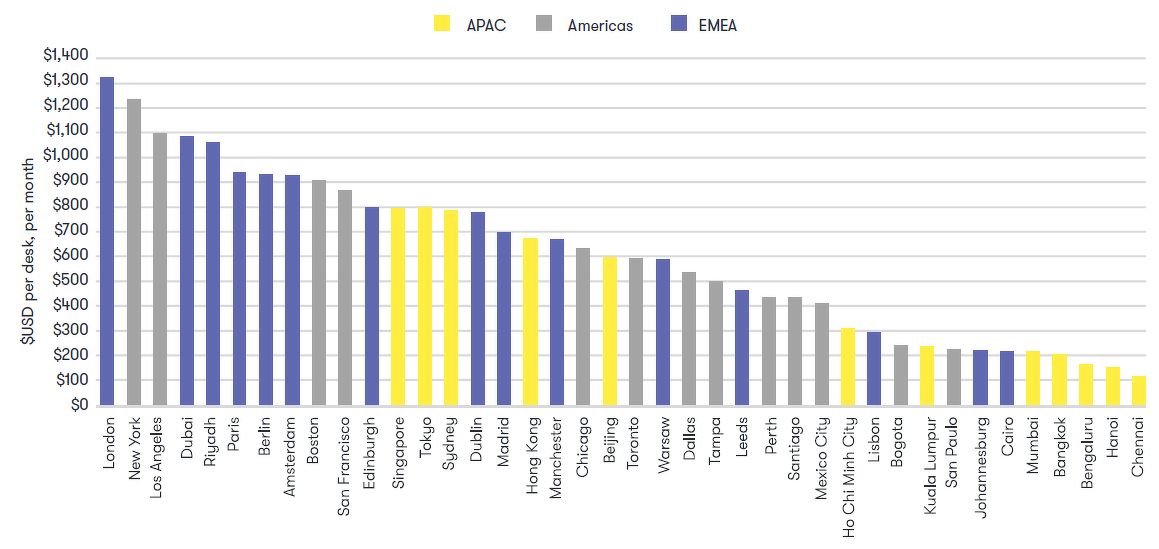
Singapore is the most expensive market for flexible office space in Asia Pacific (Apac), according to research by Workthere, Savills’ flexible office specialist. In Workthere Flexmark 5.0, the latest edition of Workthere’s flagship research report, Singapore emerged as the most premium flex office market in Apac, with prime desk rates averaging around US$800 ($1,037) per month.
Workthere Flexmark 5.0 summarises findings from a survey of 149 flexible office providers and Savills professionals conducted from June to August of this year.
Globally, Singapore ranked 12th for flex office pricing. The most expensive flex office spaces in the world are in London, where prime desk rates average US$1,320 psf per month, followed by New York (US$1,240) and Los Angeles (US$1,100). Dubai and Riyadh rounded out the top five, with prime flexible office desks costing a monthly average of US$1,089 and US$1,066, respectively.
Global flex office pricing: avergae prime desk rates
Piers Malitte, head of Workthere Asia Pacific at Savills, attributes Singapore’s top position in Apac to resilient demand underpinned by its role as a regional headquarters hub, as well as the availability of centrally located flex office spaces with high-quality fitouts.
Tokyo and Sydney ranked as the second and third most expensive flex workspace markets in Apac, with average prime desk rates just under US$800 per month. Hong Kong and Beijing are also among the prime markets in the region, with monthly desk rates of roughly US$700 and US$600.
On the other end of the spectrum, several Asian cities stood out as emerging markets with more affordable flex office solutions. These include Ho Chi Minh City (US$315), Kuala Lumpur (US$242) and Bangkok (US$200).
Stable demand, rising attendance
According to Workthere’s report, global occupancy of flexible workspaces averaged at 81% for private offices and 65% for shared coworking spaces in 2025. This reflects some moderation from peak occupancy levels in 2022, when demand was bolstered by firms seeking short-term, low-risk office solutions in the immediate post-pandemic period.
Still, Workthere anticipates stable demand to support occupancy rates going into 2026, backed by companies seeking flexibility amid uncertain economic conditions. In addition, the firm’s research found that flexible office attendance, measured by the number of days per week members spend in the space, has increased by 20% since 2022, driven by return-to-office mandates.
This trend is particularly prevalent in Apac, where flexible workspace operators reported members spending an average of 4.13 days per week in attendance, the highest compared to other regions.
In terms of user profile, global corporates make up the biggest portion of flex office space occupiers in Apac, at 41%. According to Workthere’s report, MNCs favour flex offices in Apac as it allows them to establish a footprint in the city quickly without having to commit to long-term leases.
Start-ups and small and medium-sized enterprises are the second-biggest occupiers of flex workspaces in Apac, at 25%. Other occupiers include scale-ups, or companies that have grown past the start-up phase, at 16%, and national corporates at 15%.
High demand for meeting rooms, phone booths
As flexible offices compete for members, amenities are emerging as a differentiating factor, Workthere’s report states. “As the member profile of flex offices has diversified, the range of solutions from both specialist operators and landlords has expanded, from fully serviced and managed offices to pass-based platforms, with the range of features available growing accordingly too,” comments Sarah Brook, associate director for Savills World Research.
The 12 most in-demand flex office features overall globally
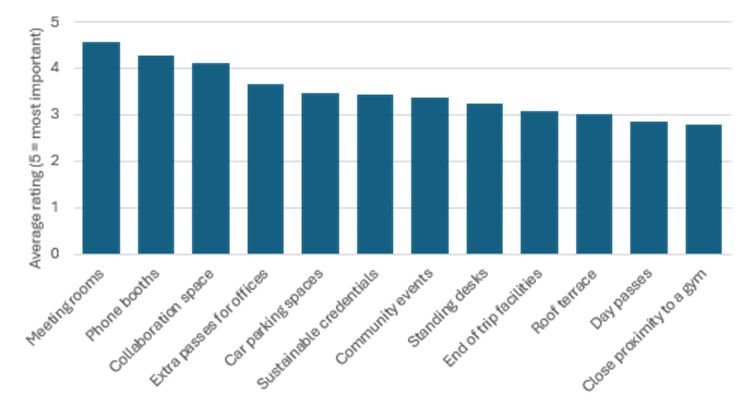
In its survey, Workthere polled respondents for must-have features in flexible offices and found that collaboration space and meeting rooms rank among the most important amenities among users, supporting hybrid work and team-based activity. Phone booths are also highly valued, along with guest passes to the workspace.
Nonetheless, preferences also differ across regions. For example, respondents in North America ranked car parking and on-site gyms among the top features they look for in flex office space. In Apac and Europe, sustainability credentials are highly rated, with the majority of occupiers in these regions deeming such credentials as important.
Expansion plans
Looking ahead, 85% of operators surveyed globally by Workthere indicate plans to expand their footprint in the next year, which reflects the sector’s continued strong performance. However, how providers are choosing to grow is evolving across regions.
In Asia, lease-based expansion remains a preferred strategy, with 56% of operators surveyed using this method. Workthere attributes this to operators responding to surging demand from multinationals seeking to expand global capability centres, particularly in India, Vietnam and Malaysia. “Leases enable operators to move quickly to secure high-quality, well-located space, critical for capturing demand and establishing brand presence ahead of competitors,” the report adds.
In contrast, European flex office providers are increasingly moving towards management agreements to expand. Under this arrangement, landlords engage flex office operators to operate a workspace, typically with a revenue-sharing structure. “This approach allows providers to scale rapidly with minimal capital outlay, although it often means ceding greater control to landlords over space design and fit out,” Workthere adds. According to its survey, European providers that are using management agreements to scale up have risen from 45% in 2023 to 63% in 2025.
Workthere believes that the adoption of management agreements will continue to grow globally, underpinned by both landlords and flexible office providers seeking greater flexibility against a backdrop of global economic uncertainty.
Other trends it projects for the flexible office sector include a flight to quality, driven by an increased focus on high-quality design and lifestyle-centric offerings. “Providers that deliver premium, well-designed spaces are better able to attract and retain members, particularly employers seeking to entice talent back to office-based settings," the report adds.
Follow Us
Property updates, 24/7.


Subscribe to Newsletter
Market insights, delivered weekly.
Top Articles
Search