
Singapore real estate giants feel the heat as China's property woes continue
Kolette Lim
/ South China Morning Post (SCMP)
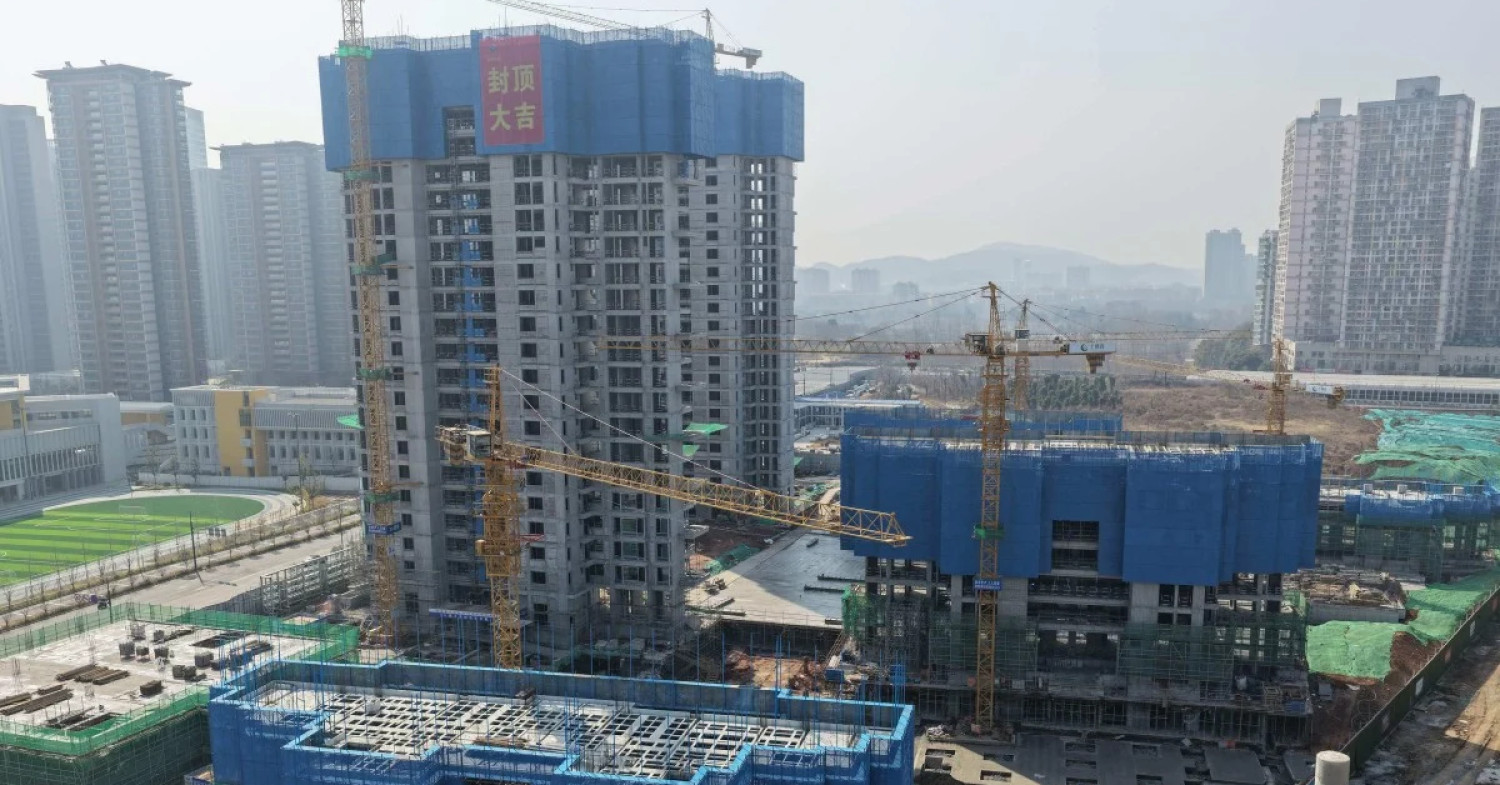
Buildings under construction in Nanjing, in China’s Jiangsu province, in February. (Photo: AFP)
Singapore’s real estate giants are taking hits as China’s property downturn drags into another year, with declining rents, emptier buildings and falling values weighing on their results.
But analysts say Beijing’s huge market and recent policy support mean most investors are unlikely to pull back entirely, instead becoming far more selective about where they invest.
Recent earnings from several Singapore firms show the pressure building across their China portfolios, even as investors watch for signs the country’s prolonged property downturn may be nearing a turning point.
Advertisement
Advertisement
Firms from the city state have been investing in China’s property market since the world’s second-largest economy opened its doors to global capital in the 1970s, and have since become one of the biggest groups of asset buyers.
Property investments from Singaporean investors reached 34.65 billion yuan in 2018, making the city state the largest asset buyer in China’s property market, according to data by real estate agency Cushman & Wakefield.
But China’s property sector has been in a slump since the central government imposed lending caps – known as the “three red lines” policy – in 2020 to curb developers’ leverage and rein in a housing boom.
Falling sales and prices have dragged down many Chinese developers. China Evergrande Group, once the country’s largest, was ordered to liquidate in 2024, while China Vanke – formerly hailed as one of the more financially resilient names – has found itself under crushing debt.
Singaporean firms are also feeling the heat.
CapitaLand Investment, one of the largest property groups in the city state, last month reported a net loss of S$142 million (US$111 million) for the six months ending December last year, from a S$148 million profit in the same period in 2024.
Revaluation losses, which increased by 68.2 per cent to S$439 million last year, were driven by higher deficits from its Chinese portfolio.
Advertisement
Advertisement
CLI’s China assets were written down about S$545 million in the past financial year – the largest in four years – with offices and business parks hit the hardest, said the group’s chief financial officer, Paul Tham.
Tham said it was difficult to predict if the devaluation would continue.
“As we continue to expect negative reversions and as occupancy is still weak for some of the asset classes, we think there could be some movement, up or down, over the next 12 months,” he said.
City Developments Limited (CDL), Singapore’s biggest listed developer, said in its financial report released last week that its overall profit margin last year was affected by allowance for foreseeable losses, largely by properties in China.
CDL recorded a committed occupancy of 27.6 per cent for its China office portfolio last year, down from 58.6 per cent a year before, and noted that Beijing’s office rental market “continues to remain challenging”.
Mapletree Logistics Trust, which has 42 properties in its China portfolio as of the end of 2025, recorded negative rental reversion in the Chinese market in the three months ending December 2025.
The company noted that lower contributions from its Chinese portfolio contributed to a dip in gross revenue to S$531.7 million in the nine months ending 2025, from S$547.4 million in the same period the previous year.
Advertisement
Advertisement
Analysts said recent moves by Beijing could help investors recoup their losses in terms of shoring up confidence of homebuyers and tenants.
However, they warned that sales and investments could remain weak in the near term as benefits of the easing and other policy changes would take time to trickle down to Singaporean firms and the broader property market.
Chinese media reported in January that authorities had effectively done away with the “three red lines” borrowing limits, though developers and analysts said the rules had already been eased in practice.
Alan Cheong, head of research and consultancy at Savills Singapore, said while investors might be more willing to increase exposure in the China market with a “major source of downward pressure” removed, clearer signs of stabilisation might take several months to emerge.
Christine Li, Knight Frank’s Asia-Pacific head of research, said Singaporean owners and investors with exposure to properties in tier one and stronger tier two cities in China were more likely to reap the benefits from cap rate stabilisation and increased confidence from tenants.
“Lower-tier markets with high inventory may see less immediate relief because the constraint there is often demand and inventory, not just developer leverage,” she added.
Beijing in December updated its eligibility list for C-Reit programmes to add commercial properties such as shopping centres, hotels and office buildings, a move that “offers some semblance of positivity”, said Pamela Ambler, head of investor intelligence at JLL in Asia-Pacific.
She said while the expansion provided improved exit channels for property owners to monetise and boost liquidity, a quick market turnaround should not be expected as interventions require time to restore meaningful confidence and capital flow.
Despite the bleak short-term outlook, analysts said investors and firms were still likely to bet on China’s massive market while adopting a cautious and selective approach.
China’s market will remain attractive over a longer horizon, according to Li, citing structural demand from urbanisation and city expansion as Beijing draws up its 15th five-year plan.
“This is a core reason why global and regional capital, including Singaporean firms, continue to watch and position selectively rather than exit entirely,” she said.
Promoting the high-quality development of the property sector is among proposals in the draft outline of the plan for 2026 to 2030.
A government work report to China’s parliament on Thursday said the central government would use city-specific policies to “control new supply and reduce inventory”, and policymakers would explore ways to revitalise existing housing stock.
Ada Choi, CBRE’s head of research for Asia-Pacific, noted that Singaporean firms would continue to benefit from their credibility.
“Homebuyers nowadays put much higher emphasis on the credibility of developers. In this aspect, Singaporean and Hong Kong developers are benefiting,” she said, noting that firms with good assets in core locations still maintained high occupancy and achieved stable rental income.
Given the current outlook, Choi said it was “not viable” for major landlords to make divestment decisions, “particularly for assets located in prime areas”.
But the performance of China assets hinges on a lot more than developments in the property sector, observers say.
CLI’s group chief operating officer Andrew Lim said during the group’s results briefing last month that external circumstances such as geopolitics and consumer sentiment could pose complications.
“For China, it’s not just about the relaxation of credit or other policies surrounding real estate. Further complications arise from tensions on the trade and tech frontiers, and this goes beyond pure economic forecasting and the dynamics of supply versus demand for the various sectors of the market,” said Cheong of Savills Singapore.
“Investors are still keen on the Chinese market, but I believe they can afford to wait until it turns rather than try to pre-empt it.”
For more news and analysis, read our weekly e-paper. Prefer a print copy? Get it delivered to your home every Monday.
https://www.edgeprop.sg/property-news/singapore-real-estate-giants-feel-heat-chinas-property-woes-continue
Follow Us
Property updates, 24/7.


Subscribe to Newsletter
Market insights, delivered weekly.

Advertisement
Advertisement
Advertisement
Top Articles
Search