
Singapore ranks second globally for real estate resilience: WiredScore

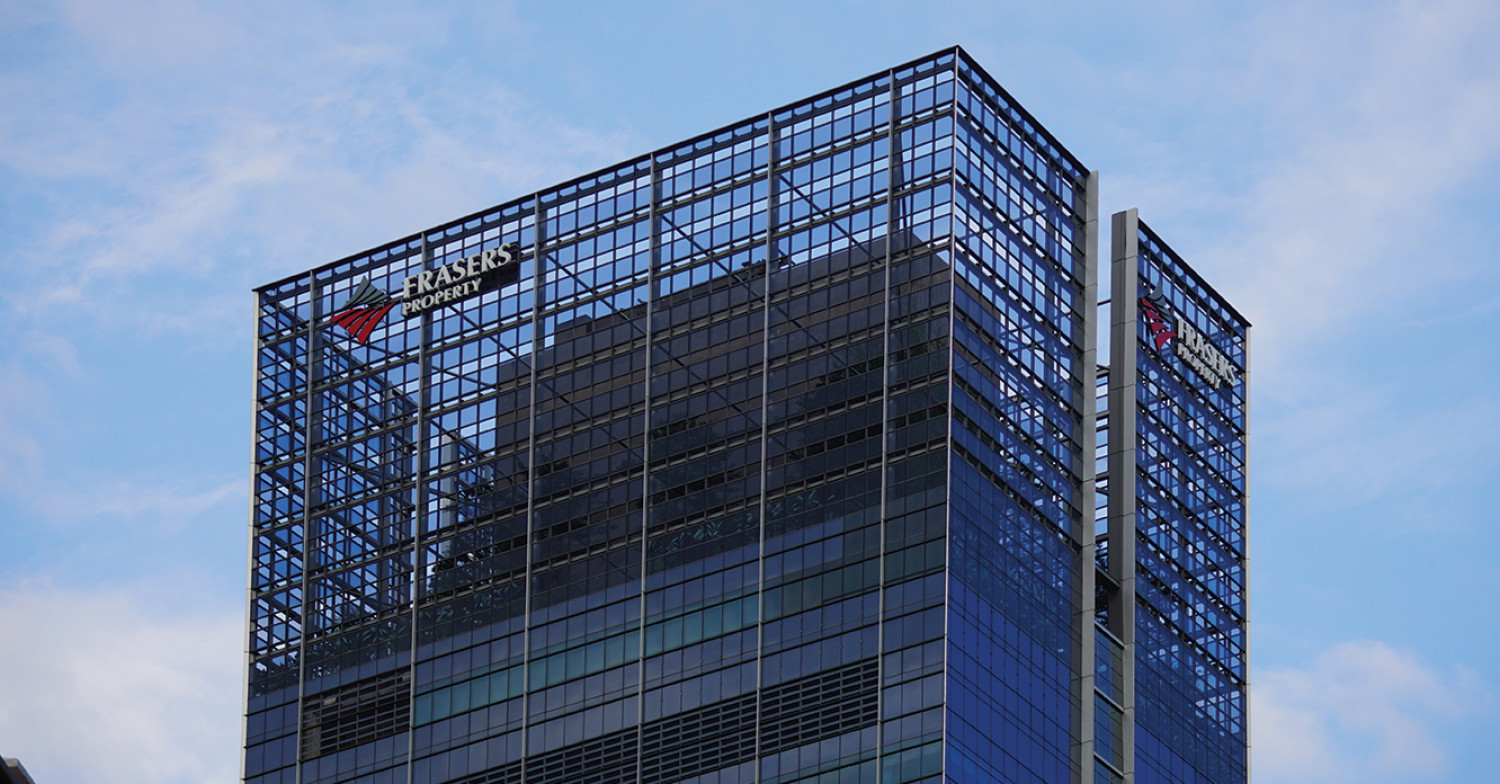
IOI Central Boulevard Towers and Frasers Tower (pictured) are widely regarded as global benchmarks for digital resilience (Photo: Shutterstock)
Singapore has been ranked the world’s second most resilient city for real estate, behind Chicago and ahead of Dubai, Madrid, Hong Kong and Bangkok, according to a new global index.
The Global Cities Resilience Index by WiredScore draws on certification data from more than 1,650 buildings worldwide to assess the performance of buildings across three pillars of resilience: digital, cyber and physical.
This comes as buildings are being tested by climate disruption, rising digital dependence and escalating cyber risk, said WiredScore, which assesses and certifies digital connectivity and smart technology in the built environment.
Its report showed that Singapore outperformed peers by embedding resilient digital infrastructure into buildings from the outset. That has enabled buildings in the city-state to deliver strong indoor mobile coverage, diverse Internet provision and more advanced cybersecurity controls at the asset level, compared to other countries.
WiredScore also highlighted IOI Central Boulevard Towers and Frasers Tower, which are widely regarded as global benchmarks for digital resilience because they were designed and operate around the assumption that connectivity, power and cybersecurity are mission-critical systems.
“These assets exemplify how Singapore’s real estate sector is setting a precedent for resilient, future-ready buildings in order to attract global, blue-chip tenants,” said Tommy Crowley, vice-president for Asia Pacific at WiredScore.
The research found that in Singapore’s buildings, robust cybersecurity policies are implemented consistently, supported by regular site-level assessments such as system verification, network traffic monitoring, active vulnerability testing, ongoing risk assessments and continuous staff training.
Sophisticated asset owners across Singapore’s real estate market have recognised that resilience is not just about backup power or physical robustness, but also about secure, adaptable digital foundations that keep buildings operational under pressure and protect occupiers from growing cyber risk, Crowley noted. The Republic’s ranking in the index is reinforced by an active, coordinated approach to digital infrastructure and cybersecurity.
At the top of the index, Chicago, Singapore, Dubai and Madrid emerge as the most resilient cities, combining strong physical foundations with robust digital and cyber performance. The geographic spread of these locations shows that top-tier resilience is driven by deliberate design, and investment and operational discipline rather than geography or policy, WiredScore noted.
The data points to a clear shift in momentum. Asia Pacific and the Middle East are setting the global benchmark for digital and cyber resilience, with cities such as Singapore, Hong Kong, Dubai, Bangkok and Abu Dhabi ranking in the top 10 for both pillars. In these markets, where building stock is often newer, digital infrastructure is treated as a core utility.
Regional insights
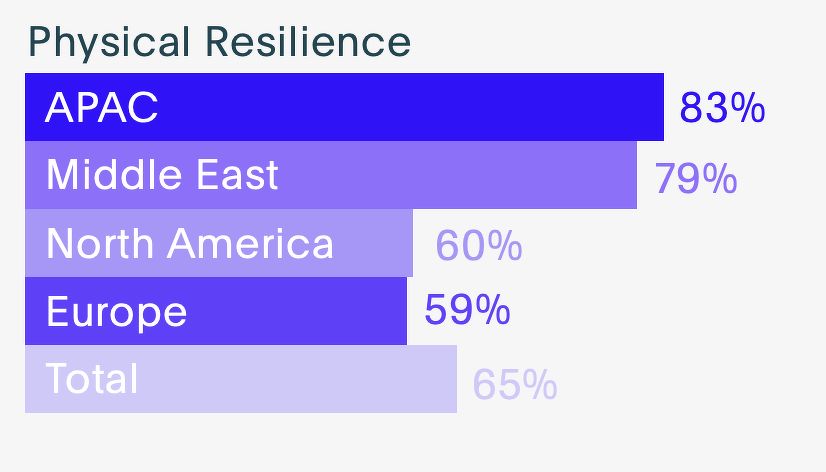
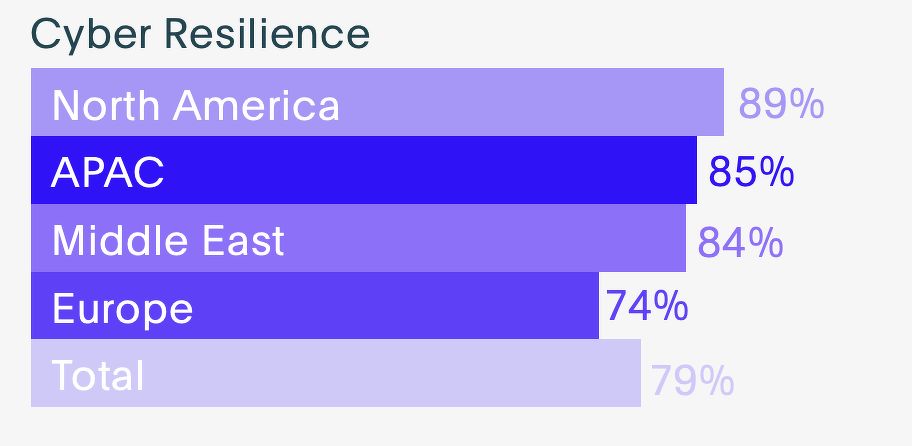
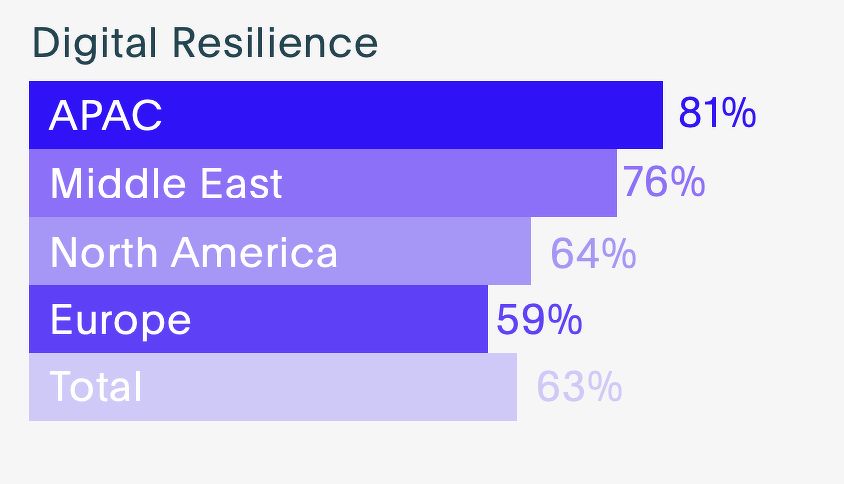
Charts: Global Cities Resilience Index, WiredScore
The report warns that as buildings become smarter and better connected, they are also becoming more exposed. Building management systems, access controls, CCTV and other operational technologies are increasingly targeted by cyber attackers. Real-world consequences range from prolonged shutdowns to tenant loss and asset devaluation.
Global cybercrime is forecast to cost the world US$23 trillion ($29.29 trillion) by 2027. WiredScore’s research shows that many buildings still lag in translating cybersecurity policies into operational practice. About 75% of organisations are operating building management systems with known vulnerabilities.
Moreover, with most occupiers expecting AI to be embedded in their daily workflows over the next few years, buildings will need to have the infrastructure capable of supporting continuous, data-intensive operations. However, due to building-level constraints, just 5% of occupiers have been able to successfully deploy AI at scale.
The built environment is no longer just about concrete and steel — it is a digital ecosystem, and a building’s value will be intrinsically linked to its ability to stay online during a crisis, said William Newton, CEO of WiredScore.
He added that the dominance of cities like Singapore and Dubai in the index reflects deliberate efforts to future-proof real estate, which landlords and developers in other regions will need to emulate to remain competitive.
For more news and analysis, read our weekly e-paper. Prefer a print copy? Get it delivered to your home every Monday.
Follow Us
Property updates, 24/7.


Subscribe to Newsletter
Market insights, delivered weekly.
Related Articles
Top Articles
Search