
Designed and built to last: Heart and integrity with LFA Studio's Renee Lim, Oliver Goh

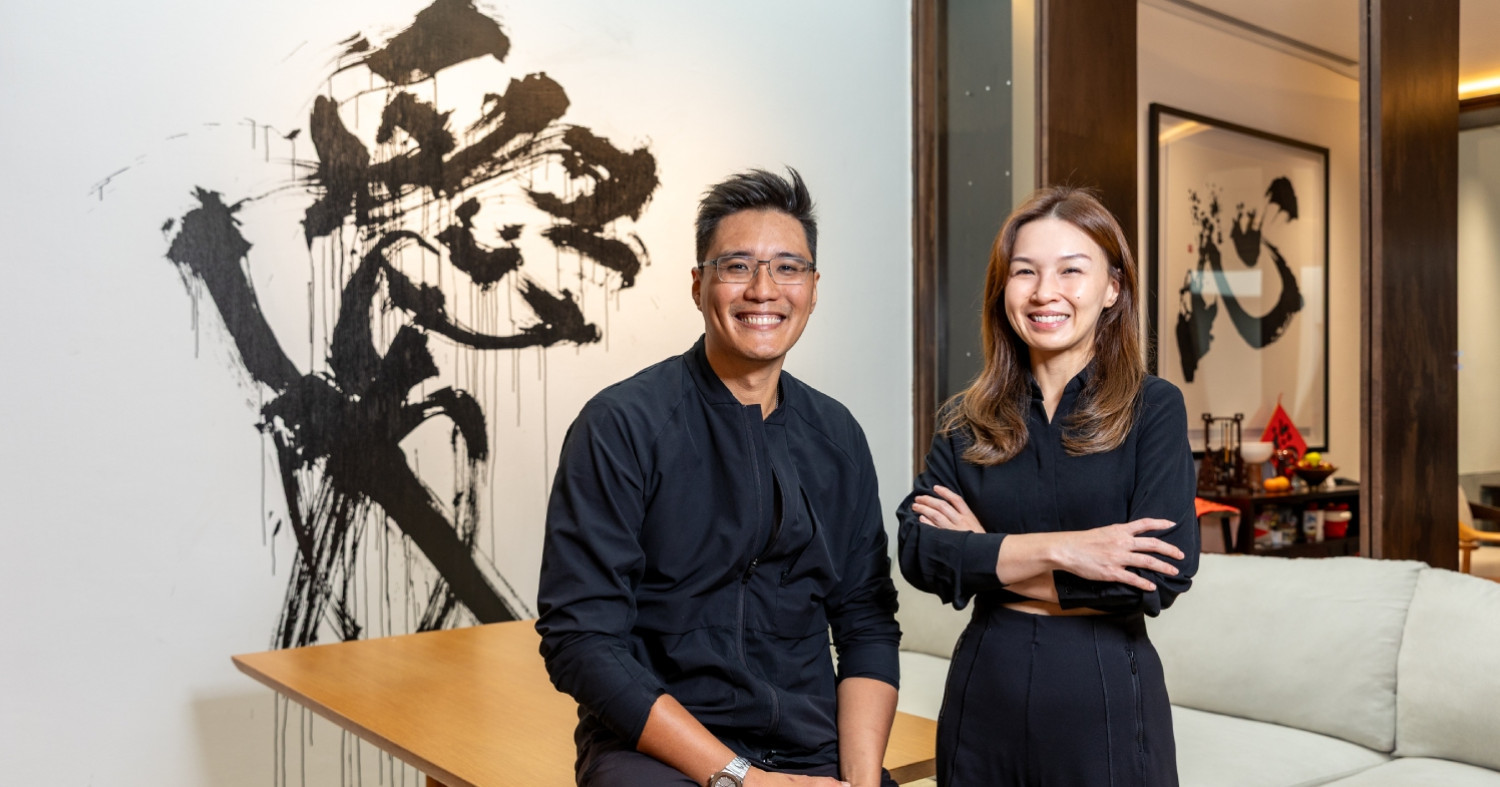
Oliver and Renee of LFA Studio hope to help their teams flourish while creating something enduring for clients and partners. (Photo: Samuel Isaac Chua / EdgeProp Singapore)


On paper, Renee Lim and Oliver Goh make an unlikely pairing. She is composed and deliberate, with a knack for defusing heated situations with calm decisiveness. He leads with heart and an easy warmth, passionate and quick to connect.
Spend a little time with the two business partners, though, and the balance becomes clear. Their dynamic is like yin and yang, as Goh puts it.
This rhythm has guided LFA Studio since they started the commercial interior design and build firm with fellow co-founder Jeffrey Lee. It also extends across LFA’s sister companies — build specialist Ngee Koon, set up by Goh, and Lemonfridge Studio, the residential interior design firm Lim co-founded earlier in her career.
While their temperaments differ, their instincts and goals converge. Both Lim and Goh are candid, grounded leaders who care deeply about their people and about building a business that grows without losing its sense of purpose.
Across LFA’s commercial design work, Ngee Koon’s build arm, and Lemonfridge’s residential practice, sustainable materials are treated as a baseline for all projects instead of a premium option. Safety decisions take precedence even when margins are squeezed, and long-standing supplier relationships may be mobilised to support resource-strapped clients.
They also encourage employees to chart their own paths and carve new ventures of their own, with the company’s backing.
“I want our people to shine brighter than me,” Lim says. She half-jokes about a future where she can ease into a slower pace — perhaps, relaxing on a beach, martini in hand, watching from afar as the team takes centre stage.
“If our people are shining bright, that means the business is successful,” she adds.
For Goh, the motivation is rooted in something more personal. “Success started as simply putting food on our table,” he says. “But over time you realise you’re responsible for many tables, not just your own, and that pushes you to keep doing better.”
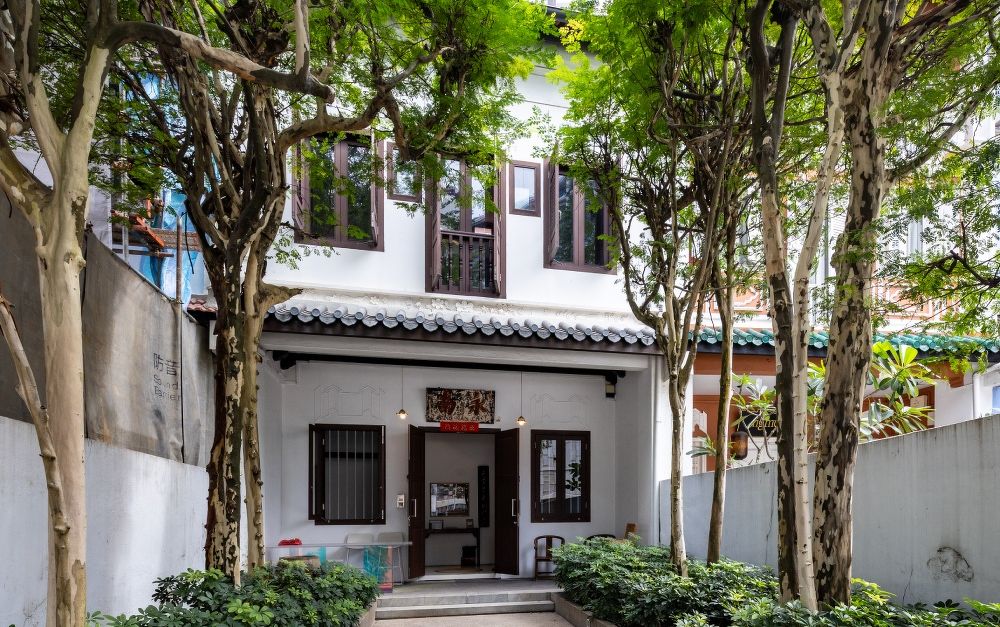
The conservation shophouse at 153 Neil Road, where LFA Studio and Ngee Koon are based. (Photo: Samuel Isaac Chua / EdgeProp Singapore)
Building room for others
Their ambitions have never been limited to designing and building spaces. They are focused, too, on growing a company that can carry more people forward with them.
Lim speaks of the possibilities that scaling LFA’s business will unlock for the team. As the firm grows, new roles open up and people have clearer pathways to step into their next stage.
“Expansion is the only way to give our people more opportunities and the space to grow with us, so they can have the time and resources to do what they want,” she says.
Goh frames it more viscerally: he wants the people around them to feel the sense of security that he once lacked in his childhood, when financial hardship and instability had been a constant. His goal is for employees to progress in their careers and be able to better provide for their families.
“If they can eventually own their home, and upgrade from a two-room flat to a three-room flat, then a condo or landed property, that will make us very happy,” he says. “We want them to do well, have stability at home, for their families to be fine, and go on family vacations.”
Going the extra mile
This sense of responsibility carries into how projects are run: the standards they set and the way they respond when issues surface. It is a sincerity that clients and partners can sense.
The headquarters for LFA and Ngee Koon sits in a conservation shophouse at 153 Neil Road. Two large Chinese calligraphy pieces hang near the entrance, featuring the characters for “heart” and “love” — a visual reminder of the ethos that guides their work.
The office also reflects their resourcefulness and commitment to supporting local makers, with most of the furniture either sourced secondhand and painstakingly restored or purchased from artisans in Singapore.
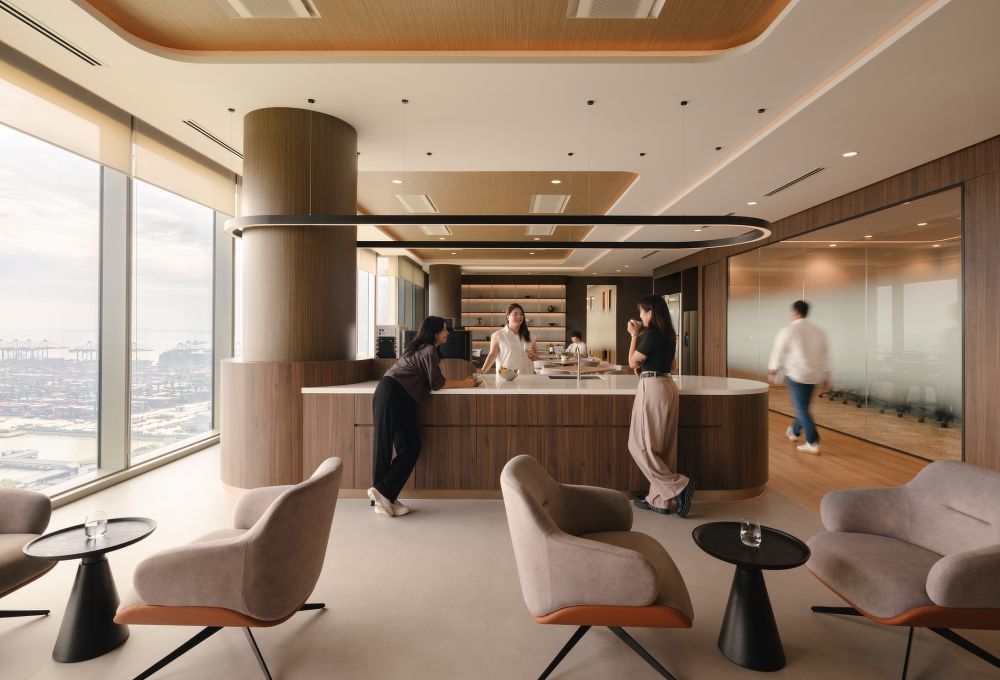
SGEI’s spacious work cafe, surrounded by natural light and offering panoramic views of Singapore's southern waterfront. (Photo: LFA Studio)
LFA and Ngee Koon have delivered projects for a diverse range of clients, including Chapel of Christ The King, LVMH Fashion Group, proptech provider SIMPPLE, government-linked firm Singapore Energy Interconnections, the Singapore Contractors Association Limited (SCAL) and conservation non-profit organisation World Wide Fund for Nature (WWF).
Indeed, WWF-Singapore’s recently completed office at Ayer Rajar demonstrates how far Lim, Goh and their teams will go for clients with limited budgets.
In addition to designing and building the space, they took the initiative to bring together 10 other local companies to join them in the project. All sponsors contributed either through a full sponsorship or provided materials at a reduced rate.
The 10 homegrown brands were Benel Singapore for the phone booth; ipse ipsa ipsum for a fluted wall panel and a donor wall; JMI Texwerkz for vinyl flooring; Koncept Kreation for the sink, pantry drawers, and dish rack; Millennium 3 Building Products for carpets for the server room; Panelogue for a display wall and cabinet panels; Pepperwall for acoustic panels; C&R Interiors for system furniture; Interface Singapore for carpets; and JAG Engineering for aircon and plumbing.
“We canvassed for every single supplier we knew. Singapore brands in flooring, walls, panels, tables, and so on,” Goh says. “All these friends came from relationships we built over the years through this business. We felt the chemistry with them and have been working closely, helping each other out,” he adds.
Together, the 12 firms including LFA and Ngee Koon delivered a new office space for WWF-Singapore, with environmentally sustainable materials and a design celebrating natural elements — warm wood flooring, woven textures, and acoustic features that complement views of the surrounding greenery.
“We created something memorable with so little budget. Cheap, good, nice design and human-centric. Fantastic,” Goh says with a grin.
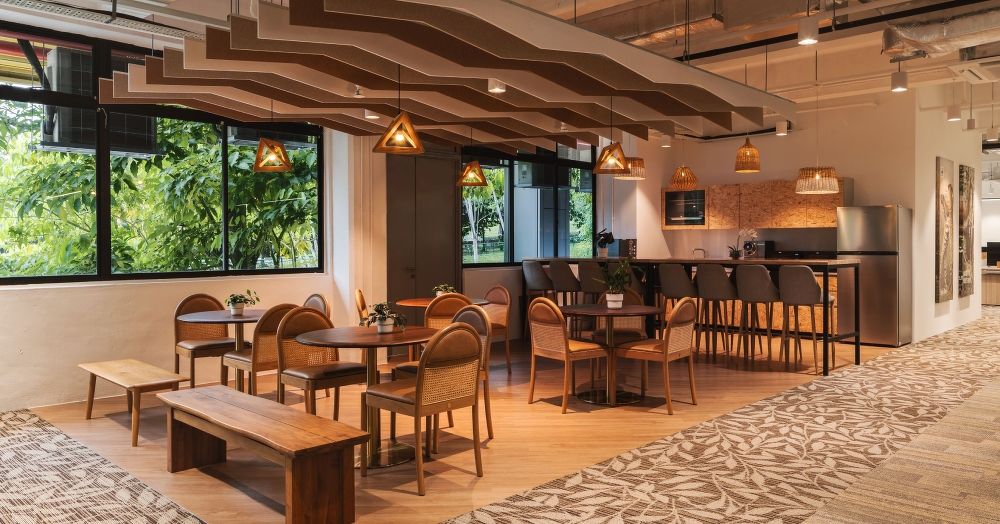
A modern and inviting pantry at WWF's recently completed office, with wood-toned flooring and the tactile charm of woven lamp shades. (Photo: LFA Studio)
Listening to clients and taking accountability
Managing tensions between design vision, compliance with building codes and budgets requires being deeply attuned to the client’s needs.
“Everything boils down to really understanding what the client wants,” Lim notes. “Are they looking for just aesthetics or do they need something more functional? For homes, do they have children or pets? For commercial properties, they may want more collaborative work spaces, for their office to feel welcoming, or to showcase their sustainable manufacturing methods.”
To deliver quality while controlling costs, they have also built their own in-house teams of contractors, carpenters and plumbers.
But it also means taking responsibility when things go wrong. Goh shares an example from a project in Hong Kong, where a minor workmanship issue prompted a complaint from the client.
In response, Lim and the carpentry team immediately flew to Hong Kong to fix it for free, and she apologised to the client in person. Internally, she called for a frank discussion about their processes and what they could have done differently.
“No business operates without hiccups,” she acknowledges. “The question is: how do you deal with them?”
During their build project for the Chapel of Christ the King, along Sophia Road in Singapore, the original plan they had quoted for the chapel’s raised platform — which included a baptismal pool concealed beneath the dais — involved only carpentry works. But Lim later determined they should use a steel structure for the congregants’ safety. They absorbed the additional costs.
She says, “It wasn’t safe without the steel structure, and they’ll be using it for baptism too. If we lose $20,000, then we lose $20,000. I’d rather do that than risk the stage possibly collapsing, right?”
When installing the platform, the co-founders and Goh’s wife, also went personally on-site to haul the heavy materials into place.
Subsequently, when the chapel experienced pipe bursts after heavy rains, the LFA and Ngee Koon team returned multiple times to repair the damage at no charge.
Leveraging tech for transparency and trust
The co-founders have focused on another pressure point in the industry: trust.
At LFA and Ngee Koon, clients receive real-time site updates via cloud solutions and detailed cost breakdowns made possible with AI tools, allowing them to track project progress and costing closely.
“We invested in AI to scan all drawings, measure and count the fixtures such as doors, so that everything is transparent and verifiable, down to the price of each door,” Goh says.
Moreover, clients can access flythroughs of the spaces and remotely flag any defects they spot. The firms are also exploring data-backed technology to automate accurate budgeting.
Other contractors have questioned this approach. “Many said we’re stupid, as we could have charged the customers another 10 more doors without them knowing — 10 doors at $2,000 each is a lot of money!” Goh recounts. “But I don’t want to overcharge anyone. We’ll openly tell you exactly what you’re paying for.”
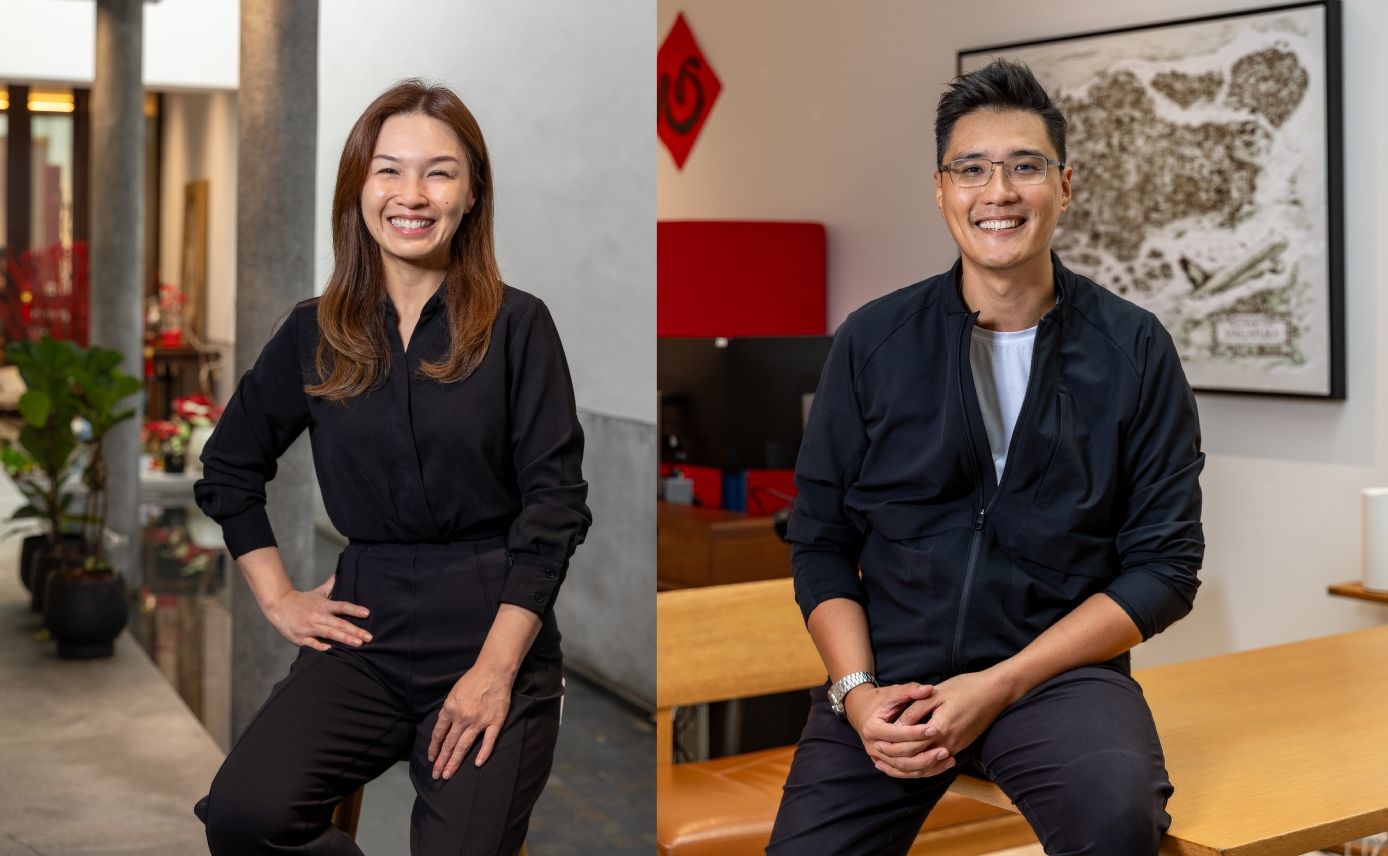
Renee Lim: "I want our people to shine brighter than me." Oliver Goh: "Sustainability is part of good design." (Photos: Samuel Isaac Chua / EdgeProp Singapore)
The result of their client-centric approach has been remarkable growth through word of mouth, with a steady stream of repeat customers and referrals.
Less than three years since LFA and Ngee Koon were founded, the firms are now being invited to tender for a flurry of interior design and build projects for hotels, restaurants, hospitals, co-living properties, lift lobbies, Good Class Bungalows, and many other developments.
With rapid growth comes the need for strong foundations. “We’re oversubscribed. People keep coming to us,” Goh says. “Everybody has been so busy and needs to rest. We must slow down, pace ourselves and make sure all our processes are in place.”
Making sustainability the default
Sustainability is at the core of everything they create. Starting with Lemonfridge, Lim and her co-founders there standardised E0-grade wood for all carpentry work in their residential projects. E0-grade panels have extremely low formaldehyde emissions, making them far safer and more eco-friendly than the industry’s typical E1 or E2 standards for indoor furniture.
“We pushed that boundary, by deciding that Lemonfridge’s standard would always be E0,” Lim says. “We hope more companies will follow.” LFA and Ngee Koon have since adopted the same standard for commercial projects. It also lends to more competitive pricing, as the firms achieve economies of scale when their carpenters buy E0 wood in bulk.
Lim points to the misconception that sustainability comes at a premium price or requires compromise. “We want to normalise it as the baseline. You don’t have to pay extra to have sustainable materials in your home or workplace,” she adds.
Goh, who is accredited as a LEED (Leadership in Energy and Environmental Design) professional and has experience in sustainability consulting, is familiar with the technical requirements. He sees sustainability as part of good design and a “preset point” in their discussions with clients.
“Sustainability is here to stay. After all, materials need to be safe. You need good indoor air quality, air flow and energy efficiency, and lighting shouldn’t be overly glaring. Then, the next step is wellness, and whether people feel comfortable living or working in the space,” Goh says.
The longevity and durability of their creations are also key. The aim is to create spaces and furniture that last, can be brought to the client’s next home or office, and may even be passed down generations.
“We’re not looking to design something like fast fashion or ‘fast furniture’ that people buy with the intention of just switching it out in one or two years,” Lim notes.
“For us, it has to be not only aesthetically pleasing and functional, but also have that longevity aspect to it. We always try to incorporate this into our designs and when advising clients,” she says.
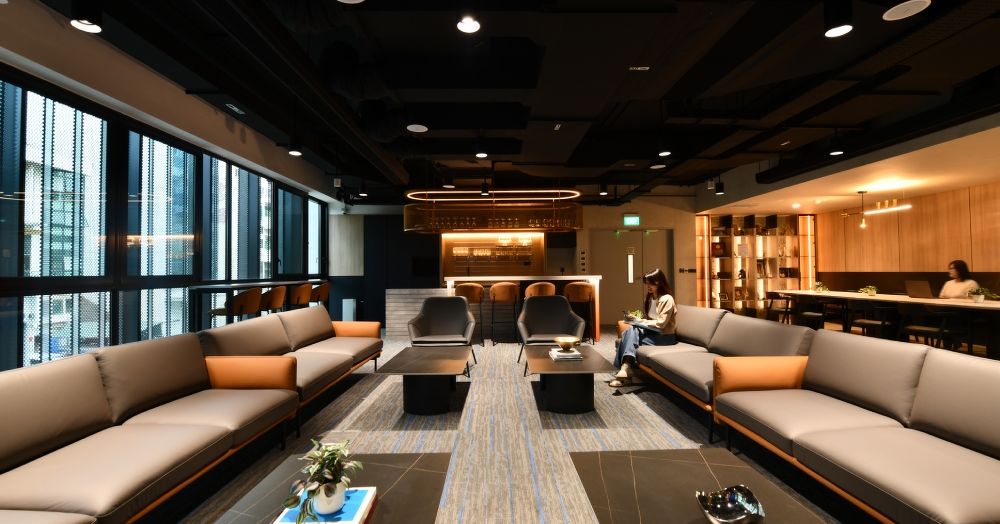
SCAL's stylish and inviting lounge area features a modern, sophisticated design, perfect for socialising or relaxing. (Photo: LFA Studio)
Mentorship and shared success
The co-founders hope to create an environment that fosters collaboration and open communication. They prioritise an open layout at their Neil Road office, and encourage younger designers to team up with more experienced staff to run projects together under profit-sharing arrangements. This way, junior employees get to learn while also earning more.
“We’ve all heard horror stories, elsewhere, of managers fighting over designers or accusing others of ‘stealing’ talent,” Lim says. “We never want that culture here; we intentionally encourage the spirit of teamwork.”
The commitment to their people also translates into active mentorship, where they help employees chase their dreams — even supporting them in launching their own brands.
If a designer wants to branch out to sell home decor or lighting, LFA can help with setting up an interior styling or lighting brand for them. If an administrative staff wants to become an electrician or a demolition and hacking specialist, they will receive support in picking up the necessary skills and marketing their services.
Employees at Lemonfridge, LFA and Ngee Koon may also progress to one of the other firms to get exposure to different property sectors and a range of roles including design consultancy, build, project management and procurement.
Lim and Goh view their role as providing the platform for their teams to flourish personally and outshine them, while creating something enduring for clients and partners alike.
By pacing their firms’ growth and prioritising accountability and authenticity, they are building a business that is sustainable in every sense of the word — one project, one person, one relationship at a time.
For more news and analysis, read our weekly e-paper. Prefer a print copy? Get it delivered to your home every Monday.
Follow Us
Property updates, 24/7.


Subscribe to Newsletter
Market insights, delivered weekly.


Top Articles
Search