
Singapore braces for higher construction costs as commodity prices, labour crunch bite

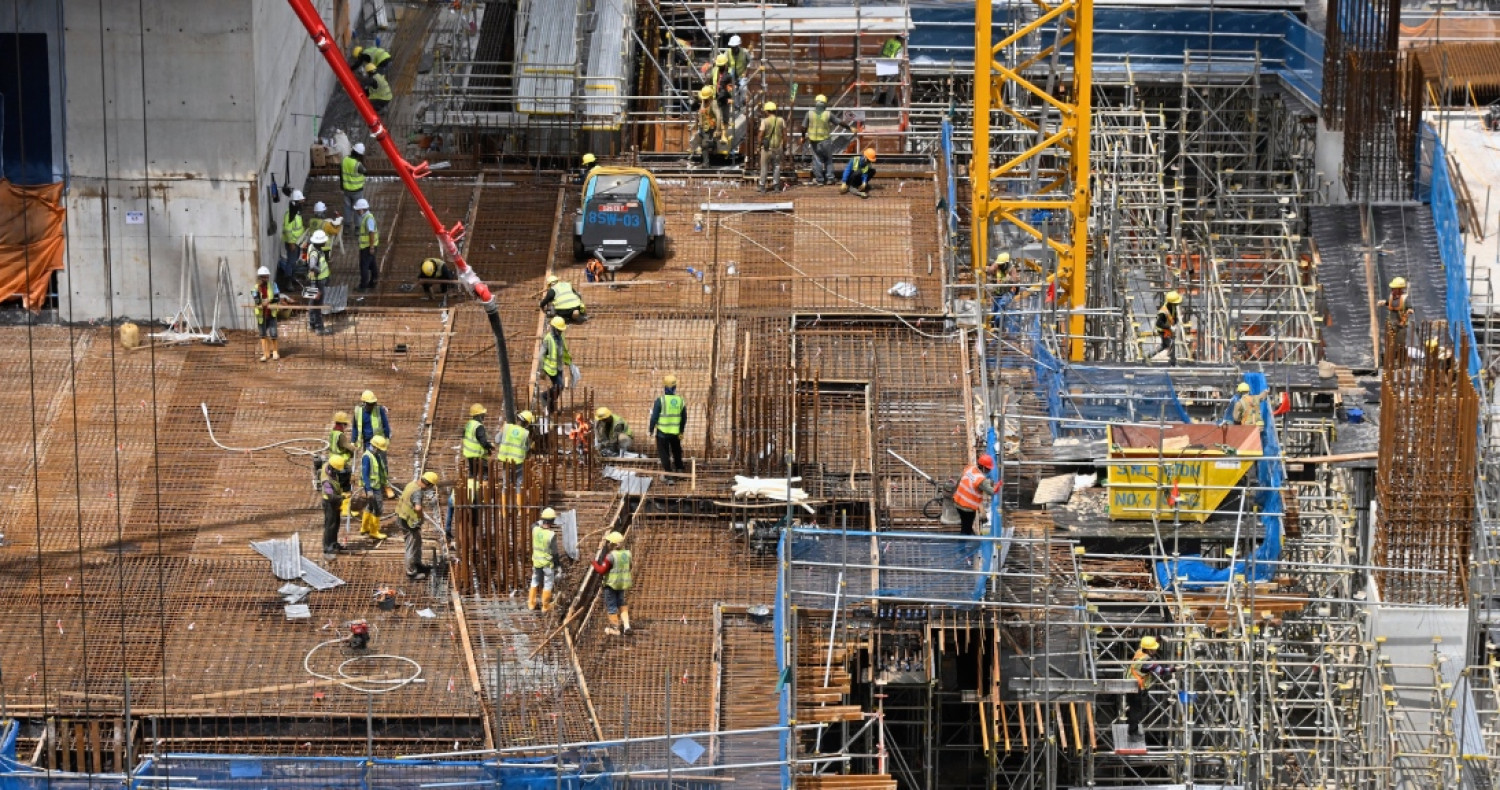
Project delivery risk is rising across Asia Pacific, with execution constraints increasingly shaping market conditions. (Photo: Albert Chua/The Edge Singapore)
Construction costs in Singapore are set to increase by 3.5–4.5% for the whole of 2026, amid higher energy prices, commodity price shocks and labour shortages that have been felt keenly across the Asia Pacific (Apac) region.
It comes as construction cost inflation in Apac has been elevated through the first half of the year, though that may moderate gradually in the second half if the Middle East conflict settles, according to global construction consultant Linesight.
Given Singapore's reliance on imported materials, region-wide conflict-related pressure on oil, freight and key commodity input costs is expected to continue to affect the city-state.
It also faces intensifying pressure from persistent shortages in skilled labour, tight subcontractor capacity and strong demand for major projects.
"General contractors are raising pricing as multiple large projects move forward at pace," Linesight said in its mid-year market insights report.
Construction industry inflation for 2025 and 2026 (forecast):
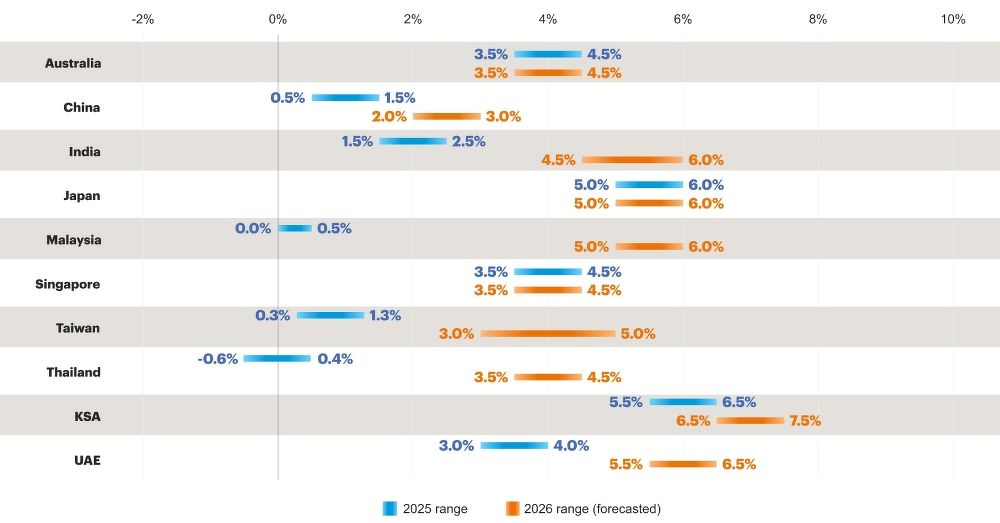
Source: Linesight, 'Construction Market Insights: Apac and the GCC', June 2026. Note: The outlook remains uncertain, and the estimate should be treated as a point-in-time forecast and may change as conditions evolve.
Demand from major projects and life sciences
In terms of construction output, Singapore could see a 4.5% increase in real terms for 2026, with medium-term annual growth of about 4% to 2030, Linesight projected. This will likely be driven by manufacturing and major transport and energy programmes.
The Building and Construction Authority (BCA) earlier said it expects total construction demand to keep steady at around $47 billion to $53 billion in nominal terms this year, similar to 2025.
Major projects including Changi Airport Terminal 5, the expansion of Marina Bay Sands, new hospitals, and rail extensions will support this sustained demand.

Artist's impression of Marina Bay Sands’ expansion project, which will include a new luxury hotel tower (left) and a 15,000-seat entertainment arena. (Image: Marina Bay Sands)
Linesight highlighted that life sciences construction remains important as Singapore continues to strengthen its position as a biopharma and next-generation therapeutics hub, backed by research capability, manufacturing depth and public-private collaboration.
Construction demand is holding firm with pharmaceutical facilities expanding, and antibody drug conjugate facilities are also emerging as a new asset type in Singapore.
Linesight noted that while most Apac markets, including Malaysia, Singapore and Thailand, are on track to post higher construction outputs this year, higher prices of oil and gas, as well as various commodities such as copper and cement, are weakening the region’s outlook.
Construction output in real terms, y-o-y change:
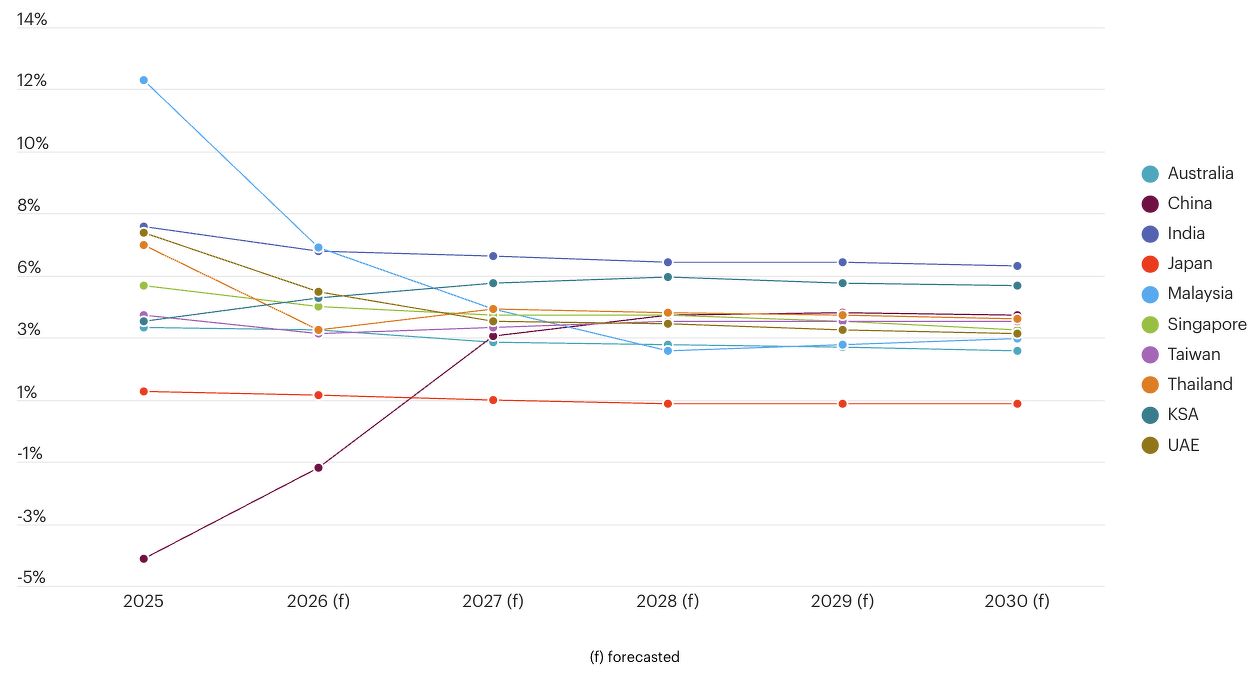
Source: Linesight, 'Construction Market Insights: Apac and the GCC', June 2026.
In particular, project delivery risk is rising across Apac because of labour shortages, power constraints, limited specialist contractor capacity, and longer procurement timelines.
This risk looms even as activity levels remain high. Execution constraints, rather than demand, are increasingly shaping market conditions.
John Butler, Linesight’s managing director for Apac and the Gulf Cooperation Council, said that demand remains strong in both regions, but certainty in delivery now depends on how well firms manage labour, supply chains and power constraints.
Volatile pricing for building materials
Construction commodities remain highly sensitive to energy, freight and raw material costs, with the Middle East conflict adding renewed volatility this year.
Price pressures vary by commodity across Apac. For copper, greater demand alongside supply constraints and geopolitical disruption are bolstering prices.
Copper prices in Singapore increased by 21.6% y-o-y in the second quarter of 2026, though they may ease from the third quarter onwards, in Linesight’s view.
Copper prices, y-o-y change:
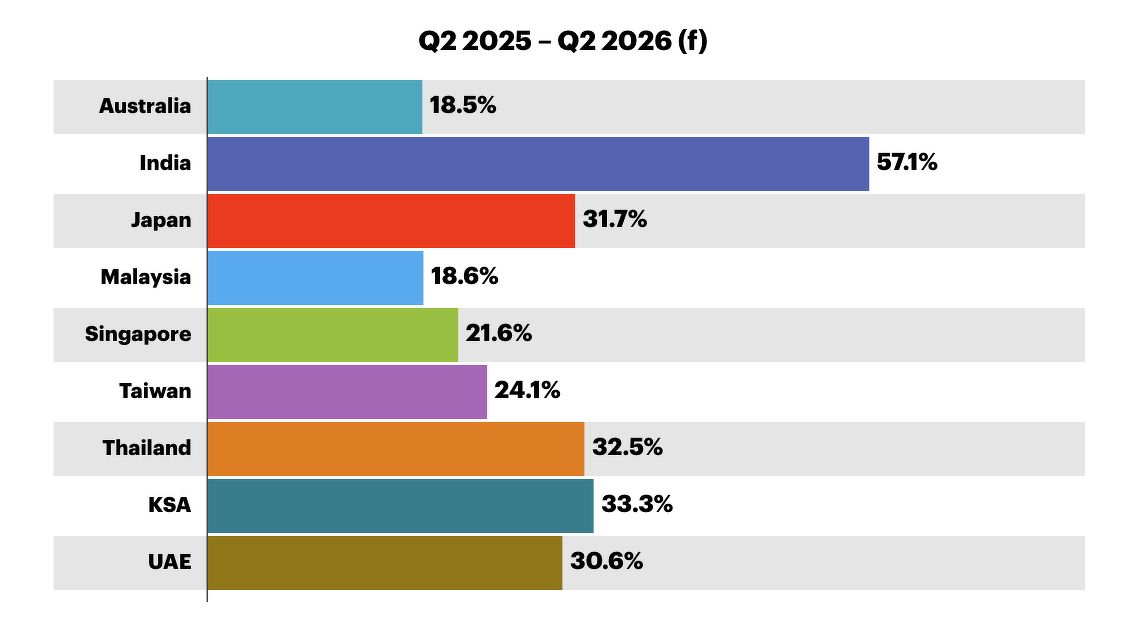
Source: Linesight, 'Construction Market Insights: Apac and the GCC', June 2026.
The firm reckoned copper prices could fall by 1–5% between 3Q2026 and 4Q2026 across the board in Apac.
“The outlook depends on the duration of the Middle East conflict, conditions along Hormuz trade routes, and the continued impact of sulphuric acid supply constraints on global copper production,” it added.
As for cement, prices are likely to stay high in Apac through 2026 amid strong underlying construction demand and elevated energy and freight costs.
In the first quarter this year, Singapore recorded the region’s biggest q-o-q jump in cement prices, at around 8%, driven by robust construction activity, major projects and supply constraints linked to import dependence.
That said, Linesight forecast cement prices in the city-state to decrease by about 1–5% between 3Q2026 and 4Q2026.
Cement price trend forecast:
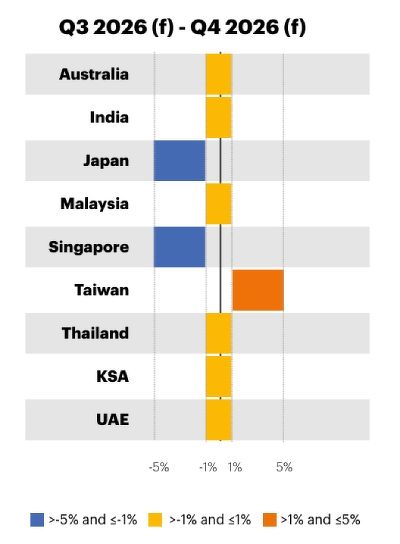
Source: Linesight, 'Construction Market Insights: Apac and the GCC', June 2026.
Meanwhile, steel and stainless steel markets in Apac are facing higher costs in inputs, energy, freight and logistics, although weak downstream demand is limiting further upside in prices.
Concrete prices went up in most markets in the region in the first half of this year, fuelled by buoyant project demand and higher energy and transport costs.
Singapore saw concrete prices move upward in the first quarter amid a strong project pipeline and increasing material and logistics costs.
That said, cost pressures moderated in the second quarter and led to some easing. Concrete prices in Singapore thus gained a milder 2.1% y-o-y in 2Q2026.
Concrete prices, percentage change relative to 1Q2024 as the baseline:
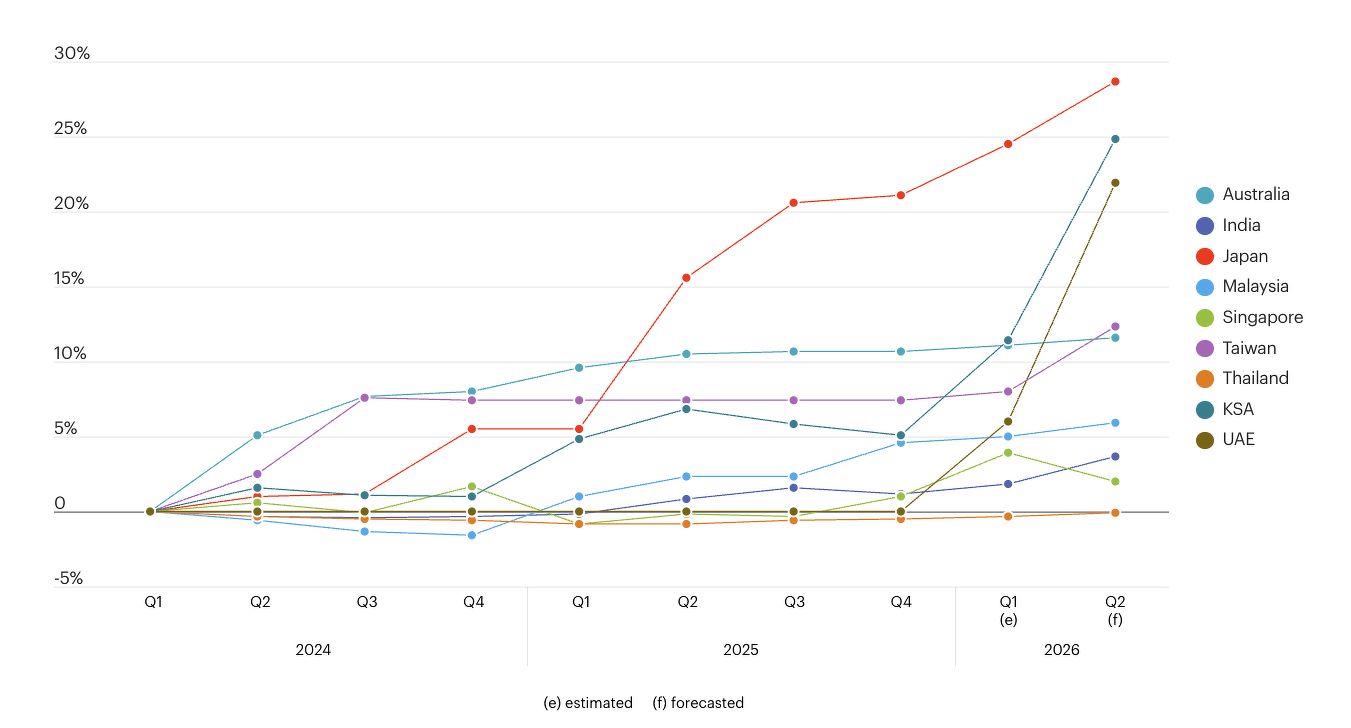
Source: Linesight, June 2026
Procuring equipment gets slower, costlier
As long equipment lead times, cost volatility and geopolitical disruption affect project viability, Linesight sees supply chains becoming an earlier strategic consideration in the construction sector.
Global manufacturing capacity is now shaping project delivery as much as on-site activity, as costlier and longer procurement timelines for equipment are adding to delivery risk.
For mission-critical and high-tech industrial projects, long lead equipment — machinery or components that take a significant amount of time to be manufactured, fabricated or delivered — accounts for around 35% to 40% of total capital expenditure.
Lead times for mechanical systems, such as chillers, computer room air handlers and cooling towers, are generally ranging from 20 to 43 weeks globally. There has been “controlled volatility” and signs of modest improvements in lead times this year, Linesight noted.
In contrast, electrical infrastructure continues to face acute pressure. Generators have “significantly extended” lead times — even exceeding 100 weeks in the Americas and Europe, the consultant added.
Costs of long lead equipment have also escalated globally, with a consistent upward trend across all major equipment categories, going by Linesight’s cost data.
This has largely been driven by strong global demand for data centre infrastructure, particularly with hyperscale expansion and as AI investments accelerate rapidly.
Linesight pointed out that the scale and pace of this demand have outstripped existing global manufacturing capacity for critical equipment.
That has led to persistent supply demand imbalances and sustained pricing pressure across both electrical and mechanical systems.
Construction programme risk is therefore shifting away from traditional site activity and towards production pipelines and supplier capacity.
“Achieving project resilience relies heavily on early supply chain engagement,” said Neil Doyle, director of procurement and supply chain management at Linesight.
“To avoid delays, delivery teams must plan their design and supply chain engagement strategies in parallel,” he added.
For more news and analysis, read our weekly e-paper. Prefer a print copy? Get it delivered to your home every Monday.
Follow Us
Property updates, 24/7.


Subscribe to Newsletter
Market insights, delivered weekly.
Related Articles


Top Articles
Search