
Special Feature
How Jesslyn Seah is reframing property for the next generation, from roof to legacy
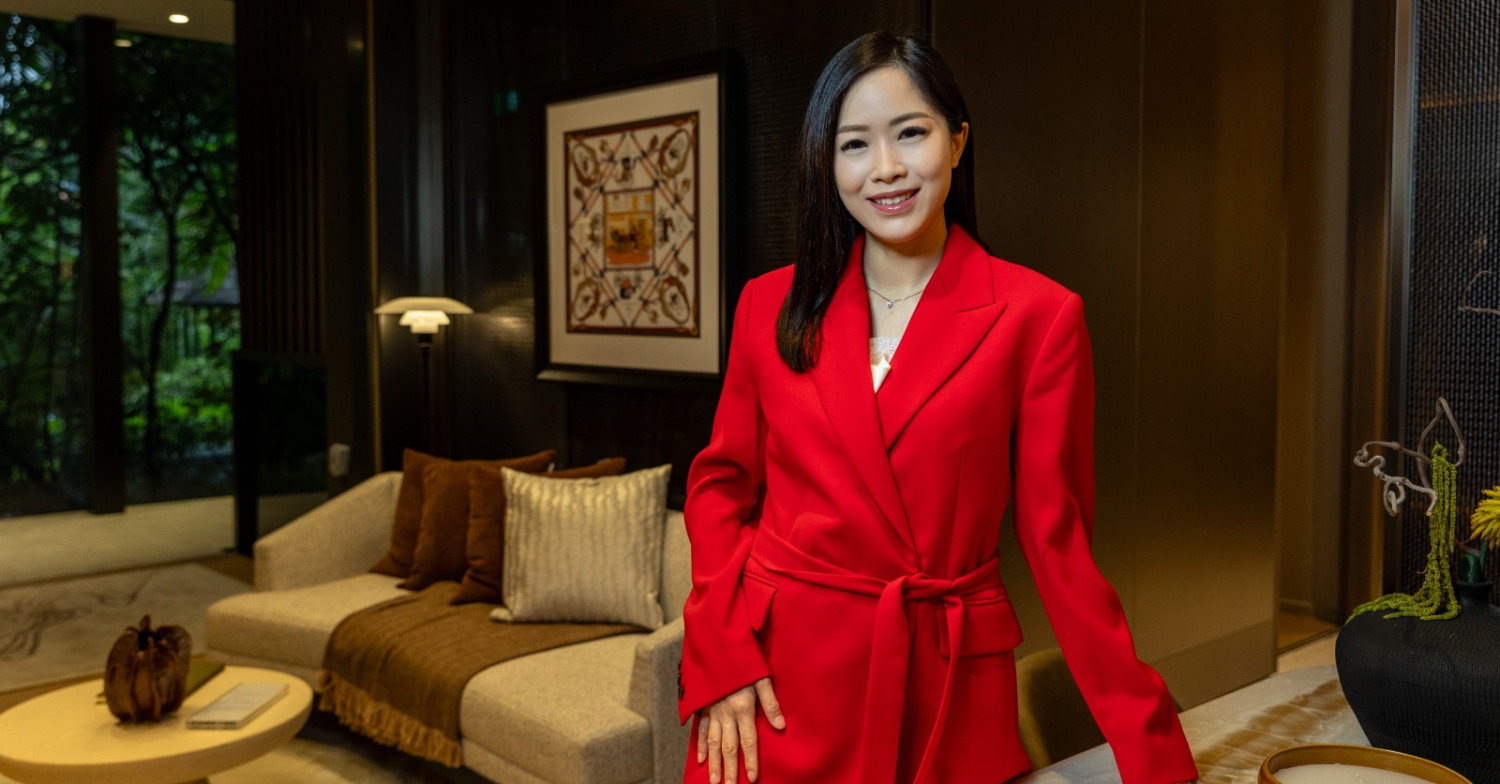
Through lived experience, Jesslyn Seah now advises parents on balancing comfort with long term upside. (Photo: EdgeProp Singapore)
For many Singaporean families, property remains a straightforward equation: secure a home, pay it off and stay put. It is practical, familiar and, in many cases, seen as the right thing to do.
For Jesslyn Seah, that equation no longer holds.
“Providing a roof over your child’s head is no longer enough,” Seah says. “We need to think about what we are leaving behind, not just for them, but also for ourselves.”
This perspective is shaped not by theory, but by lived experience. It now forms the foundation of her advisory work with parents, which she brands as “Our Next Chapter”, as they navigate an increasingly expensive and complex property market.

Seah advocates calculated sacrifices today for stronger financial outcomes tomorrow. (Photo: Jesslyn Seah)
A shift triggered by motherhood
Seah did not enter the industry with a clear thesis. In her early years, she describes her approach as “random”, taking on listings, relying on referrals and working without a defined structure.
That changed five years ago, when she became a mother.
“When I had my son, Zac, everything shifted,” she says. “I started thinking beyond day-to-day needs, asking myself what kind of future I was actually building for him.”
The answer was uncomfortable.
Like many Singaporeans, Seah had taken the conventional route. She purchased a Build-to-Order flat, waited through the construction period, fulfilled the Minimum Occupation Period and eventually sold it.
On paper, it was a success. In reality, it felt like a missed opportunity.
“I spent about 11 years on that journey and made only around $400,000,” she says. “When I compared it to what could have been achieved in the private market over the same period, the difference was very clear.”
That realisation marked the beginning of a more intentional strategy, one centred on asset growth rather than just home ownership.

Seah’s strength lies in helping homeowners see possibilities beyond conventional property pathways. (Photo: Jesslyn Seah)
A personal upgrade, built on constraints
Seah’s move into the private market was not driven by surplus cash. In fact, it came at a time when her income was inconsistent and her confidence was low.
“I did not think I could afford it,” she admits. “That was the biggest mental block.”
Instead of waiting for perfect conditions, she recalibrated her expectations after a consultation with her mentor, PropNex deputy CEO Kelvin Fong.
“I confided in him that I could not afford a new launch and he advised me to consider a resale condo instead, just so I could step into the private market and build my net worth from there,” Seah shares.
She sold her HDB flat, moved temporarily into her parents’ home and purchased a resale executive condominium in the west, a development that had just met its five-year Minimum Occupation Period.
It was not her ideal location and far from being a dream home, but it was a calculated move.
“We made sacrifices,” Seah says. “We moved further out west and our commute was less convenient. But we were entering the private market at a price point we could still manage.”
The result was immediate and measurable.
“Within three years, the value increase was significantly higher than what I saw with my HDB,” she notes. “That gave my husband and me the confidence to plan the next move.”

Motherhood reshaped Seah’s approach to property planning and legacy building. (Photo: Jesslyn Seah)
Small sacrifices, long-term leverage
A recurring theme in Seah’s work with clients is the concept of trade-offs. Many parents, she observes, prioritise stability above all else: staying close to schools, avoiding interim housing and minimising disruption.
Those instincts are valid, but they often come at a cost.
“If you optimise for comfort today, you may be giving up a lot of upside tomorrow,” Seah says. “That opportunity cost compounds over time.”
Seah does not push a single solution. Instead, she lays out scenarios.
“I show clients what happens if they stay put and what happens if they move,” she explains. “Then I let them decide.”
The goal is not persuasion for the sake of commission. It is to help parents gain clarity.
“There is no right or wrong,” she says. “But parents need to understand the consequences of each decision on their family’s future.”

Seah believes understanding what is possible gives families confidence to shape their next chapter. (Photo: Jesslyn Seah)
Structuring a pathway, not a transaction
What differentiates Seah’s approach is her emphasis on long-term planning over one-off transactions.
A typical consultation goes beyond affordability.
“I look at their full financial position, income, CPF usage and loan eligibility,” she says. “Then we map out a timeline. When do you buy it? When do you exit? What is the next step after that?”
For parents, the conversation inevitably turns to legacy.
“I ask them what they want to give their child,” Seah says. “Is it just a home, or is it an option?”
For many families, that optionality could take different forms, from funding education to supporting a first property purchase or reducing financial pressure on the next generation.
“I am already seeing parents paying 25% down payments for their children’s homes,” Seah notes. “That will become more common as prices continue to rise.”
For those who push back on intergenerational support, Seah reframes the discussion.
“Then, I focus on how property can pave the way for their retirement,” she says. “Surely, we wouldn’t want to burden our children in our old age. And most parents want to have enough to leave something behind.”

Seah believes parents should plan not only for shelter, but future opportunities for their children. (Photo: Jesslyn Seah)
The blind spot many homeowners miss
One of the most overlooked risks, Seah says, is the impact of CPF usage on property returns.
“Many homeowners think if their flat is fully paid up when they sell, everything is profit,” she explains. “But they forget about accrued CPF interest.”
Over time, CPF accrued interest can significantly erode gains, especially for properties with limited appreciation.
“I have seen owners shocked when they realise they have little or no cash proceeds after selling,” she says. “Some even face negative sales situations.”
The solution, in her view, is not panic but earlier intervention.
“If you are still in your 30s or 40s, you have time to restructure,” she says. “After 55, your options become more limited.”
A clearer purpose
Today, Seah’s work is more focused than it has ever been. She no longer markets properties broadly.
Instead, she speaks directly to parents, particularly those who feel stuck between competing priorities, drawing on 15 years of experience helping over 500 families grow wealth and create lasting legacies.
“I have been in their position,” she says. “I know the hesitation.”
Her role, as she sees it, is not to push decisions, but to expand perspective. It is a quieter, more grounded proposition than the usual sales pitch.
“Sometimes people just need to see what is possible,” she says. “Once they understand that, they can choose their path forward with confidence.”

For more information,
Contact Jesslyn Seah | 97355423
Associate Division Director (R043870J)
PROPNEX REALTY PTE. LTD.
Follow Us
Property updates, 24/7.


Subscribe to Newsletter
Market insights, delivered weekly.
Top Articles
Search