Luxury asset values may be turning a corner; young investors bet on fractional ownership

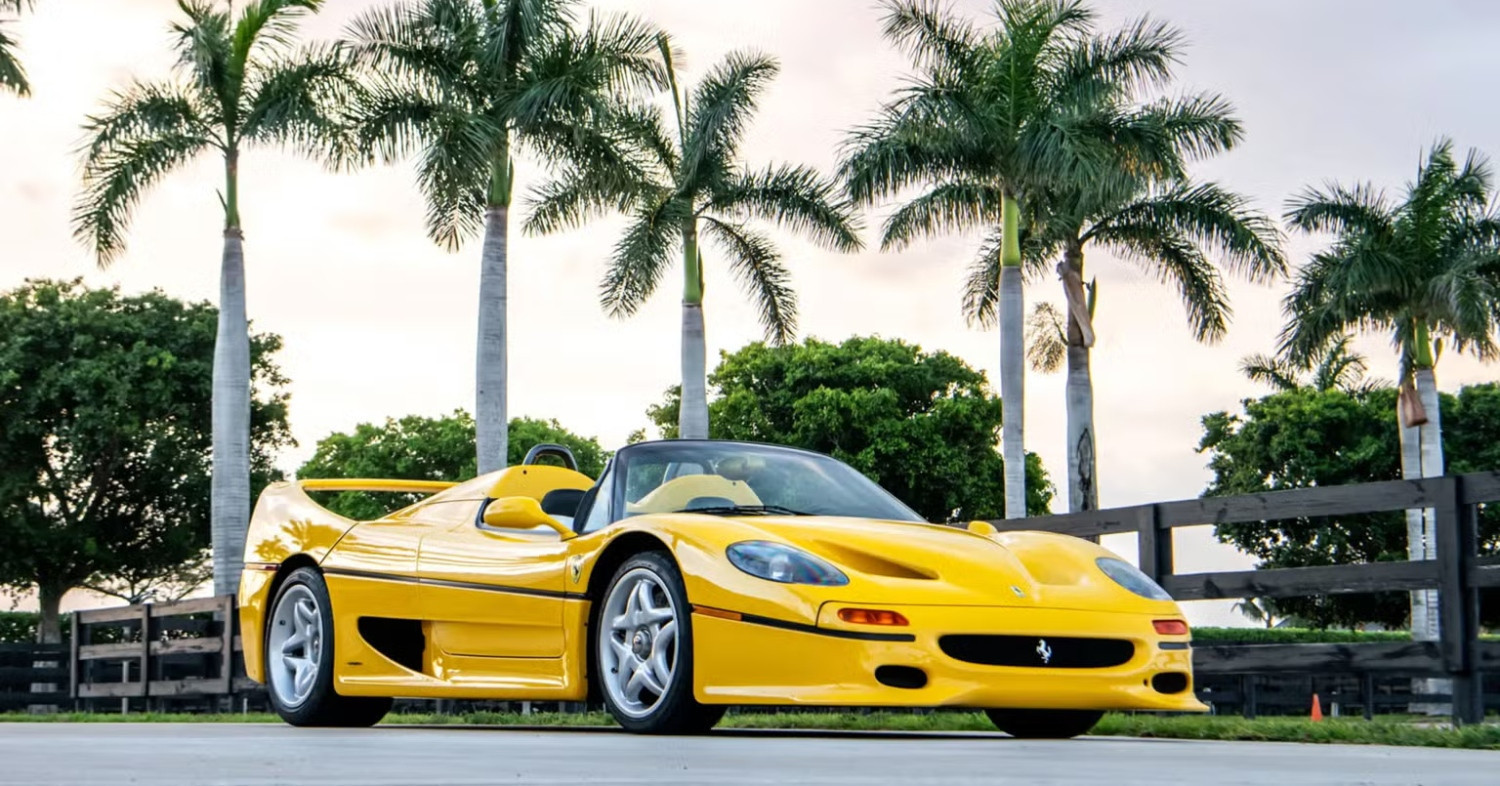
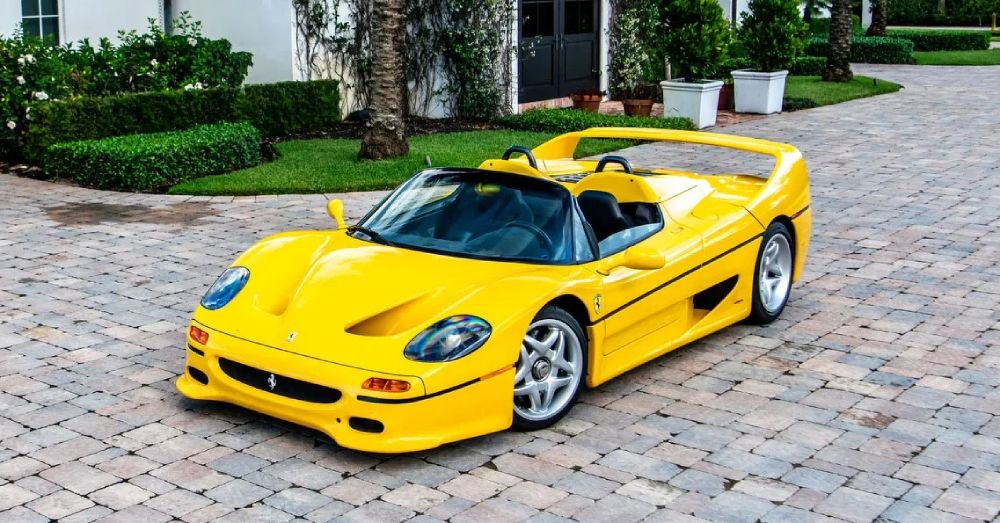
A 1995 Ferrari F50, once owned by fashion icon Ralph Lauren, was sold by auction house RM Sotheby's for US$9.2 million. (Photo: RM Sotheby's)
The global luxury investment market appears to be stabilising after a volatile decade, with capital values appreciating for watches and fine art but declining for cars, handbags, wines and whisky.
While buyers remained active, they are increasingly disciplined and favour rarity, cultural significance, provenance and relative value over momentum-driven purchasing.
At the same time, fractional ownership has surged — opening the luxury market up to a new generation of investors under 40 who are seeking access to rare assets across watches, art, cars and more.
Advertisement
Advertisement
In the Asia Pacific (Apac), the luxury investment market is maturing to become more discerning, with capital increasingly informed by expertise and long-term conviction, said Christine Li, head of research for the region at Knight Frank.

An art revival while timepieces clock gains
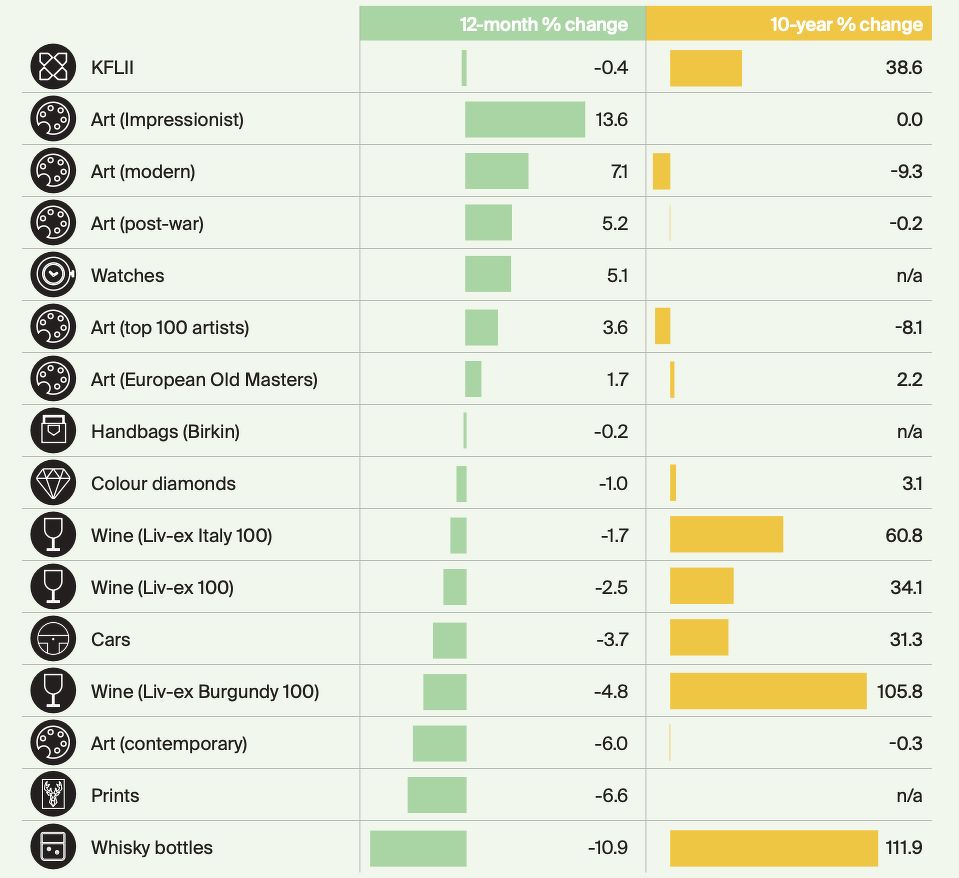
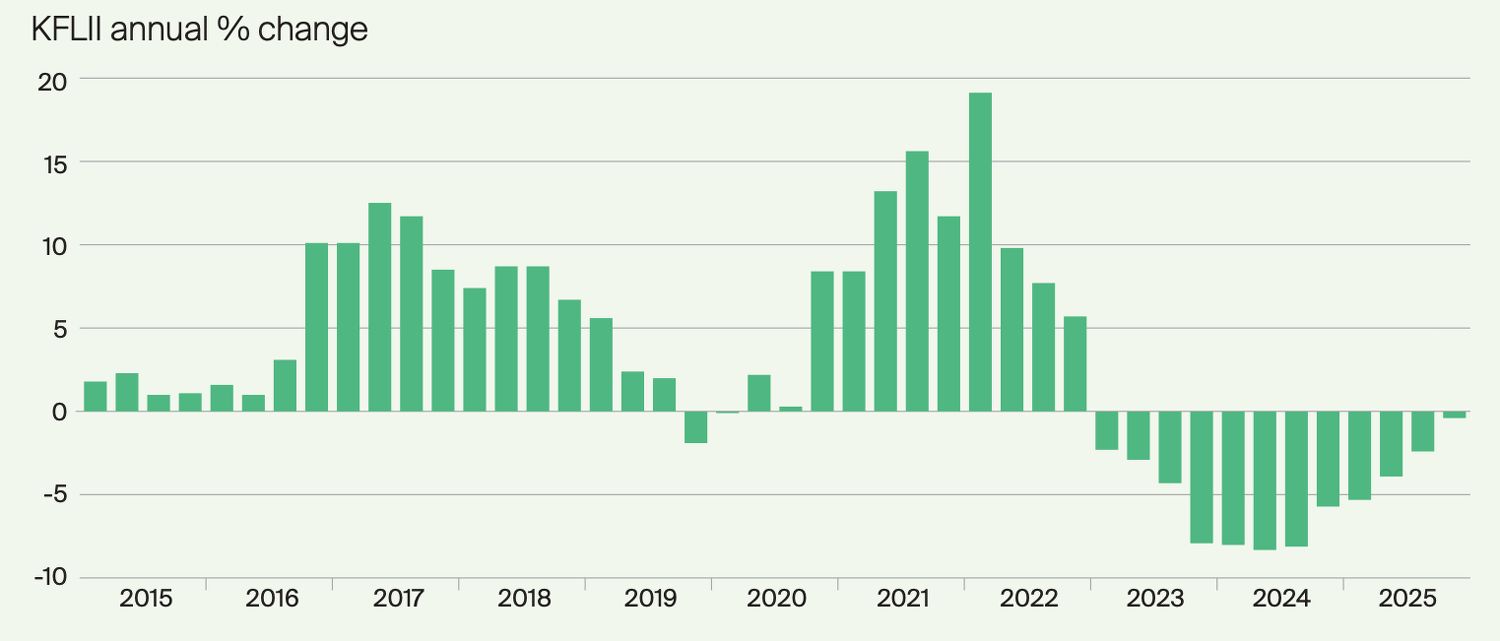
The Knight Frank Investment Index (KFLII) closed 2025 down a marginal 0.4%, following two years of sustained losses. While values remained under pressure, the pace of decline had slowed through the year.
Uneven performance in the Knight Frank Luxury Investment Index (KFLII), 4Q2025:
A bar chart showing the 12-month and 10-year changes in the luxury investment index for assets such as art, watches, cars, handbags, whisky, wine, and more

Source: The Wealth Report 2026, Knight Frank
This suggests that the luxury investment market is starting to find its footing, Knight Frank noted in this year’s edition of The Wealth Report, released in late April.
Performance has been uneven in 2025. Impressionist art, modern art, post-war art and watches delivered solid y-o-y gains of 13.6%, 7.1%, 5.2% and 5.1% respectively.
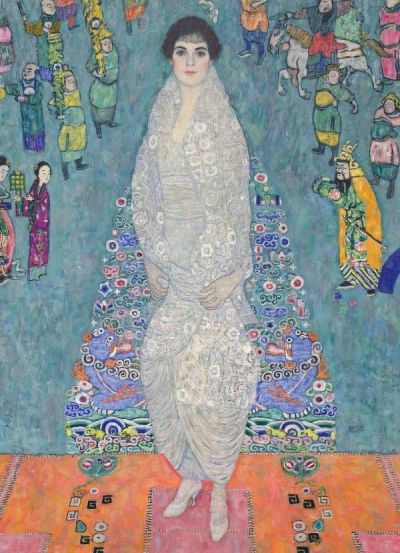
The surge in values of Impressionist art was driven by major single-owner sales and standout results including Gustav Klimt’s Portrait of Elisabeth Lederer, which fetched US$236.4 million ($301.4 million) — the highest-ever price for a modern artwork sold at auction.
A photo of Gustav Klimt’s artwork titled 'Portrait of Elisabeth Lederer'

Gustav Klimt’s ‘Portrait of Elisabeth Lederer’ became the second-most expensive painting to sell at auction when it went under the hammer with Sotheby’s in November. (Photo: Sotheby’s website)
Advertisement
Advertisement
Combined sales of fine art at major auction houses worldwide climbed to US$4.56 billion last year, up 11% y-o-y, reversing from the consecutive years of declines since 2022.
For watches, there was strong demand in the secondary market for Patek Philippe’s standout models, the Aquanaut and the Nautilus.
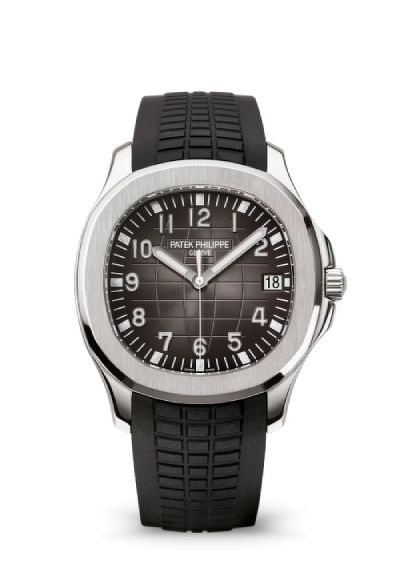
The Patek Philippe Market Index jumped by 12.1% over the year. Its star performer, the Aquanaut 5167A, is one of the more accessible models in its line-up and is among the hardest to source, given the overwhelming demand. More traditional Patek offerings — such as the Gondolo and Calatrava — continued to languish.
A photo of the Aquanaut 5167A by Patek Philippe

Patek Philippe’s Aquanaut 5167A has proved a resilient performer, with the model sold for US$95,250 at Sotheby’s. (Photo: Patek Philippe website)

Meanwhile, the secondary watch market also saw continued resilience from Rolex. The Rolex Market Index rose by 4.6% over the same period, with nearly all models posting solid performances, with the exception of the Sea-Dweller and Sky-Dweller.
That said, most other watch brands and collections continued to drift lower as demand stayed consistent while supply rose.
Advertisement
Advertisement
Li noted that wealthy collectors in Apac continue to "favour categories such as watches and trophy artworks while more speculative segments undergo correction".

'Beater bags' and classic automobiles

On the other hand, handbags, fine wine, cars, contemporary art, prints and whisky bottles saw declines ranging from 0.2% to 10.9%, the KFLII showed.
Hermès' iconic Birkin and Kelly bags retained their pricing power, with the index down only marginally by 0.2%. Some investors see them as a quasi-haven asset serving as an inflation hedge and an alternative to gold, said Dana Auslander, chief executive of luxury alternative asset manager Luxus.
Demand from luxury handbag collectors is rotating towards pre-owned, well-loved and visibly worn pieces — so-called “beater bags”, prized for their patina and relative accessibility.
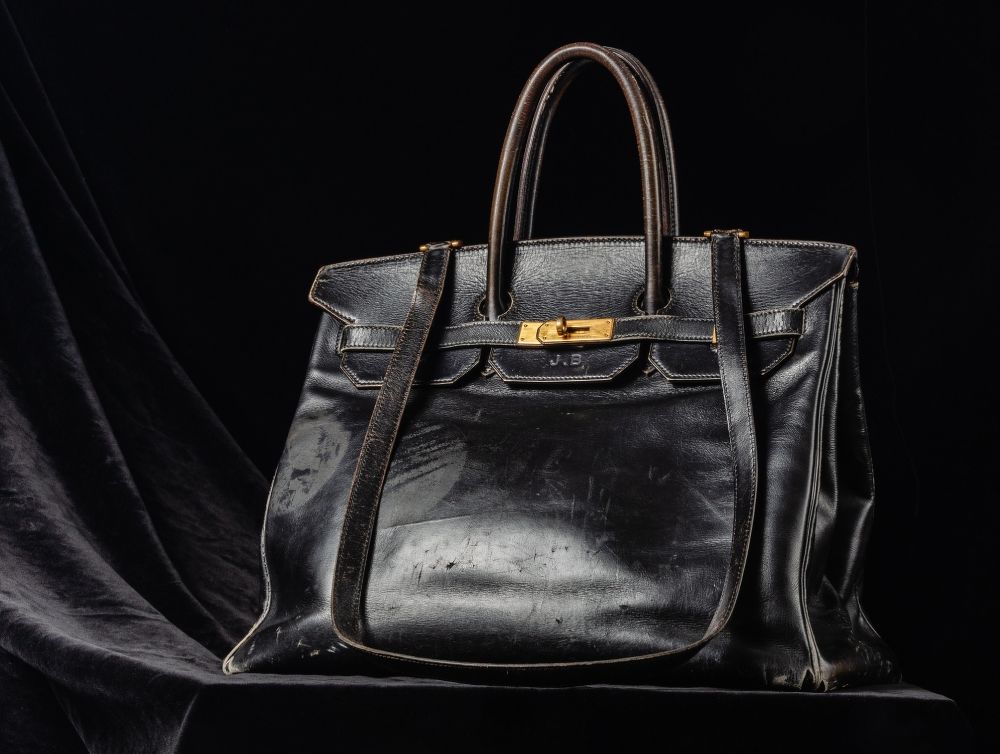
The original Birkin bag owned by Jane Birkin, sold by Sotheby's

A loveworn Hermès Birkin, owned by model and actress Jane Birkin, sold for a record-breaking US$10.1 million at Sotheby’s Paris after a spirited bidding war. (Photo: Sotheby’s website)
The most active segment for resale bags sits in the US$6,000 to US$9,000 ($7,649 to $11,474) price range, driven by younger buyers and Gen Z collectors, according to Luxus. Resale platforms and auction houses are increasingly being asked to source at this level.
Meanwhile, classic car values fell by 3.7% in a subdued year for the global market.
Nonetheless, flagship 'halo' models such as the Ferrari F50 remained in fierce demand, with major US and European auctions achieving notable results. A yellow 1996 Ferrari F50 was sold by RM Sotheby's for US$9.245 million.
A photo of a ultra-rare yellow Ferrari F50 previously owned by Ralph Lauren and recently sold by RM Sotheby's

This 1995 Ferrari F50, whose first owner was collector and fashion designer Ralph Lauren, is finished in the rare Giallo

Modena

yellow. It fetched over US$9.2 million in August 2025. (Photo: RM Sotheby's)
Other top performers included the BMW CI Index, which measures the market for classic BMW automobiles, rising by 22%, fuelled by demand for models such as the E30 M3 and 850 CSI.
Lamborghini also posted strong results, led by the Countach, Miura and Diablo — poster supercars with limited supply and growing appeal among younger and emerging collectors.
Liam Bailey, global head of research at Knight Frank, commented: “After a cycle defined by extraordinary highs followed by rapid adjustment, the luxury investment market is now entering a more rational and more discerning phase.”
A volatile decade in luxury investment:
A bar chart showing fluctuations in the Knight Frank Luxury Investment Index over the past decade

Source: The Wealth Report 2026, Knight Frank

Next-gen luxury investors eye fractional platforms
Younger generations of investors are reshaping ownership models through digital and fractional platforms, Bailey added.
Likewise, Li has observed that younger investors in Apac are broadening their participation in the luxury market and paying more attention to authenticity and identity.
For instance, online trading platform Timeless Investments, which has almost 100,000 customers in the EU and UK, sells fractions from as little as US$60 each in the physical assets — collectibles ranging from cars to wine to sneakers.
Almost a third of its investor base are aged 20–30, despite accounting for only 12.9% of the population. Those aged 30–40 are similarly over-represented, constituting 28.7% of the investors even though they make up 15.5% of the population.
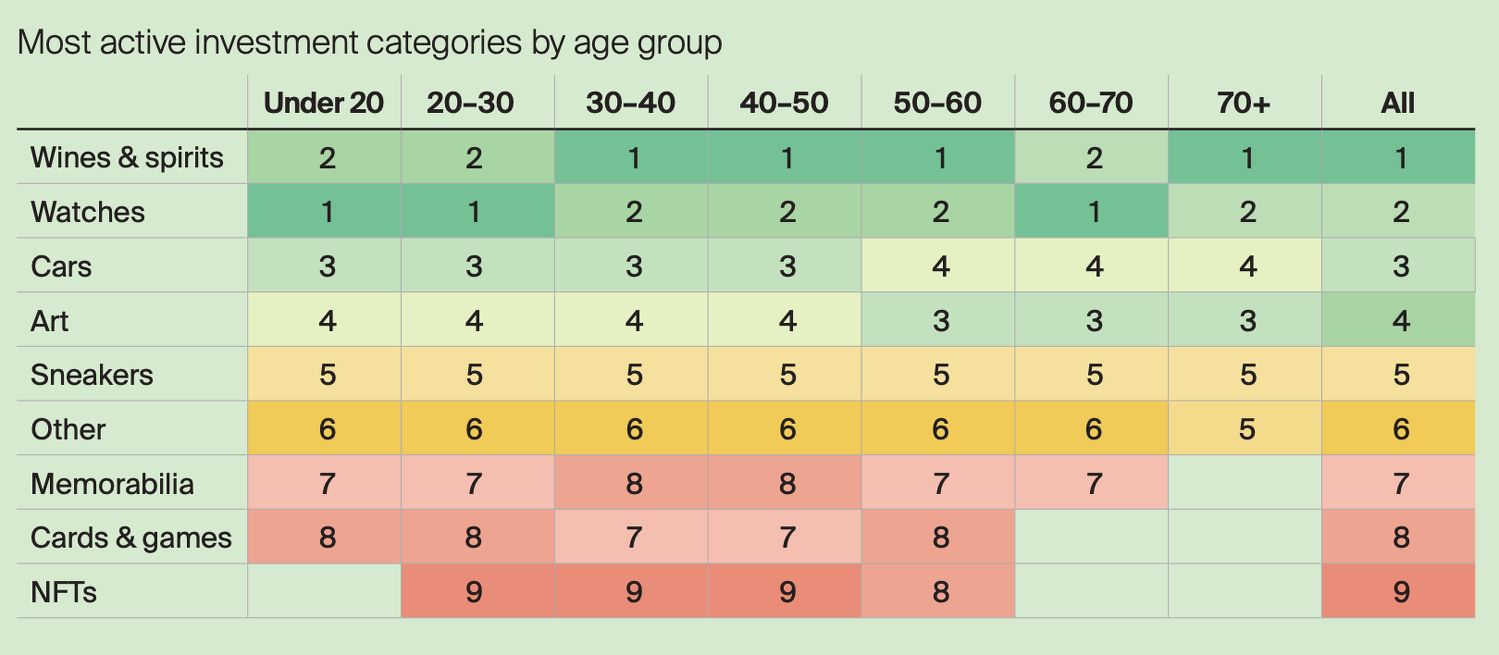
Most popular investments on Timeless:
A table showing the most active investment categories by age group on Timeless Investments, including wines, spirits, sneakers, cards and games, NFTs, automobiles, and more

Source: Timeless Investments

Watches, wines and spirits are the most popular investments across all age groups.
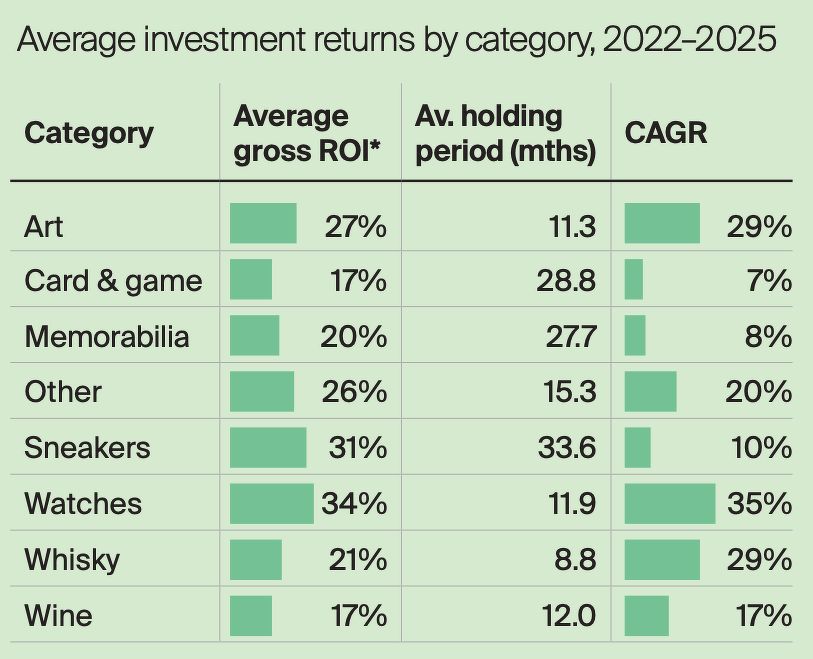
The Berlin-based start-up’s strongest returns come from watches, whisky and art — with returns equivalent to compound annual growth rates (CAGR) of 35%, 29% and 29% respectively, and average holding periods of typically around a year.
From 2022 to 2025, the Timeless portfolio has exited 63 collectibles across a range of categories, with an average CAGR of 16%, according to the Knight Frank report.
Online trading platform Timeless' investment exits:
A chart and table showing the average investment returns by category, from 2022 to 2025, on the Timeless platform

*Gross ROI = the difference between the acquisition price and the exit price. Fees are not included and this does not reflect the net return to investors. Source: Timeless Investments

Beyond traditional luxury items like handbags and diamonds, interest is also growing in rare curiosities such as fossils, minerals, meteorites and dinosaurs.
Transactions are handled through an app, where customers can also trade fractions. Timeless stores, insures and maintains the assets. When it proposes a sale, investors will vote on whether to proceed.
For more news and analysis, read our weekly e-paper. Prefer a print copy? Get it delivered to your home every Monday.
Follow Us
Property updates, 24/7.
Subscribe to Newsletter
Market insights, delivered weekly.