
Feng shui: What matters, what doesn’t, and what homebuyers ask about


Joey Yap delivering the opening address at the Feng Shui & Astrology 2026 event
- Joey Yap’s Feng Shui & Astrology 2026 event in Singapore drew global buyers, highlighting how external environment outweighs decorative fixes in property decisions.
- Homebuyers increasingly seek clarity on renovation timing and layout, with Joey Yap emphasising that intention and purpose drive effective feng shui, not generic rules.
- Compared to past beliefs, modern feng shui focuses on main doors, bedrooms, and kitchens, as these spaces directly impact daily life and long-term wellbeing.
AI generated
Feng shui master Joey Yap was in Singapore, hosting two events at Resorts World Sentosa — Feng Shui & Astrology 2026 on Jan 31, followed by Crimson Horse QiMen from Feb 1 to 2.
Attendees came from across the globe, including Slovenia, Australia, Romania, Japan, Indonesia, Thailand and India, to hear the Malaysian-based consultant share insights into Chinese metaphysics and the year ahead.
2026 is the year of the rare Fire Horse, a cyclical occurrence that comes once every 60 years. It brings strong momentum and rapid shifts, meaning property decisions can play out faster than usual. For buyers and investors alike, this makes 2026 a pivotal year for mindful and well-timed choices.
How feng shui enters the homebuying process
Feng shui rarely appears at the start of a property search.
It usually comes into view later, after a unit has been shortlisted and renovation plans start taking shape. As move-in timelines are discussed, questions begin to surface around dates, layouts, and whether certain parts of the home should remain undisturbed for now.
This is often the point where buyers pause and look for guidance, and where feng shui naturally enters the conversation.
For Joey, this moment is less about belief and more about intention.
“The first question I ask is very simple: What is this home meant to support over the next five to 10 years?” he says.
A retirement home, a young family’s first property, a business owner’s base and an investment unit all have very different priorities. Once the purpose is clear, feng shui becomes more precise — and far less generic.
“Used properly, feng shui doesn’t impose rules. It aligns the house with intention. And when the intention is clear, the feng shui almost always becomes simpler,” he says.
What people actually seek clarity on
At this stage, buyers are trying to avoid making the wrong move.
They worry about choosing the wrong date to start renovations, knocking down the wrong wall, or placing things in a way that creates problems later. Even confident buyers want to know that their decisions won’t work against them once they move in.
Read also: 5 Must-Know Feng Shui Tips For Homebuyers
According to Joey, the questions people ask often reveal something deeper.
“People usually begin with questions like, ‘Is this house lucky?’ or ‘Will this affect my marriage or finances?’ On the surface, these sound like feng shui questions. At a deeper level, they reflect something very human — fear of making an irreversible mistake,” he remarks.
Buying a home brings together money, family, identity and long-term commitment. Feng shui, when used properly, becomes a way to evaluate whether a space supports a person’s goals and stage of life.
He shares: “When buyers know the feng shui of a house is supportive, decision-making becomes calmer. Doubt reduces. They stop second-guessing every small detail. That clarity alone has real consequences.”

Joey Yap answering questions from attendees during his #AskJoeyYap session.
Clearing the myths
When feng shui comes up, many people still associate it with lucky charms, decorative trinkets, or rearranging furniture for good fortune.
Joey is direct about this misconception. “People obsess over house numbers, ornaments, colours, crystals, or even how many fish they should keep. These details are treated as critical. They aren’t,” he states.
Instead, what matters most is the external environment — the land, surroundings, roads, neighbouring buildings, and how energy naturally arrives at the property.
Read also: Outlook for the Year of the Earth Boar
He adds: “If the external environment is supportive, about 60% to 70% of the feng shui is already set before you even step inside. Ironically, this is the part most buyers ignore.”
“Good feng shui doesn’t begin with the sofa. It begins with understanding what the land and surroundings are already doing to you, quietly, every single day,” he says.
Outdated rules and misunderstood beliefs
Many so-called feng shui “rules” still circulate today, often stripped of their original context.
“You hear things like a T-junction is always bad, house number four is always unlucky, or a road facing the house is disastrous. These ideas were observations made in very specific environments, at specific points in time,” he continues.
Over the years, nuance disappeared and blanket rules took its place.
“A road facing a house is not inherently bad. What matters is angle, speed, traffic volume, and how energy arrives and disperses. Declaring all roads as bad feng shui is like saying all knives are dangerous without asking whether they’re in a kitchen or flying towards your head,” he quips.
The spaces that matter most in 2026

Some spaces matter more simply because they shape daily life more directly — affecting rest, focus, health and relationships.As Joey puts it: “Good feng shui doesn’t begin with decor. It begins with understanding what actually affects you every single day.”
He says this means focusing on a small number of key spaces, rather than trying to adjust everything at once. The spaces include:
- 1. Main door: The main door sets the tone for how movement and activity enter the home. Keeping it clear, functional and calm supports smoother transitions in and out of daily life.
- 2. Bedroom: This is where rest and recovery take place. In a fast-moving year, a stable and restful bedroom becomes especially important for sustaining energy and focus.
- 3. Kitchen: The kitchen anchors health and family stability. It is the fire within the home. In 2026, managing this fire well ensures balance rather than excess heat that can harm relationships and well-being.
- 4. Study or work desk: As work continues to blend into home life, this space plays a larger role in focus and productivity. A defined, well-organised setup helps maintain direction.
- 5. Balcony or living room: These spaces connect you to the outside world. They shape how new opportunities, connections and networks flow into your life. A vibrant living area or open balcony makes you more receptive to support and recognition.
A simple place to start
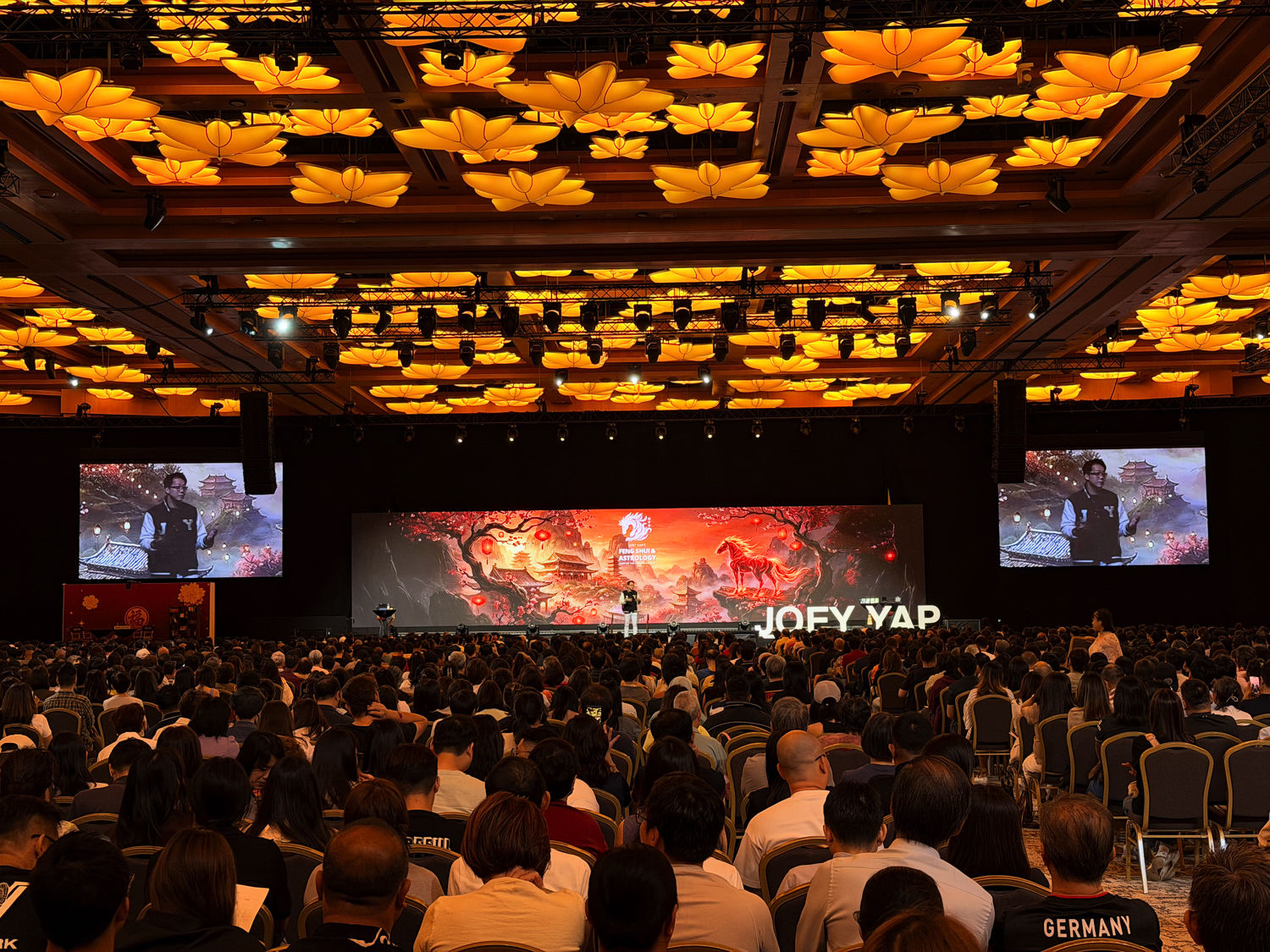
An overview of the Feng Shui & Astrology 2026 event.
For homeowners who want peace of mind without going deep into feng shui, Joey points to something surprisingly basic
One should ask, “How do you actually feel when you enter the place?” That first feeling is often the most reliable signal.
“If you walk into a home and immediately feel uneasy, uncomfortable or drained, something is already off. You don’t need a feng shui master to tell you that. Your body usually knows long before your rational mind tries to explain it away,” Joey shares. “If a home feels supportive, open, and easy to be in, you’re already practising good feng shui — whether you call it that or not.”
One final thought
If Joey had to leave homebuyers with just one piece of advice, it wouldn’t be about directions, charts or formulas. It would be about mindset.
“The most powerful feng shui in the world is the feng shui of your own heart,” he declares.
He explains that when someone is constantly pessimistic, emotionally reactive or caught in negative thinking, that state already creates imbalance — regardless of how good the house itself may be.
This is because, as he puts it, external feng shui tends to amplify what is already happening internally. When a person is tense or chaotic inside, the environment rarely feels supportive.
When the inner state is aligned, even an imperfect home can sometimes work surprisingly well.
“In that state, no house, no direction and no environment will ever feel quite right. You could place them in an objectively excellent property, and they would still feel unsettled,” he remarks. “But if your internal feng shui is good, it’s more likely that you’ll naturally be attracted to a property whose environment also reflects natural good feng shui.”
Follow Us
Property updates, 24/7.


Subscribe to Newsletter
Market insights, delivered weekly.

Top Articles
Search