
The AI shift and the Island: How AI-driven uncertainty elsewhere could fuel residential demand in Singapore
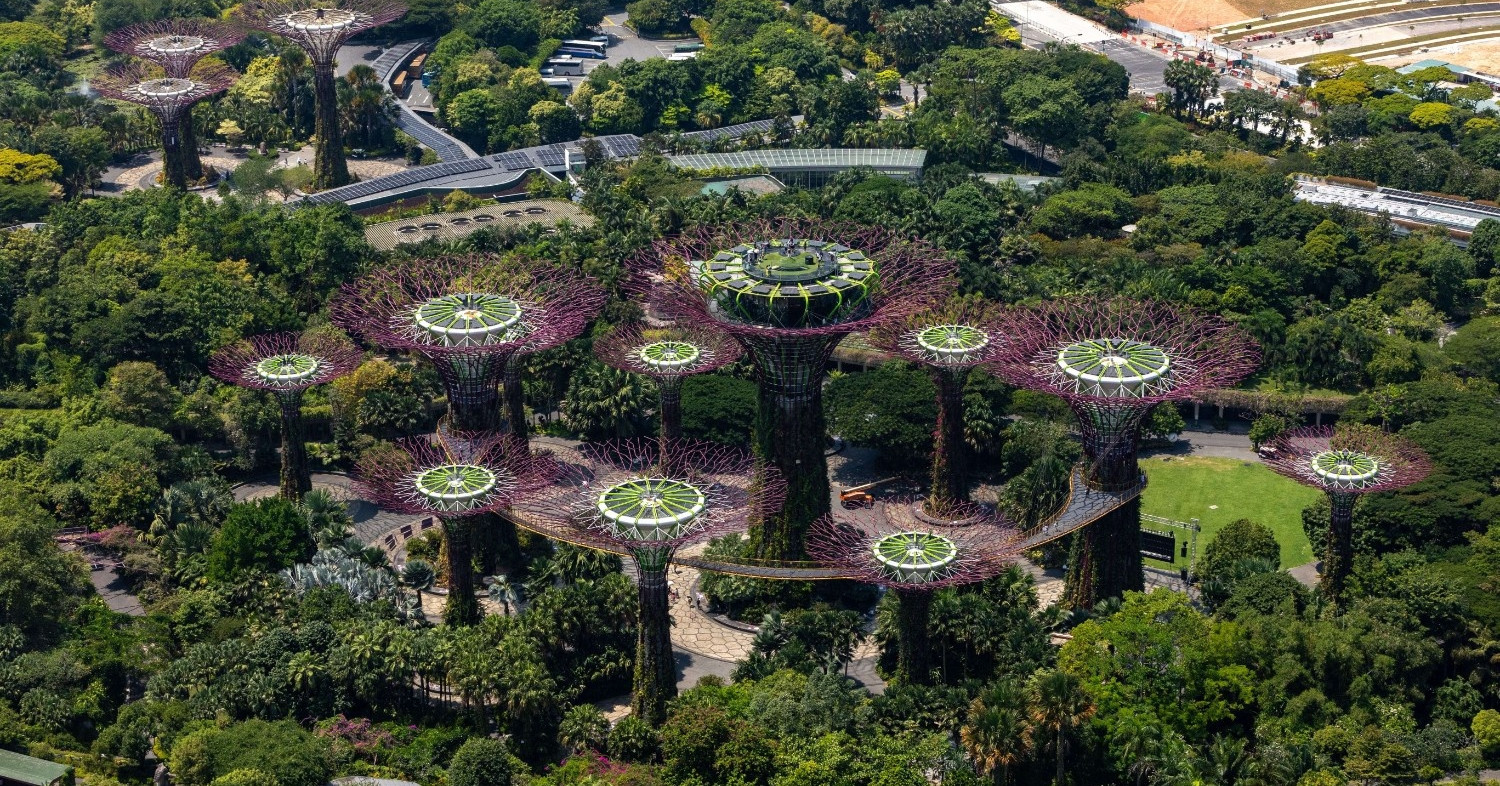
San Francisco built much of the frontier AI stack. Singapore is positioning itself as the place where the commercial, financial and operational layers surrounding that stack increasingly converge. (Photo: Samuel Isaac Chua/EdgeProp Singapore)
The most mispriced asset in any cycle is a city that simply continues to function.
Markets rarely misprice what they can see. The deeper opportunity lies in what they misclassify. AI is still largely being priced as a technology story: semiconductors, software, productivity and data centres. But AI is also a geographical and residential story.
The people building AI may work in the cloud. They still need somewhere to live.
That distinction matters because AI does not affect all countries equally. It concentrates capital, talent and economic coordination into a small number of functioning jurisdictions, while placing growing strain on labour markets, fiscal systems and political consensus elsewhere.
Singapore sits unusually well on the winning side of that divide.
As AI compresses labour demand across developed economies, the people and capital most exposed to the transition increasingly seek jurisdictions that remain politically stable, fiscally credible, operationally efficient and globally connected.
In practice, few places satisfy all four conditions simultaneously. Singapore is one of them.
What appears today as immigration inflow, wealth migration or technology investment may increasingly become something more structural: sustained residential demand generated by AI-driven global divergence.
AI compresses work. Singapore compresses uncertainty. Real estate prices the difference.
The system that was already running
Before the signal became obvious, the infrastructure was already in place.
Singapore has not suddenly become an unusually coordinated state. It has been one for decades. Sovereign capital allocates investment. The immigration system admits talent. The Economic Development Board places laboratories and corporate headquarters.
The result is a city that does not need to react dramatically to the future because it has spent 60 years building administrative systems designed to absorb it.
In most countries, AI policy is a press conference. In Singapore, it is a visa category.
Elsewhere, the future is announced. Here, it is administered.
What looks externally like momentum is often simply coordination made visible.
Hassabis and the elegant footnote
In November 2025, Demis Hassabis opened Google DeepMind’s first Southeast Asian research laboratory in Singapore.
Hassabis — Nobel laureate, founder and solver of protein folding — spent part of his childhood visiting his Singaporean mother’s family here. This explains nothing, and yet it explains something.
DeepMind did not become DeepMind because of Singapore. But Singapore has quietly become the kind of place where people like Hassabis now arrive deliberately.
The city acknowledged the lab without excessive celebration. In Singapore, the commentary is usually embedded in the lease.
At the same time, GIC appeared in Anthropic’s funding rounds, while Singapore increasingly surfaced near the top of Anthropic’s Economic Index for AI adoption intensity — ahead of cities that historically assumed the future had already chosen their address.
San Francisco built much of the frontier AI stack. Singapore is positioning itself as the place where the commercial, financial and operational layers surrounding that stack increasingly converge.
The Bay Area builds the future. Singapore quietly asks where the future intends to domicile its capital — and whether it has considered freehold.
The mechanism
The mechanism underpinning all this is surprisingly simple.
Each company that replaces labour with AI captures the full productivity gain internally while distributing the resulting loss of aggregate demand across the broader economy.
Automation, therefore, remains individually rational even when it becomes collectively destabilising.
No firm can afford to wait for competitors to slow down.
The same logic scales to countries.
This dynamic was formalised in The AI Layoff Trap, a paper by economists at the University of Pennsylvania and Boston University that has circulated widely through technology and finance circles since early 2026. Its influence stems less from alarmism than from precision.
The paper’s central argument is not that AI suddenly creates mass unemployment; it is that prolonged labour displacement gradually erodes the payroll-based tax systems.
The danger is structural rather than cyclical.
As labour income weakens, fiscal deficits widen. Governments respond through redistribution, borrowing or higher taxation on increasingly mobile pools of capital and high-income residents.
The more successful and internationally mobile that cohort becomes, the easier it is for them to relocate before the adjustment fully arrives. This is where Singapore re-enters the story.
The pre-emption
Policy is slow. Capital is not.
In most developed economies outside the US, tax liability is determined primarily by residency rather than citizenship. Establishing genuine domicile elsewhere often requires no renunciation, no irreversible political act — merely mobility, planning and sufficient incentive.
In many developed economies, a relatively small upper-income cohort contributes a disproportionate share of income tax revenue. The fiscal system is broad in theory and narrow where it matters.
Once even a modest share of that cohort exits, deficits widen, tax pressure intensifies, and further departures follow. The cruel irony is that the people most capable of funding the adjustment are often the ones most able to leave before it arrives.
The first to relocate are not usually the displaced workers. They are the people who understood the displacement mechanism earliest — founders, researchers, fund managers, senior operators and globally mobile professionals.
The person building the AI displacement model and the person positioning capital ahead of its consequences are sometimes the same person.
They tend to arrive in Singapore around the same time.
Demand rarely announces itself dramatically. It signs a lease, enrols a child in school, asks how long it takes to obtain permanent residency, and quietly upgrades from a serviced apartment to a freehold.
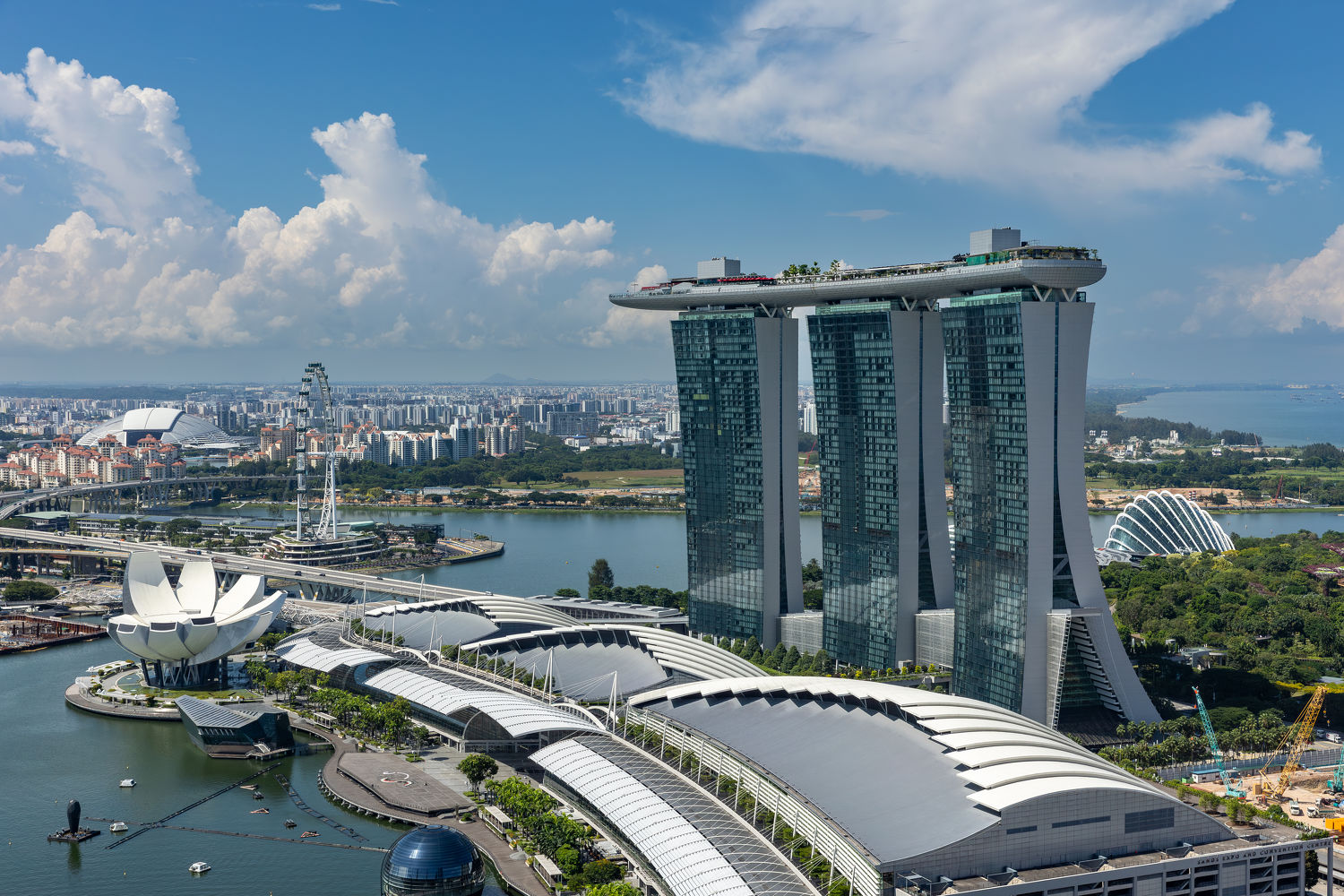
AI compresses work. Singapore compresses uncertainty. Real estate prices the difference. (Photo: Samuel Isaac Chua/EdgeProp Singapore)
The recursive exit
The AI Layoff Trap’s logic contains a second-order implication. The only durable way to offset AI-driven labour displacement is through even broader AI deployment: new industries, new applications, new forms of productivity and new categories of work built atop the technology itself.
The cure and the disruption increasingly share a name.
The societies most affected by AI, therefore, require more AI to stabilise themselves. This means the cities at the centre of AI activity are not merely avoiding the disruption. They are becoming the primary environments through which the disruption is managed.
This is why Singapore real estate is not simply a hedge against technological instability elsewhere. It is a stake in one of the few places where the capital funding AI, the talent deploying it, and the institutions integrating it are converging simultaneously.
Every AI company scaling internationally requires a place to base researchers, house executives, structure regional operations and domicile capital. The resulting residential demand is not incidental to the thesis. It is the thesis, expressed in square metres.
Permission
The bottleneck in AI is no longer capability. It is deployment.
Europe regulates. The US innovates. Singapore operationalises.
Only one of those verbs consistently signs leases.
The scarce resource in the AI economy is no longer intelligence. It is permission: permission to build, deploy, scale, integrate and recruit.
Singapore has spent decades building administrative systems optimised around operational certainty. In the AI era, that certainty becomes economically valuable.
The table at which both sides sit
The global AI race increasingly has two poles: the US and China.
Export controls, data localisation rules and national-security restrictions are steadily separating the two ecosystems. Both sides, nevertheless, require neutral, legally sophisticated and politically stable jurisdictions through which international operations can still function.
Singapore occupies an advantageous position.
It is one of the few places where leading US and Chinese technology firms maintain significant operations simultaneously. Singapore does not attempt to dominate either ecosystem. It provides a table at which both can still transact.
Neutrality is not absence. It is infrastructure.
The table, naturally, requires an expensive address.
The geography of AI’s winners increasingly flows into Singapore’s premium residential market. That is not metaphorical. It is the asking price.
The talent stack
In 2026, Singapore launched the ONE Pass (AI and Tech) track — a purpose-built visa framework aimed at top-tier artificial intelligence talent: a five-year, renewable visa with minimal restrictions.
The salary threshold is the sort of number that quietly sorts a room without anyone needing to ask further questions.
More than 8,000 people are already on the broader ONE Pass framework, including senior international technology executives such as OpenAI’s Oliver Jay, whose international strategy operations are run from Singapore.
These are not passive arrivals. That senior researcher, founder or fund manager relocating under the ONE Pass does not simply occupy residential space. They generate income, hire locally, seed companies and reinforce the ecosystem that attracts the next arrival.
Each principal makes Singapore marginally more valuable for the one that follows.
In 2025, Singapore ranked first globally in the Insead Global Talent Competitiveness Index — the first time Switzerland did not.
Talent follows infrastructure. Residential premiums follow talent.
The infrastructure bet
Data centres follow power. Talent follows law. Capital follows both.
Singapore imposed a moratorium on new data-centre construction in 2019 before gradually reopening approvals from 2022 onwards. Since then, AWS, Google, Microsoft and ByteDance have all expanded aggressively across Singapore and neighbouring Johor.
The overflow infrastructure moved north. The talent largely stayed on the island.
The infrastructure scales across borders. The residential demand concentrates locally.
The Stockholm analogy
Sweden did not build OpenAI. It built Spotify, Klarna and a generation of companies that understood where the technological frontier was heading and positioned themselves accordingly.
Position compounds.
Singapore has understood this principle for decades.
It does not need to invent frontier intelligence itself. It needs to become indispensable to the commercial layer built around that intelligence: capital formation, legal infrastructure, regional headquarters, deployment, talent concentration and wealth preservation.
The frontier models may remain American or Chinese. The applications layer has no permanently fixed address. Singapore is quietly arranging to provide one.
The AI Layoff Trap does not predict catastrophe. It describes a mechanism.
The distinction matters because catastrophes are visible. Mechanisms are not.
By the time the mechanism becomes fully visible, much of it may already be priced.
The last stable address
Singapore’s 60-year project — governance, coordination, institutional legibility and rule of law — was not built specifically for AI. The AI era simply made those characteristics unusually valuable.
Singapore did not set out to become a refuge from the consequences of AI. It simply built a system that works — for capital, for talent and for time.
As other systems come under strain, competence stops looking administrative. It starts looking scarce.
And scarce things, in Singapore, tend to acquire an address.

Chunkky Lim is the pen name of a Harvard MBA and former hedge fund professional who now helms his family office, managing a diversified real estate portfolio across industrial, commercial and residential sectors
Follow Us
Property updates, 24/7.


Subscribe to Newsletter
Market insights, delivered weekly.
Top Articles
Search