
Apac real estate investment grew 13.7% in 2025, led by rebound in retail deals: Knight Frank

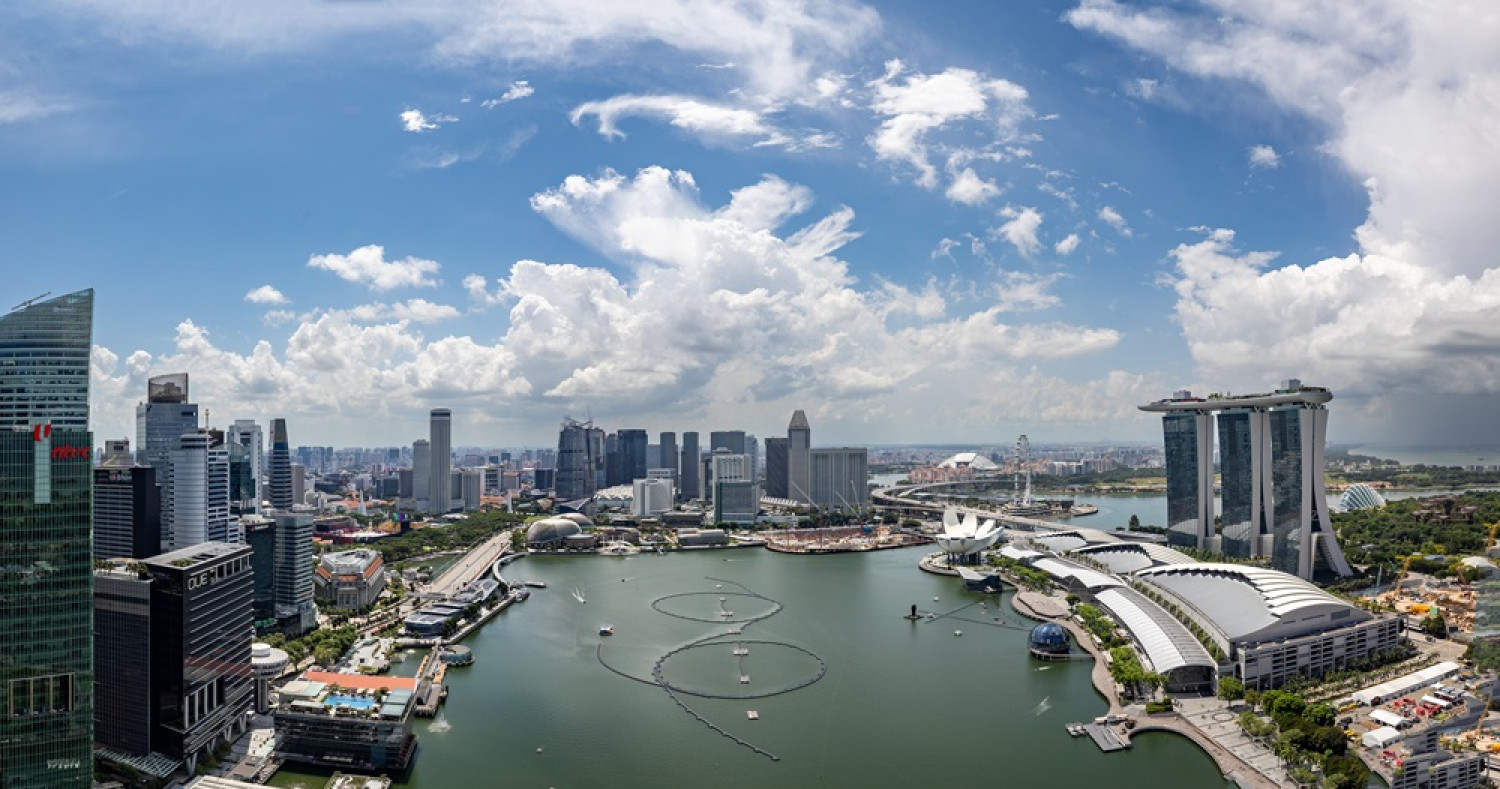
Knight Frank’s report attributes the improved performance in 2025 to a sharp rebound in retail asset deals, supported by improving occupier fundamentals and resilient consumer demand. Apac retail real estate investments in 4Q2025 surged 109.5% q-o-q and nearly doubled y-o-y, while full-year investment jumped 31.2% versus 2024. (Photo: Samuel Isaac Chua/EdgeProp Singapore)
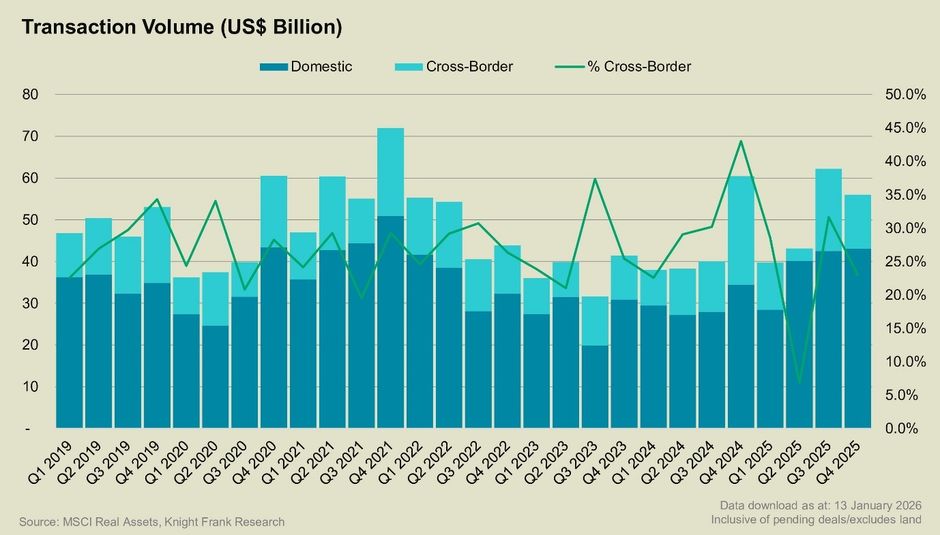
Real estate investment in the Asia Pacific (Apac) region grew in 2025, despite a lower volume recorded in the last quarter of the year. A January research report by Knight Frank shows that Apac real estate investment totalled US$56 billion ($70.9 billion) in 4Q2025, a 10% decrease from the previous quarter and a 7.4% decline y-o-y.
However, investment volume clocked in at US$201 billion for the whole of 2025, marking a 13.7% increase from 2024. Knight Frank adds that the performance aligns with its projected growth of 10% to 15% for last year.
Knight Frank’s report attributes the improved performance in 2025 to a sharp rebound in retail asset deals, supported by improving occupier fundamentals and resilient consumer demand. Apac retail real estate investments in 4Q2025 surged 109.5% q-o-q and nearly doubled y-o-y, while full-year investment jumped 31.2% versus 2024.
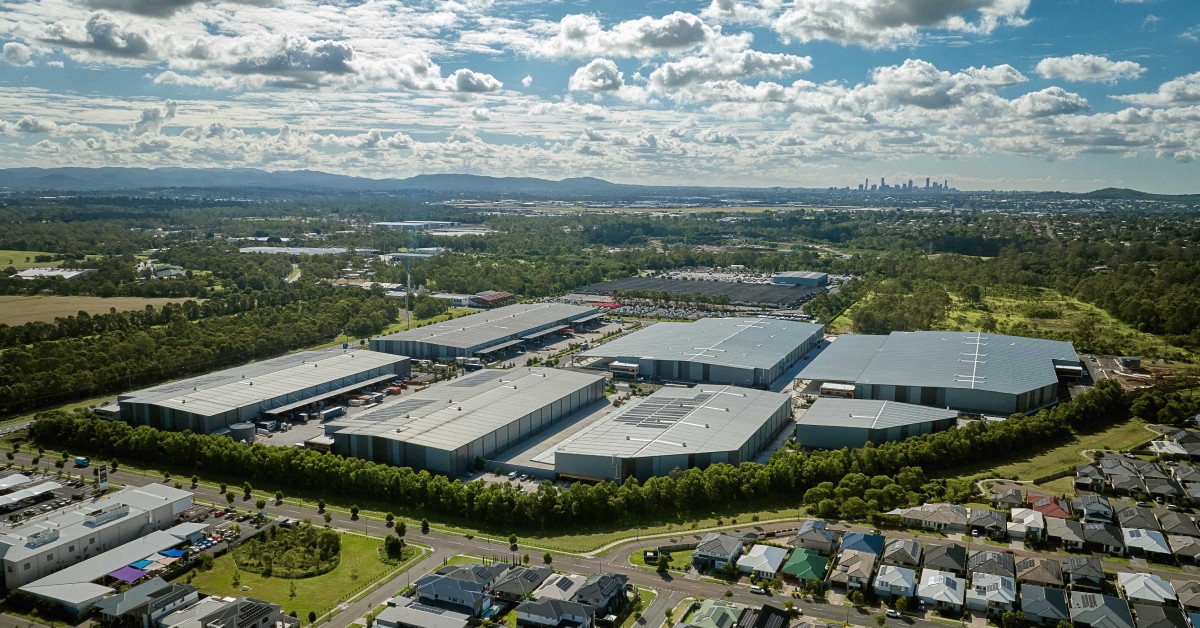
Notable Apac retail transactions during 4Q2025 included Lendlease Global Commercial REIT’s acquisition of a 70% stake in PLQ Mall in Singapore in a deal that values the mall at $885 million, as well as the purchase of a 25% stake in Brisbane mall Westfield Chermside by Australian asset group Dexus for A$683 million ($604 million).
Knight Frank also analysed cross-border capital flow across the region, which declined 19% y-o-y from $57.8 billion in 2024 to $46.8 billion in 2025. The firm posits that the lower cross-border investments reflect “lingering geopolitical uncertainties, currency volatility and a shift in investor focus towards domestic opportunities”.
Christine Li, head of research for Apac at Knight Frank, adds that cross-border investors are choosing to focus on markets with supply constraints and strong occupier demand, including Tokyo’s office market, Australia’s retail landscape and South Korea’s prime logistics space. “The common thread is that investors are backing rental growth potential rather than chasing yield compression, a more sustainable approach than previous cycles,” she adds.
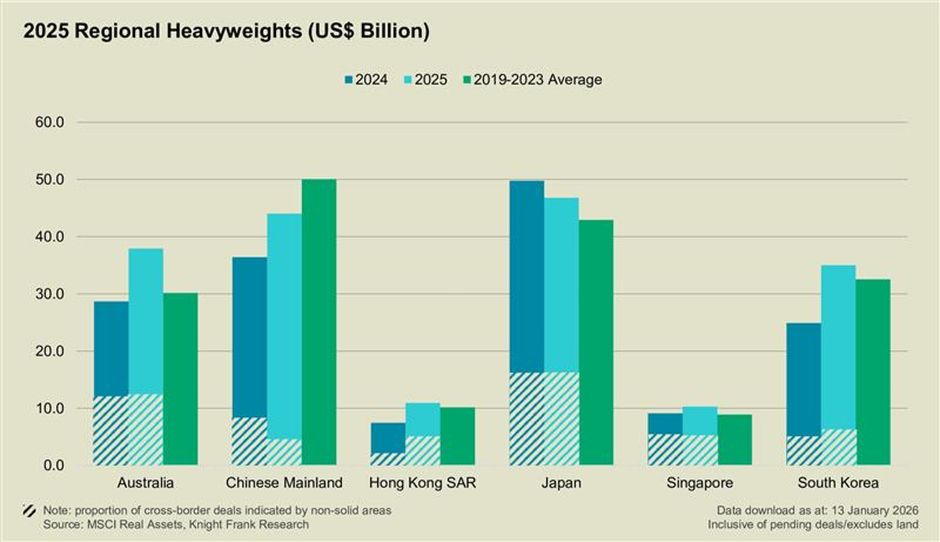
Japan led the pack for international investments in 2025, registering US$16.2 billion in volume in 2025, up 0.4% y-o-y. Australia ranked second with US$12.4 billion in investments, up 3.2% y-o-y, followed by South Korea, at US$6.3 billion, up 23.7% compared to the year before.
Looking ahead, Knight Frank expects Apac real estate investments to sustain momentum in 2026, backed by borrowing costs that have likely bottomed. The firm projects investment volume to grow by 5% to 10% this year, with core markets such as Japan, Australia, Singapore and South Korea leading deal activity
Follow Us
Property updates, 24/7.


Subscribe to Newsletter
Market insights, delivered weekly.


Top Articles
Search