
Developers, project teams encouraged to use Kit-of-Parts approach; overseas testing for new construction workers to stop


Consultants may save 320 man hours per project from the streamlined approval process, and the Kit-of-Parts approach could lower manufacturing costs, BCA said. (Photo: Samuel Isaac Chua/EdgeProp Singapore)
- Singapore’s Building and Construction Authority will streamline approvals for developers using the Kit-of-Parts approach, saving consultants about 320 man hours per large project.
- Consultants working on public sector projects will be able to provide feedback to government agencies on areas for improvement, with a new annual survey to be launched in May 2026.
- The removal of overseas skills testing for new construction workers from 2027 will cut hiring timelines from four months to one, improving workforce agility.
AI generated
Property developers and project teams that adopt the Kit-of-Parts (KoP) approach — dubbed the “Lego bricks” method as it standardises precast components across projects — across their projects are expected to benefit from a streamlined approval process in Singapore.
Two other “pro-enterprise” measures were also unveiled at the BuildSG LEAD Summit on April 30: the progressive removal of overseas testing for new construction work permit holders from 2027 onwards, and a new annual rating survey for consultants to provide feedback to public agencies.
The three initiatives announced at the summit are meant to accelerate the transformation of Singapore’s built environment sector, the Building and Construction Authority (BCA) said.
New regulatory pathway to incentivise adoption of Kit-of-Parts approach
KoP involves the use of pre-designed and prefabricated standard building components across multiple projects, to make manufacturing and assembly more efficient.
From April 30, developers applying this approach will only need to submit one design standardisation plan (DSP), which outlines typical spatial grids and sizes, and a catalogue of standardised or modularised parts for BCA's acceptance.
“This is essentially a bao kar liao [do everything] approach that meets BCA’s buildability and constructability requirements,” said Minister for National Development, Chee Hong Tat, at the summit.
In other words, once a developer’s proposal is accepted by BCA, project teams from this developer need not submit new buildability and constructability applications for individual projects adopting KoP subsequently.

At the BuildSG LEAD Summit, Chee emphasised that the Kit-of-Parts approach does not mean going for “cookie-cutter” designs. (Photo: Ministry of National Development)
Consultants are expected to save about 320 man hours per project — for a typical large residential non-landed or institutional project — from the streamlined approval process.
The KoP approach is also likely to lower manufacturing costs for precast components by at least 10% and reduce manpower needs by at least 20%. It could also facilitate access to a greater variety of precast sources.
While the components may be standardised, consultants can vary their building layouts and facade designs.
“I just want to assure our designers and architects that we are not going for a cookie-cutter type of design. We still want you to give good designs … that can have distinctive identities across different projects,” Chee said at the summit.
“We believe we can achieve this together with the standardisation of some of the components. The two are not mutually exclusive,” he added.
Examples of possible pre-designed parts include:
- Architectural elements: e.g. facade walls, parapet walls
- Structural elements: e.g. household shelters, bathroom units, staircases
- Mechanical and electrical (M&E) elements: e.g. integrated M&E ducts
Tan Poh Tuck, executive director of building construction at Teambuild Engineering and Construction, which has expertise in residential, institutional and industrial projects, said that from an operational perspective, precast standardisation enhances efficiency across the value chain.
“In our precast operations … it enables better mould reuse, production planning and resource optimisation, which directly improves throughput and reduces wastage,” he commented.
On site, installation processes are simplified and cycle times are potentially reduced, which contributes to safer and more predictable project delivery, Tan added.
Engineering firm KTP Consultants managing director, Aaron Foong, noted that with the buildability type approval for the KoP approach, there can be a pre-validated regulatory pathway through the cataloguing of repetitive designs that shortens the design-to-approval cycle.
“This initiative elevates engineering design productivity by systematising routine processes and improving consistency across supply chain delivery,” Foong said.
Major public-sector developers are in the process of adopting the KoP approach.
For example, HDB is developing an enhanced precast components catalogue, comprising building components with established specifications such as standard dimensions, material content and connection details.
The Ministry of Education, MOH Holdings, Land Transport Authority and JTC are also embarking on similar efforts for schools, healthcare facilities, commuter facilities (such as bus shelters and covered walkways), industrial buildings, and workers’ dormitories, respectively.
Removal of overseas testing requirement for construction workers
To speed up the process of bringing in new workers, from January 2027, BCA will cease the overseas testing for new construction work permit holders from China and Thailand.
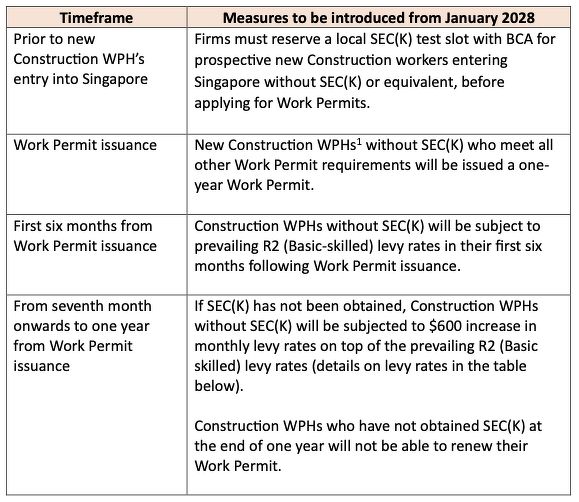
This overseas testing requirement — the pre-entry Skills Evaluation Certificate (Knowledge) (SEC(K)) testing — will also be removed for all source countries from January 2028, to give firms sufficient time to adjust their recruitment processes.
This is expected to significantly reduce hiring timelines — from the current four months to about one month — and enable better matching between workers’ skills and job requirements.
It will also give employers more flexibility to conduct on-the-job training that best meets their projects’ needs.
Upholding skills standards in the construction sector:
Source: BCA
A spokesperson from the Singapore Contractors Association Ltd (SCAL) said responsible firms will benefit from a shorter lead time when bringing in new skilled workers, and can also be more agile in responding effectively to their projects’ manpower requirements.
“SCAL will work with members to ensure that their new construction workers’ skills are assessed in a timely manner, to uphold the skills standards in the industry,” the spokesperson added.
Specialists Trade Alliance of Singapore (STAS) president Ian Teo noted that removing the overseas testing requirement will provide flexibility for specialist contractors to directly assess, select and bring in new workers with the skill sets needed for projects.
BCA will adjust the testing capacity in Singapore to ensure new construction work permit holders can obtain SEC(K) locally and in a timely manner.
Currently, the pre-entry SEC(K) testing is mandatory in the workers’ source countries. It evaluates foreign workers’ trade knowledge and craft-skills competencies, to ensure they have the foundational skills required for safe and effective construction work in Singapore’s built environment sector. The trade test is administered by BCA through appointed overseas testing centres.
From January 2028 onwards, to be eligible for work permit renewals, new construction work permit holders must pass the SEC(K) in Singapore within one year from the issuance of their work permit. Firms are to reserve a test slot before the workers enter Singapore.
Firms will pay the prevailing R2 (basic-skilled) levy rate for new construction work permit holders who are brought in without SEC(K) for the first six months. These workers will then need to pass the test conducted in Singapore within six months to maintain the levy rate — if not, the firms will be liable to pay a higher levy rate after the six-month grace period.
Annual rating system on public sector agencies and projects
Consultancy firms working on public sector projects will be able to provide regular feedback to government agencies on areas for improvement, with a new annual survey to be launched in May 2026.
Administered by BCA, the survey will remain open for a month. Consultancy firms can give ratings to agencies on a scale of 1 “Strongly Disagree” to 6 “Strongly Agree” in specific areas on agencies’ practices.
The aggregated findings — without attribution to any firms — will be shared with the relevant agencies. This is meant to provide a "safe space" for consultants to share candid and constructive feedback, and the agencies will be encouraged to improve on their practices, BCA noted.
Natalie Yong, first vice-president (quantity surveyor division) of the Singapore Institute of Surveyors and Valuers, described the reciprocal feedback platform as a “timely and meaningful step” towards a more balanced and transparent procurement ecosystem.
“It should not be seen as a channel to fault-find or air grievances, but as a safe and constructive mechanism to drive continuous procurement practices, strengthen collaboration and ultimately raise overall public sector project delivery standards and outcomes,” Yong added.
Currently, public agencies are able to rate consultancy firms through the Consultants Performance Appraisal System (CPAS).
Together, the existing CPAS and the new annual survey to rate government agencies is expected to facilitate two-way feedback to help all parties improve their practices and deliver better projects to benefit the public.
Chuck Kho, president of the Association of Consulting Engineers Singapore, said this will enhance transparency and collaboration across public-sector procurement.
Singapore Institute of Architects president, Tiah Nan Chyuan, noted that the institute is looking to mirror BCA’s efforts and provide its members with a similar feedback system for the private sector.
For more news and analysis, read our weekly e-paper. Prefer a print copy? Get it delivered to your home every Monday.
Follow Us
Property updates, 24/7.


Subscribe to Newsletter
Market insights, delivered weekly.



Top Articles
Search