
Australia property sector enters a new compliance era as rules tighten for agents, developers

Stock image of a waterfront suburb in Australia, for illustration purposes only. Tranche 2's practical implications for property professionals are expected to affect multiple stages of a typical transaction. (Photo: Unsplash)
For years, Australia’s real estate market has not just been a favoured destination for homebuyers and investors, but has also been viewed by authorities as vulnerable to misuse for the laundering of illicit funds.
That landscape is now shifting. The passage of Australia’s Anti-Money Laundering and Counter-Terrorism Financing Amendment Bill 2024 — commonly known as Tranche 2, as the second phase of regulatory reforms — marks a significant regulatory shift for the property sector in the country.
It extends formal anti-money laundering (AML) and counter-terrorism financing (CTF) regulatory coverage to a broader range of real estate professionals.
With the July 1, 2026 compliance deadline approaching, the focus is increasingly shifting from awareness to action, and the stakes are significant.
Real estate and money laundering risk
Australia's financial intelligence agency, the Australian Transaction Reports and Analysis Centre (Austrac), has, in various public assessments, flagged domestic real estate as presenting a very high money laundering risk.
This reflects factors such as high transaction values, complex ownership structures and the potential for large sums of money to be invested or transferred through property transactions. Real estate as an asset class also draws a high volume of international investment, which Austrac has noted can make it "highly desirable" as a means to transfer and store wealth.
The country’s stable political environment, open economy and independent legal system can also increase its attractiveness to international capital, and thus as a potential destination for illicit wealth.
The numbers tell a stark story. Between 2019 and 2024, the Australian Federal Police seized over A$1.1 billion ($1 billion) in illegal assets — more than A$720 million ($659 million) of which was in real estate, spanning 370 confiscated properties.
In 2023 alone, the authorities reported confiscating A$229 million in allegedly laundered real estate, alongside bank accounts, cars, fine art, yachts and other high-value luxury items. In 2024, more than $110 million in assets were restrained, including waterfront properties, high-rise apartments and a house that was still under construction.
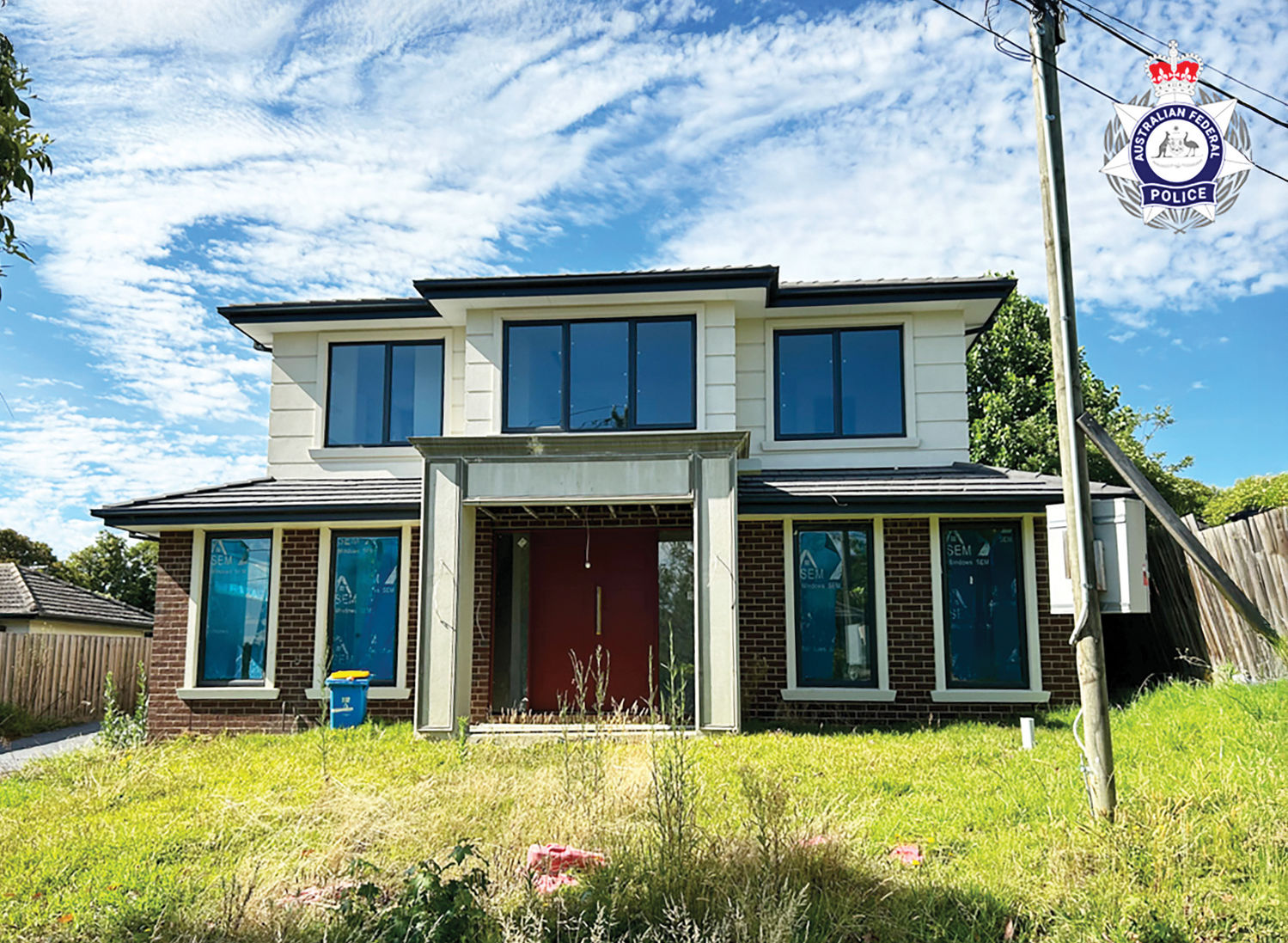
A house worth $3.9 million was under construction when it was seized by the Criminal Assets Confiscation Taskforce in 2024. (Photo: Australian Federal Police)
These figures are indicative of broader, ongoing risk.
Importantly, certain of the so-called “gatekeeper” professions can be involved in setting up and operating the complex business structures and banking arrangements that criminals may use to conceal wealth and obfuscate money laundering activity.
Specifically for real estate assets in Australia, Austrac has highlighted that lawyers, accountants and property agents are commonly involved in the purchase, sale, transfer of ownership and financing arrangements.
Since late 2025, the Sydney Morning Herald newspaper has been reporting on alleged fraud and money-laundering activity involving a group dubbed the Penthouse Syndicate, which allegedly defrauded some of the country’s largest banks and financial institutions. Just this April, authorities announced that a legal professional was arrested; he is accused of involvement in the fraudulent purchase of mortgaged properties valued at more than A$25 million.
Until now, real estate agents, buyers’ agents and property developers have operated outside the stringent AML/CTF framework that governs banks and financial institutions. Tranche 2 is intended to address that regulatory gap.
Key reform requirements
Passed by the Australian Parliament on Nov 29, 2024, the AML/CTF Amendment Bill significantly expands the reach of the existing regime.
The reform is intended to bring the country into closer alignment with standards set by the Financial Action Task Force (FATF) — the global body responsible for setting AML/CTF benchmarks — and materially expand the number of regulated entities under Austrac to approximately 100,000.
For real estate professionals, the reforms introduce both initial and ongoing compliance expectations.
Enrolment with Austrac opened on March 31 this year, with broader AML/CTF compliance obligations expected to apply from July 1. By that point, regulated entities are generally expected to have in place measures such as an AML/CTF programme, defined key compliance roles and responsibilities, and customer due diligence processes.
Ongoing requirements under the regime may include suspicious matter reporting and annual compliance reports.
The penalties for non-compliance are significant: up to A$6.6 million for individuals and A$33 million for corporate entities.
Notably, the scope of the regime is broad and may even extend to smaller operators, including certain sole practitioners involved in facilitating property transactions, even where they do not directly handle client funds.

Stock image of a luxury home. Real estate agents will also be expected to consider behavioural indicators, such as remote buyers who have never personally inspected a property. (Photo: Unsplash)
The day-to-day impact on transactions
The practical implications for property professionals are expected to affect multiple stages of a typical transaction.
Under the proposed reforms, agents, lawyers and accountants may be required to collect and verify client identity information, confirm the underlying ownership and control of corporate or trust structures, and in certain cases seek evidence of the source of funds or source of wealth.
Austrac’s national risk assessment identifies several transaction-level risk factors that regulated entities are expected to consider.
Large transaction values remain a primary concern, given that real estate transactions can involve significant sums of money.
Complex or layered ownership structures — particularly those involving offshore entities — introduce opacity that can obscure the true beneficial owner.
Cash-heavy deals and informal arrangements are generally viewed as further increasing vulnerability.
Beyond structural complexity, Tranche 2 also flags specific behavioural indicators that real estate agents will be expected to consider as part of a risk-based approach: remote buyers who have never personally inspected a property, customers purchasing on behalf of undisclosed third parties, and politically exposed persons that may require enhanced due diligence due to their potential exposure to fraud, bribery or links to high-risk jurisdictions.
For an industry where speed, relationships and discretion have traditionally been competitive advantages, these requirements represent a cultural as much as an operational shift.
Building compliance into the business
The challenge for many real estate businesses lies in embedding AML/CTF obligations into how they operate day to day.
Effective compliance typically involves investment in staff training, updated client onboarding processes and robust record-keeping.
For larger real estate agencies and developers, this may mean dedicated compliance personnel or third-party support. For smaller operators, it will mean understanding how the regime applies to their specific business model and acting accordingly.
Tranche 2 is more than a compliance update — it is a structural shift in how Australia approaches financial crime in its property markets.
By aligning with FATF standards, Australia is signalling to the international community that it is serious about addressing perceived vulnerabilities in the real estate sector.
For professionals in the industry, the message is clear: the regulatory perimeter for the property sector is expanding materially.
A key question now is how quickly and how well businesses can build the systems, culture and capability to meet what the law requires.

Qing Liu is senior director of compliance and third-party risk in Australia at Moody's.
Follow Us
Property updates, 24/7.


Subscribe to Newsletter
Market insights, delivered weekly.


Top Articles
Search