
Singapore's Barbie Dreamhouse: Inside collector Jian Yang's home, where dolls number in the tens of thousands
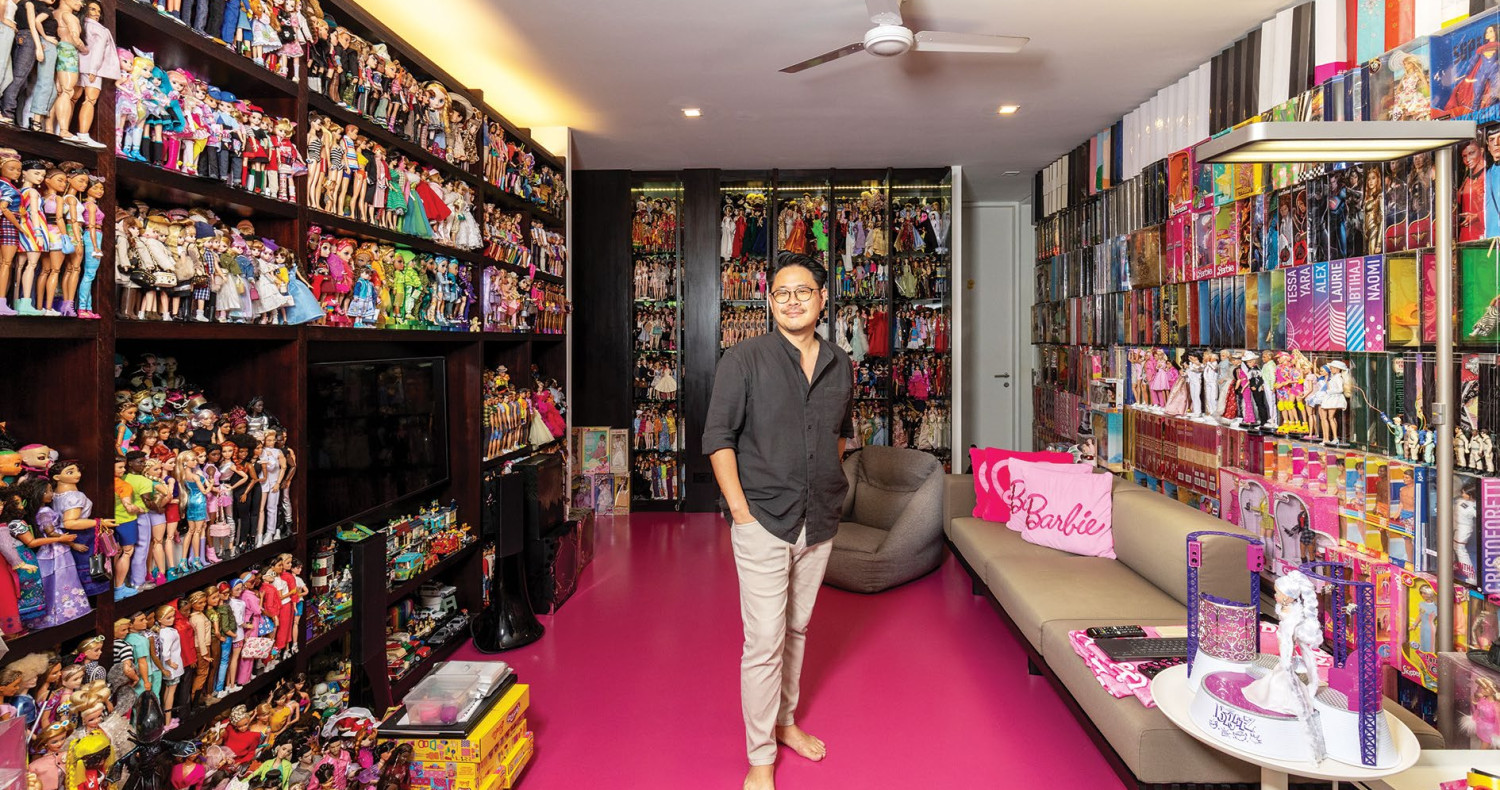
At Jian Yang’s townhouse, his dolls are stacked to the ceiling, aptly paired with flooring in a vibrant Pantone 219 C, widely known as “Barbie Pink” (Photo: Samuel Isaac Chua/EdgeProp Singapore)

Ask Buddy
When Jian Yang bought his first home in his early 30s, he was not just looking for a roof over his head. He needed a stage big enough to house his growing collection of Barbie dolls.
Today, his 1959 strata-titled townhouse in District 19 is as much a character as he is.
Step inside and you are immediately met with tens of thousands of dolls — 13,000 at last count in 2024 — though Jian has admittedly stopped keeping track given the sheer volume.
His vast collection has appeared in global media, from BBC to Bloomberg, as well as in tourism campaigns and talks. For Jian, the house is not simply a place of residence; it is where his identity takes physical form.
A townhouse chosen with heart — and Barbie
The 47-year-old, who runs a marketing agency, describes his home as a half-terraced townhouse; it is effectively one storey of what was originally a two-storey terraced property, now split into separate strata units.
The 9,999-year leasehold unit measures about 1,050 sq ft across the main upper level and the ground floor, which opens out to a private outdoor area.
Before purchasing the home, Jian had spent most of his early adult years living with his family. At 27, he moved to Bahrain in the Middle East for work, and lived on his own for four years. The experience of independence reshaped his expectations of home.
When he returned to Singapore, he knew he wanted a place of his own — and a place for his collection.
He planned for the collection to be prominently displayed, having grown tired of the dolls sitting in wooden cupboards at his parents’ home. Moving out was his chance to bring both the dolls — and the persona attached to them — firmly into view.
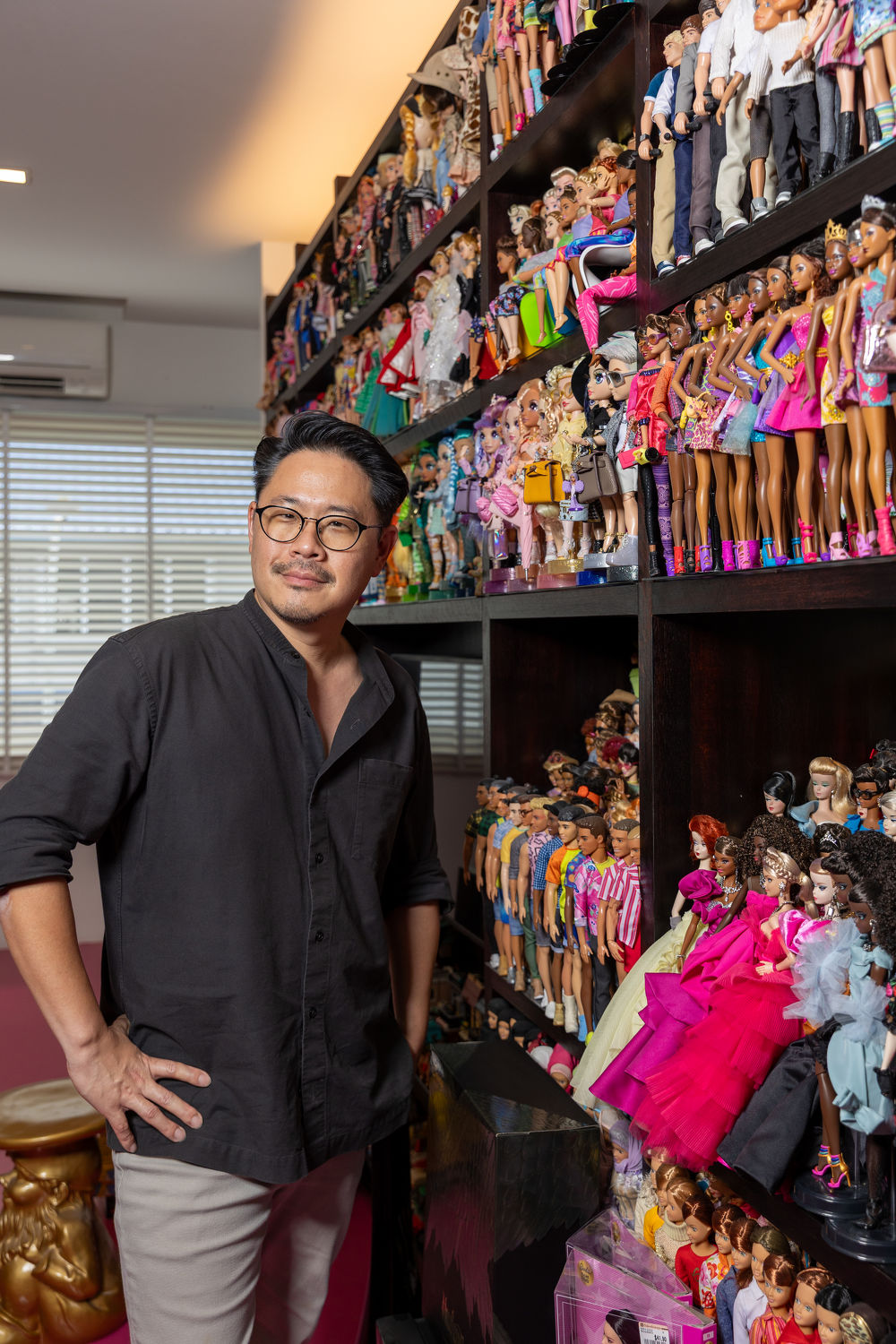
Even Jian's first property purchase came with "a Barbie twist" (Photo: Samuel Isaac Chua/EdgeProp Singapore)
In 2011, at 32 and armed with a budget of $1 million, Jian began looking for private property in the vicinity of his family home — their houses are currently just 600m apart. “I’m very close to my parents, but not close enough to live with them,” he says with a laugh.
Space was not a primary concern. There was no urgent need to house his entire collection in one place, as his parents and grandparents still had ample storage space at their homes. As such, he was open to a variety of property types, unit sizes and configurations.
When Jian’s search began, the townhouse was not on the market. It was only while viewing an apartment across the road that he first caught sight of the house’s outdoor terrace space. He fell in love with it instantly, and found himself wondering idly whether the house might one day be for sale.
As it turned out, it would be. Just a few days later, in a serendipitous turn, his mother spotted the townhouse’s address in the classifieds. They arranged to view the unit that same day.
Several features stood out. The spiral staircase leading down to the ground floor, where he had envisioned setting up a fish pond, felt immediately familiar. It reminded him of the Peranakan house he grew up in, one with terrazzo floors, heavy wooden furniture and mosaic staircases.
Then came the detail that sealed the deal for Jian: the townhouse was built in 1959 — the same year that Barbie was launched.
He made an offer almost immediately, snagging the property for about $1 million.
Designing a journey through the home
The home unfolds in a carefully choreographed sequence. Jian’s long-time friend at Visual Text Architects conceived the circulation path across the space, mapping out how and when the collection reveals itself to anyone moving through the house.
Step through the front gate, past an unassuming facade and up a flight of stairs — and you are met with the “first hit of dolls”, framed by a single window in an otherwise pure-white stairwell. These are the dolls Jian chooses to see first and last each day. At the moment, the spot is occupied by his Wizard of Oz-themed collectibles.
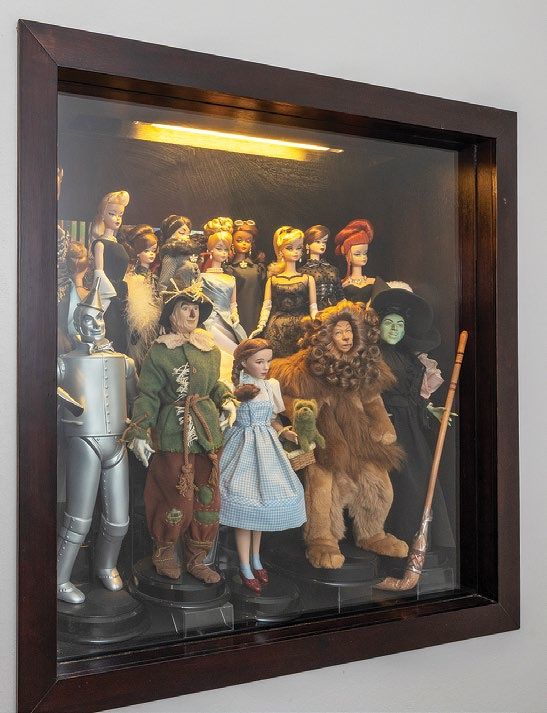
The “first hit of dolls” — currently with a Wizard of Oz theme — positioned such that they are the first and last thing he sees each day (Photo: Samuel Isaac Chua/EdgeProp Singapore)
From here, walk straight and enter the kitchen. Dolls appear before you even step fully inside — mermaid Barbie and Ken dolls are suspended from the ceiling with fishing lines, hovering above the dining table, while others are lined atop the refrigerator.
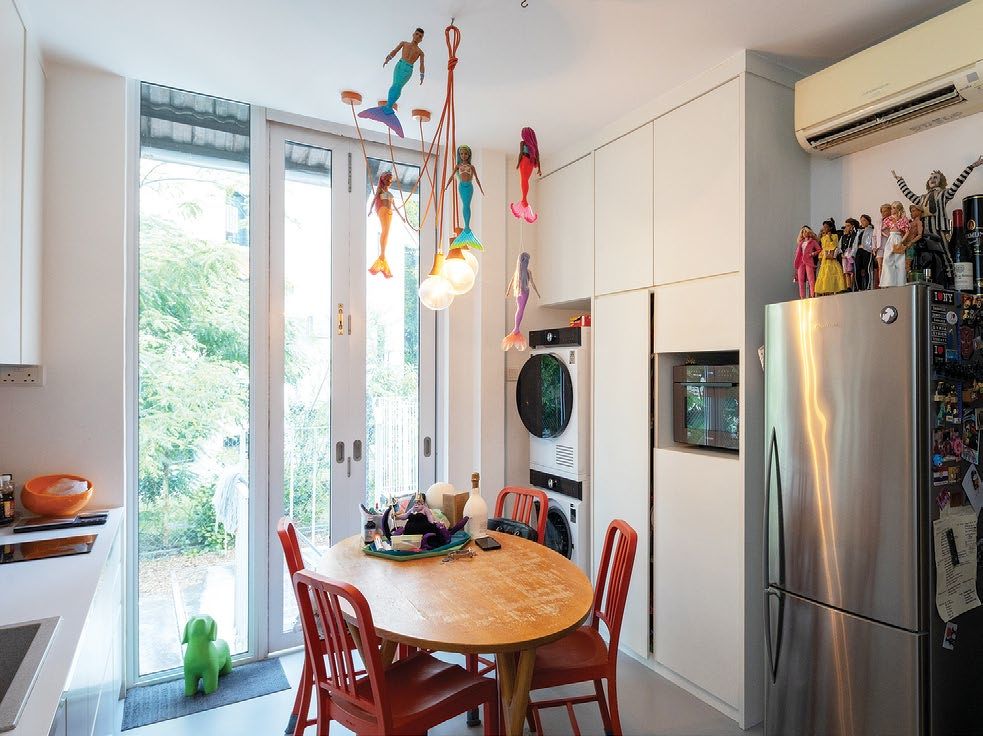
In the kitchen, mermaid Barbie and Ken dolls are suspended from the ceiling with fishing lines, hovering above the dining table (Photo: Samuel Isaac Chua/EdgeProp Singapore)
To your right, the main showcase comes into view. Serving as a partition wall between the kitchen and living room, it is designed as a double-sided display with dolls facing both spaces.
At the end of the showcase, the bathroom is to your left. It is understated at first glance, save for a Barbie floor mat and a yellow rubber duck on the wall. But walk into the shower area and another surprise greets you: a full-height shelf lined with Tubbz — collectible duck figurines styled after pop culture characters — from top to bottom.
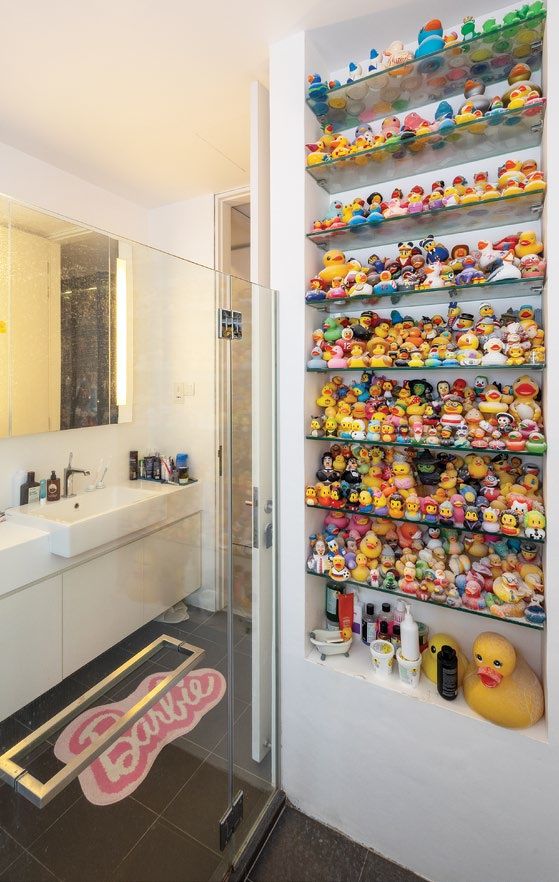
A shelf in the shower is chock-full of Tubbz figurines (Photo: Samuel Isaac Chua/EdgeProp Singapore)
Adjacent to the bathroom is the main bedroom, which Jian has allocated as the only doll-free zone indoors, offering a quiet counterbalance to the visual saturation elsewhere in the house. A shelf holds dozens of Jian’s bags, neatly arranged in rows. The only exceptions are a freestanding rack of Popmart bag charms, worth $2,000 in total, as well as one Barbie and a Lego figurine on the bedside table.
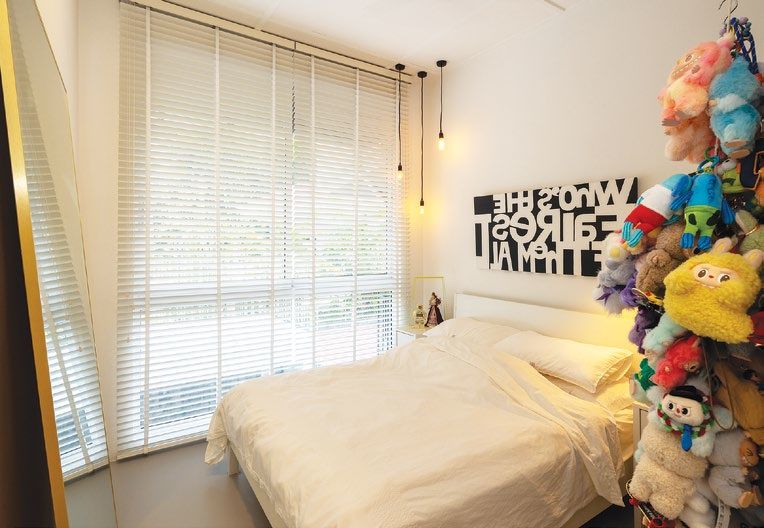
The bedroom is a largely doll-free zone. Dozens of Popmart bag charms hang at a corner, offering a cheerful splash of colour. (Photo: Samuel Isaac Chua/EdgeProp Singapore)
Moving on, there is the walk-in wardrobe — what Jian calls his adult version of playing dress-up. As a child, he would change his dolls’ clothes endlessly. “I am now my doll, and I change my own clothes … It’s my way of putting myself in this ‘Ken world’,” he says.
At first glance, it seems like a regular wardrobe. But behind the doors are nine closets of dolls, each stacked about six boxes deep, up to a nine-foot (2.7m) ceiling. He describes it as his trove of “all the good dolls”, which include luxury brands’ collaborations with Barbie, some priced as high as $2,000 each at the time of purchase.
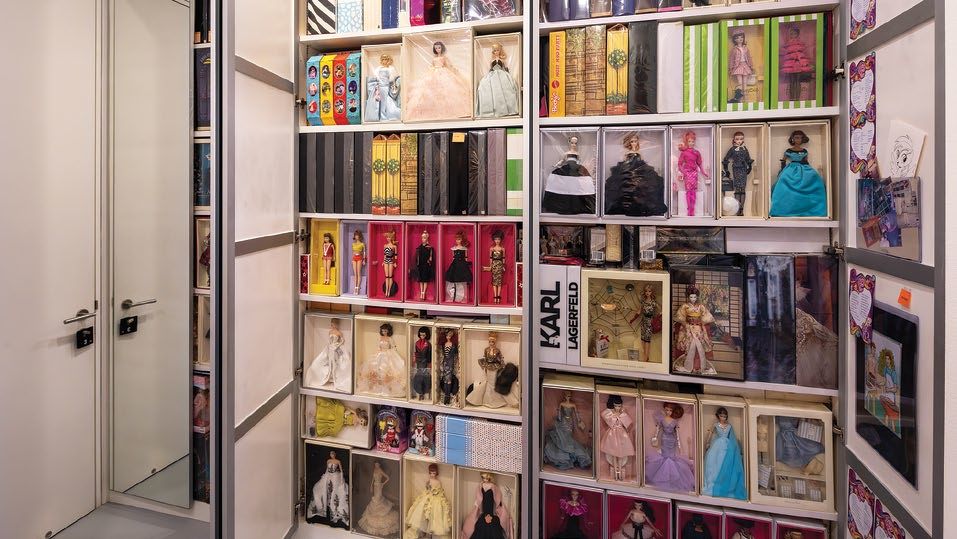
The walk-in wardrobe houses numerous precious and rare dolls, with some priced as high as $2,000 at the time of purchase (Photo: Samuel Isaac Chua/EdgeProp Singapore)
Past the walk-in wardrobe is the study, which serves as Jian’s play area and “crazy, mad scientist” lab. Here, doll heads, toy limbs and shredded clothes are not clutter, but materials: parts he mixes, matches and reworks to experiment with new looks and create his own versions of the dolls.
At the end of the study, the path finally opens into the living room. This, Jian says, is where he hopes guests experience their “holy sh*t moment”. It is not hard to see why.
Dark shelving and display boxes run floor to ceiling on two sides of the room, flanked by the main showcase wall and lined tightly with dolls as far as the eye can travel. Yet, everyday elements such as a sofa, coffee table and TV sit in the middle of it all, anchoring the collection within a space that is still unmistakably a home.
Underfoot, the floor is finished in Pantone 219 C, widely known as “Barbie Pink”, the vibrant magenta-pink associated with the Mattel brand.
The main showcase was originally designed as a top-and-bottom structure with glass squares intended to let light pass through. Over time, he has layered more dolls into the shelves, which evolved into a dense but controlled maximalist look.
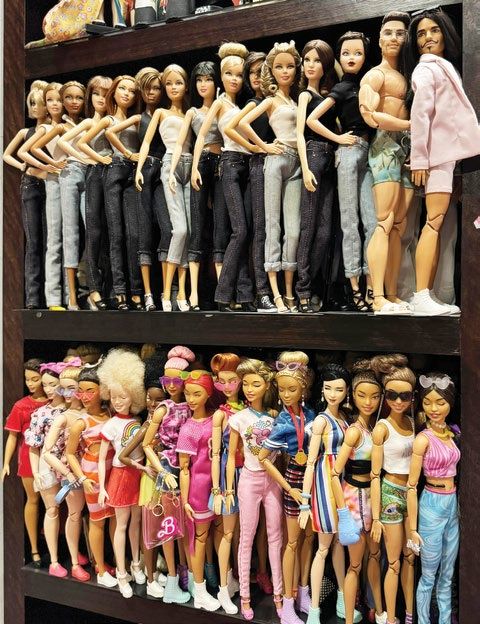
Over time, Jian has layered more dolls into the shelves, which evolved into a dense but controlled maximalist look (Photo: Samuel Isaac Chua/EdgeProp Singapore)
Friends who have visited large collections overseas tell him that the difference is stark, as other spaces tend to feel crowded and overwhelming. “While it’s very much the same amount of dolls, they say that here, it feels like a very liveable, pleasant space,” he notes.
From teenage maximalism to a curated collector’s space
By his own admission, Jian does not have conventional interior-design instincts. Left to himself, he thinks the townhouse might have simply ended up a jumble of display cases and frames, with every inch of blank wall filled.
He thus readily handed control over to his architect, who understood that the collection itself had to be the star. By then, the Barbie collection was already significant — standing at roughly 6,000.
The architect’s view was blunt: once the dolls were in, no one would notice the furniture. Everything that came with the original property was therefore cleared out.
The design philosophy that followed was simple but strict: a minimalist shell framing a maximalist collection, a layout that leads you through the home in a deliberate sequence and clear separation between display zones and private living spaces.
Although Jian jokes that the architect is a “control freak”, he appreciates the direction as he would otherwise “simply add an extra flower pot or desk to fill an empty space”.
“The only design decision I was allowed to make was my Pantone 219 C floor,” Jian adds.
In total, he spent about $168,000 on renovations. This included several design and practical decisions made with the collection’s upkeep in mind.
For example, the house’s original 10-foot ceiling was lowered by one foot to create a layer of insulation. This way, the space stays cool even when the air-conditioning is turned off, helping to regulate temperature and humidity.
To keep dust at bay, he rarely opens the windows, and a helper comes in weekly to clean.
Choosing identity over upgrading
Should he sell the property at a profit, Jian would be able to comfortably afford a larger landed home worth between $3 million and $4 million. But he has no plans to move.
To Jian, the house is no longer just a home or an investment; it has become a key part of his public identity. The shelves and their colourful inhabitants have appeared in TED talks, news coverage by the likes of Bloomberg and Yahoo Finance, Singapore Tourism Board campaigns and more.
On social media, the home also features prominently. Jian has amassed close to 45,000 followers on Instagram, where his content often showcases the dolls he brings along to events and overseas destinations.
Most recently, he collaborated with the Eco Fashion Weekend sustainable fashion festival, dressing his Barbies in outfits made from offcuts by sustainable fashion labels such as Nimbu and Nyana Nyana Eco Collective, and posting the results to his social media feed.
His Instagram also features his book, Flushable Fashion, which highlights dolls dressed in couture that Jian created with tissue paper.
His face is not what people associate with him online — the house is. “You don’t consider it until you look at your digital footprint … People won’t recognise me, but if you show them this shelf, everyone recognises it,” he says.
Living with, not around, the collection
The collection extends well beyond these walls. Jian also has toys in two self-storage units, four bedrooms at his parents’ bungalow, his office conference room and even his best friend’s house.
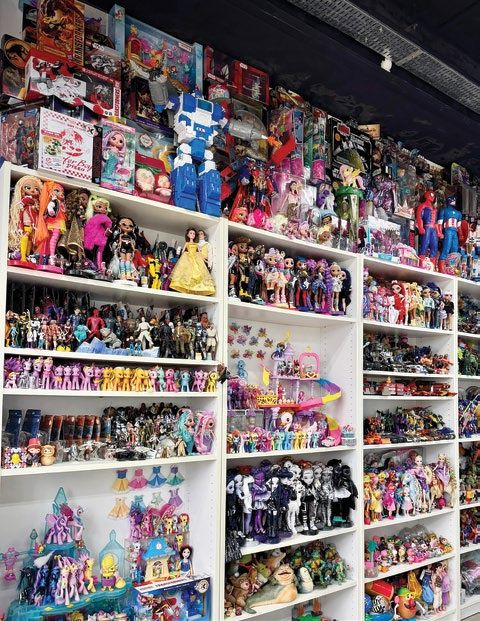
Jian also keeps his dolls and other toys in two self-storage units, his parents’ bungalow, his office (pictured) and even his best friend’s house (Photo: Jian Yang)
Despite the scale of the collection, none of it has come at the cost of liveability. Jian’s aesthetic was based on his teenage bedroom, which he describes as “a maximalist Barbie heaven”, and he remains entirely comfortable surrounded by “bright pink boxes with Barbie logos everywhere”.
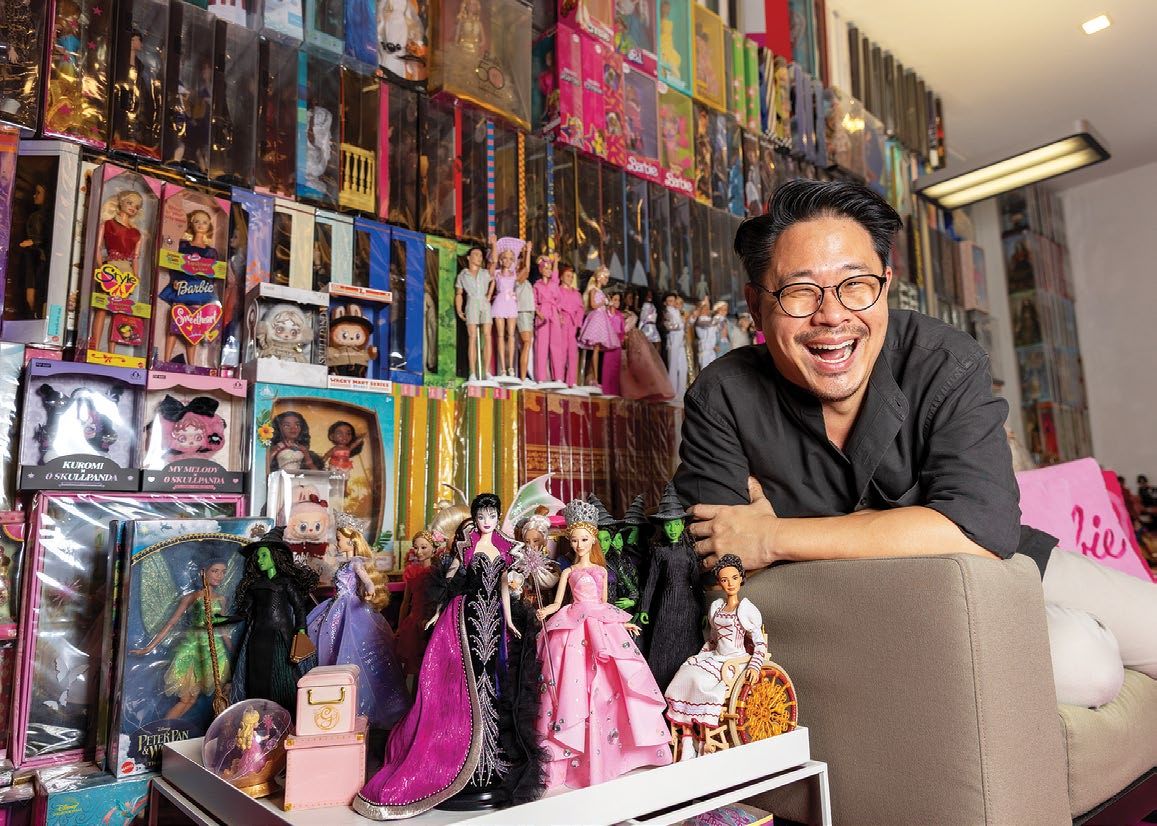
Jian remains very comfortable being surrounded by “bright pink boxes with Barbie logos everywhere” (Photo: Samuel Isaac Chua/EdgeProp Singapore)
Jian also believes that a home should ideally be able to evolve along with the lifestyles of the people living in it — something this one has done.
When he first moved in, he used to host dinners up to three times a week, with parties that spilled out to clubs and wound back home in the early hours.
But today, his social life is quieter — “two glasses of wine and pleasant conversation” — rather than late nights out. Over time, the townhouse has evolved with him, from a mark of independence and a party pad into a deeply personal, highly functional archive of a lifelong passion.
Asked to describe the home in one phrase, he does not hesitate: “It’s a Barbie Dreamhouse.”
--------
How the collection became a headline
Jian Yang did not set out to build a collection, much less such a vast one. “I don’t think I ever started collecting. I just never stopped playing,” he says.
His first Barbie — a Great Shape Barbie — was a gift from his parents in 1984.
As he grew older, the dolls began to mirror his life. Buying his first pair of Calvin Klein underwear at 13 led to the purchase of a Calvin Klein Barbie. Getting a DKNY polo shirt meant adding another doll to the mix. As he discovered films like Gone with the Wind and Star Trek, he sought out dolls themed after each one.
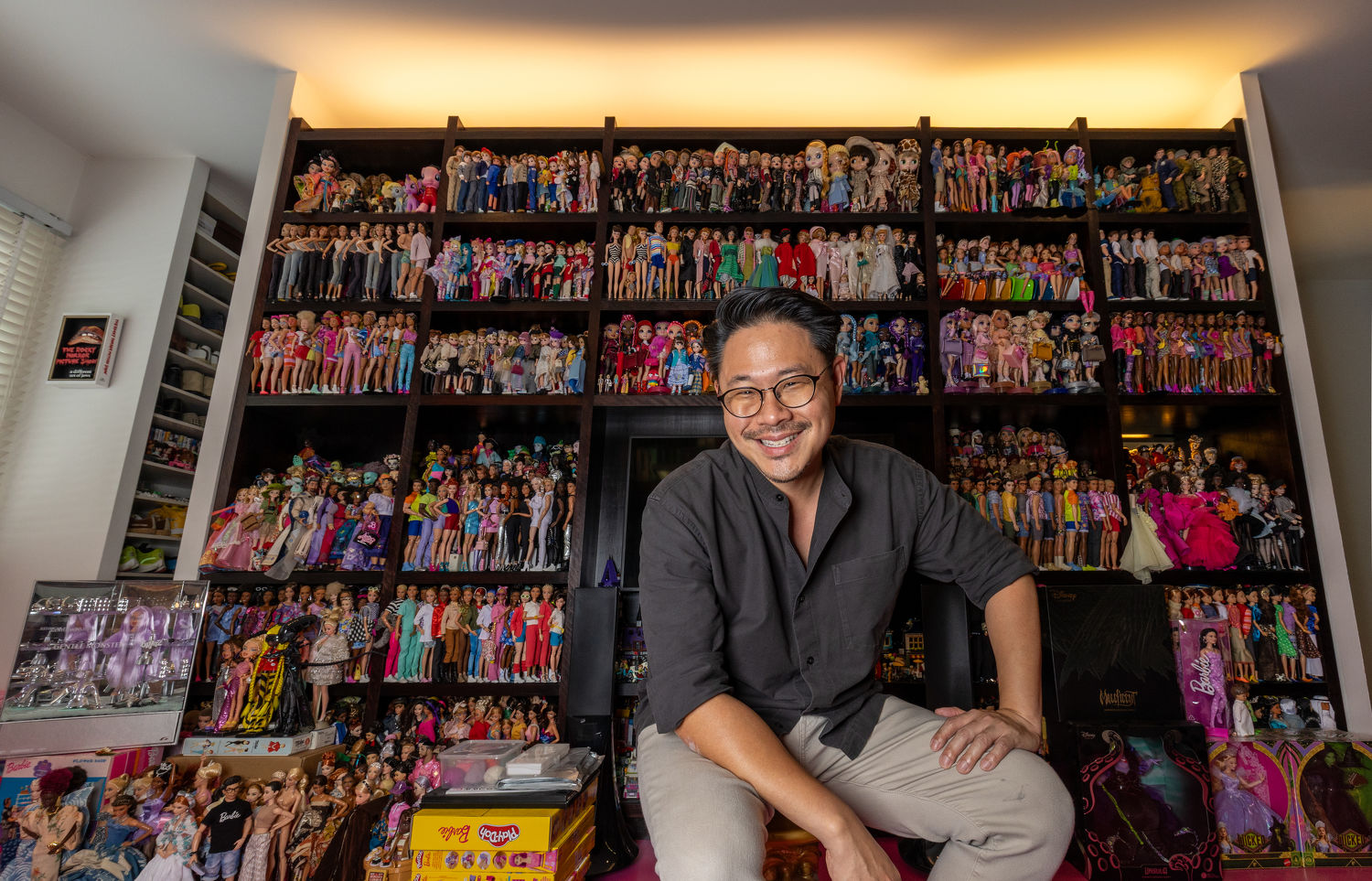
Jian Yang: I don't think I ever started collecting. I just never stopped playing. (Photo: Samuel Isaac Chua/EdgeProp Singapore)
To Jian, Barbie has simply always been present. “It’s almost like Barbie organically fit into my lifestyle,” he says.
While other interests, including Transformers and Star Wars, came and went, Barbie — untethered to any single movie franchise — remained.
A turning point came in the mid-1990s, when he was working as a journalist at the now-defunct The New Paper. He was initially meant to be interviewed by a colleague for a news feature on his 160-strong Swatch timepiece collection. But when the photographer arrived and saw a bedroom full of dolls, the watches were promptly forgotten, and the story became about the Barbies instead.
“That was the first time anyone called my toys a collection,” Jian says. It was also the first time he realised that what he had — about 200 dolls at 17 years old — might indeed be one.
Property Diaries is a new series that goes behind the scenes of real estate transactions, featuring homebuyers, investors and renters sharing their search journeys, decisions and lessons learnt.
Have a story to share? Write to us at propertyeditor@edgeprop.sg.
For more news and analysis, read our weekly e-paper. Prefer a print copy? Get it delivered to your home every Monday.
Ask Buddy
Follow Us
Property updates, 24/7.


Subscribe to Newsletter
Market insights, delivered weekly.
Top Articles
Search